Summer School

0

The chances of Legally Blonde: The Musical showing up on anyone’s list of “great American musicals” are as likely as the chances of a UCLA sorority president with a bachelor’s in fashion merchandising really being admitted to Harvard Law School.

Based on the 2001 novel by Amanda Brown and film starring Reese Witherspoon, it’s the theatrical equivalent of cotton candy—colorful and sweet, but a bit lightweight. The Marin Musical Theatre Company is running a production through July 28.

Elle Woods (Claudia Shapiro) was dumped by her lawyer-to-be boyfriend Warner (Jeremy Kaplan) and does what any red-blooded American girl would do—she decides to follow him to law school and win him back. She crams for the LSAT, brings a bunch of cheerleaders to her Harvard interview and wins admission after she explains love brought her there.

Despite being treated like a laughingstock, Elle finds a friend in teaching assistant Emmett Forrest (Tyler Gable). With his help, she winds up on a legal team headed by stern Professor Callahan (Nelson Brown) as he defends exercise queen Brooke Wyndham (Alison Peltz) against a murder charge.

Will Elle pull a Perry Mason and make a prosecution witness crack under cross-examination? More importantly, will she succeed in winning Warner back, or will she find her soul mate in the sensitive Emmett? The answers are pretty (in pink) obvious.

Director Jenny Boynton’s energetic cast of young folk and stage veterans carries the light load. Shapiro successfully blends her character’s cheerful optimism with her vulnerability, though one wonders what she ever saw in the shallow Warner. Gable is nicely understated as the one person at Harvard who sees Elle’s potential, and more.

A subplot involving a lovelorn hairdresser (Dani Innocenti Beem), her ex (Victor Schutz), their dog Rufus (Molly Malone Wesley Dog) and a UPS driver (Schutz again) provides some of the show’s biggest laughs.

Laughs also arrive via the Laurence O’Keefe-and-Nell Benjamin score with “There! Right There!” which attempts to musically answer the question of a key witness’s orientation—is he gay or European? It was one of the few ensemble numbers with audible lyrics, as Jeff Paul and the orchestra regularly overpowered the vocals. Sound design is not this show’s strong suit.

Like a trip to the county fair, Legally Blonde: The Musical provides a pleasant summer evening of fun and entertainment.

Marin Musical Theatre Company’s ‘Legally Blonde: The Musical’ runs through July 28 at the Novato Theater Company Playhouse, 5420 Nave Drive, Ste. C, Novato. Friday & Saturday, 7:30 pm; Sunday, 2pm. $27–$50. 800.838.3006. marinmusicals.org.

Sláinte!

0

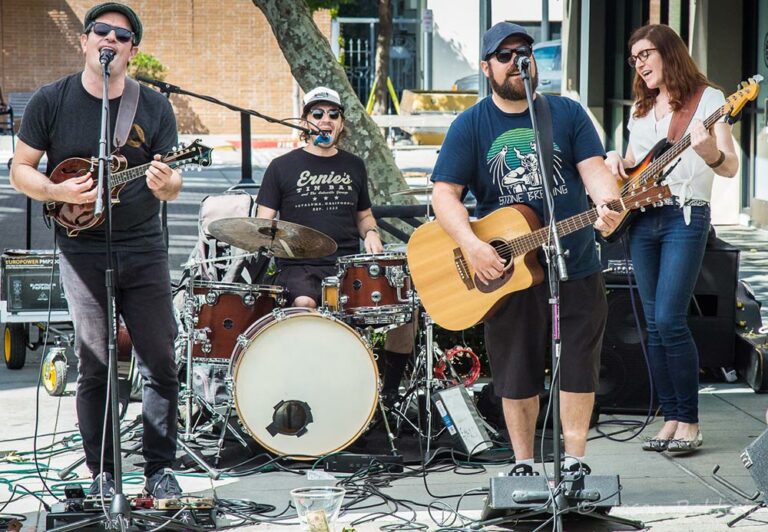
Drawing from his Irish heritage and punk upbringing, Sonoma native and multi-instrumentalist Tony Gibson feels right at home when he’s fronting folk-rock revivalists the Gentlemen Soldiers on stages and at festivals throughout the Bay Area.

“We’re a fun band, we really enjoy performing for people, but we also enjoy each other onstage,” says Gibson.

The band’s been an Irish-music institution for nearly a decade, and now they’re sizing up a proper debut album—slated for release later this year—and making July feel like March when they perform in Novato on July 26 and in Petaluma on July 27.

Gibson, who moved back to the North Bay after working in the Southern California music business in the early 2000s, started the band in 2011 with high school friends and musicians Marcos Garcia (guitar and vocals) and JB Duff (drums and vocals) as a way to celebrate Saint Patrick’s Day at Murphy’s Irish Pub in Sonoma.

“We decided we wanted to put a sort of Pogues-ish band together,” Gibson says. “We spent the first three years grinding through the Sonoma music venues. Eventually, we took a direction forward to playing throughout the Bay Area.”

The group recruited bassist Emily Froberg a few years back and plays a mix of traditional and modern Irish songs and other folk tunes with an upbeat rhythm and acoustic instrumentation accompanied by stirring harmonies. While this sound made them a mainstay on North Bay stages for eight years, they weren’t able to commit to a recording until now.

“We’re all in different bands as well, and Marcos and I work day jobs and Emily and JB are full-time musicians,” Gibson says. ”It’s the kind of thing where a record gets put on the backburner, but as of last summer, we slowly and surely have been making a record. It’s been a long time coming.”

Furthermore, Gibson is looking ahead musically and plans to write more original material and fill out the band’s live sound. Having learned mandolin in addition to guitar, he’s now practicing Irish Bouzouki, which lies somewhere between the two instruments.

“We’ve got a little bit of everything,” Gibson says, of the music. “It’s rowdy, but it’s playful. It’s a good time; and in times like these, it’s good to seek out good times.”

Gentlemen Soldiers play on Friday, Jul 26, at Finnegan’s Marin (877 Grant Ave., Novato. 9pm. Free. 415.899.1516) and Saturday, Jul 27, at the Big Easy (128 American Alley, Petaluma. 8pm. 707.776.7163.

Wise Guys

Are you Weed Wise? The state of California hopes you already have the cannabis smarts. In case you don’t, there’s a new campaign called Get #WeedWise that comes with a $1.7 million budget for online ads and billboards that will read “Support the Legal Marketplace. The Difference is Clear.” and “Find legal retailers at CApotcheck.com.” Curiously, or perhaps not, the state is using the words “weed” and “pot” and not cannabis.

There’s more cannabis in California now than ever before and many ways to buy it.

Lori Ajax, who heads the Bureau of Cannabis Control, doesn’t like the black market and those not playing by the rules and paying taxes. To combat the illegal market, Sacramento has a three-pronged strategy. First, cut off the product at its source. In June, law enforcement agents raided hundreds of unlicensed marijuana grows in Riverside, Santa Barbara and San Luis Obispo counties where they confiscated tons of processed weed and hundreds of thousands of plants still in the ground. Second, the state announced it will increase the number of licenses for legal dispensaries, cut the associated red tape and streamline the process. Third, Ajax and her agency have launched a public education campaign to persuade consumers to only buy from state-approved outlets.

“We believe this campaign will directly impact consumer safety by clarifying that only cannabis purchased from licensed retailers has met the state’s safety regulations,” she said in a statement.

Ajax added that the “education campaign was meant to send a clear message to unlicensed businesses that they need to get licensed or shut down.”

For the last few years, cannabis education has come largely from the private sector. Until Prop 64 passed, the state couldn’t offer education; that could have been interpreted as encouragement to break the law. But it’s now a dire situation. If Sacramento doesn’t act, the underground economy will only grow bigger.

Will Ms. Ajax’s strategy work? Maybe the stick is what’s needed. Expect more raids and more confiscation of crops.

Meanwhile, “Weed Wise” seems less motivated by compassion and concern for the health of consumers and more driven by the desire for tax revenue and eagerness to control the cannabis juggernaut.

Jonah Raskin is the author of “Dark Day Dark Night: A Marijuana Murder Mystery.”

Hero & Zero

Hero

Rational humans serving on the California Coastal Commission saved the day, at least temporarily, for the wildlife inhabiting the Farallon Islands. Last week, the commission members told the U.S. Fish and Wildlife Service to reconsider that ill-conceived plan to dump 1.5 tons of poison pellets on the islands to kill non-native mice. The USFWS responded by withdrawing its application for now.

No one denies the mice, numbering in the tens of thousands, pose a problem. The invasive species upsets the ecosystem by eating the food of the native dwellers on the islands. They attract non-native predators that prey on them, and unfortunately, eat native animals, too.

It’s a quandary, yet a 2,917 pound airdrop of toxic cereal grain pellets is another sure way to upset the delicate ecological balance of the islands. Native wildlife would also ingest the rodenticide, either directly, or by feeding on the mice. The anticoagulant poison then works its way up the food chain.

Special thanks to Alison Hermance and Kelle Kacmarcik of WildCare in San Rafael. Both women testified eloquently before the commission to oppose the USFWS plan and suggest more moderate measures of eradicating the mice.

“The situation on the Farallon Islands has existed for decades. It does not need to be solved overnight with a massive poison drop,” said Hermance.

Zero

Another creative scam has reached Marin County. Fake ads have appeared on Craigslist for a vacation home in Bolinas. The home is real; the advertiser is bogus. The con artist attempted to scam folks by renting out the home without the consent of the owner. Now thats chutzpah.

This fraud appears to be a growing trend, according to the Marin County sheriff’s department. If you see a suspicious person hanging around a vacation or vacant home in your neighborhood, call the sheriff’s office at (415) 479-2311.

Hero & Zero

Hero

Rational humans serving on the California Coastal Commission saved the day, at least temporarily, for the wildlife inhabiting the Farallon Islands. Last week, the commission members told the U.S. Fish and Wildlife Service to reconsider that ill-conceived plan to dump 1.5 tons of poison pellets on the islands to kill non-native mice. The USFWS responded by withdrawing its application for now.

No one denies the mice, numbering in the tens of thousands, pose a problem. The invasive species upsets the ecosystem by eating the food of the native dwellers on the islands. They attract non-native predators that prey on them, and unfortunately, eat native animals, too.

It’s a quandary, yet a 2,917 pound airdrop of toxic cereal grain pellets is another sure way to upset the delicate ecological balance of the islands. Native wildlife would also ingest the rodenticide, either directly, or by feeding on the mice. The anticoagulant poison then works its way up the food chain.

Special thanks to Alison Hermance and Kelle Kacmarcik of WildCare in San Rafael. Both women testified eloquently before the commission to oppose the USFWS plan and suggest more moderate measures of eradicating the mice.

“The situation on the Farallon Islands has existed for decades. It does not need to be solved overnight with a massive poison drop,” said Hermance.

Zero

Another creative scam has reached Marin County. Fake ads have appeared on Craigslist for a vacation home in Bolinas. The home is real; the advertiser is bogus. The con artist attempted to scam folks by renting out the home without the consent of the owner. Now thats chutzpah.

This fraud appears to be a growing trend, according to the Marin County sheriff’s department. If you see a suspicious person hanging around a vacation or vacant home in your neighborhood, call the sheriff’s office at (415) 479-2311.

Scaling Up

0

Noah Oppenheim at the Pacific Coast Federation of Fishermen’s Associations has lots to say about a recent move by U.S. Rep. Jared Huffman to get out in front of the reauthorization of a key piece of fisheries law in the U.S.

Huffman’s conducting a national “listening tour” in advance of the scheduled spring 2020 re-upping of the Magnuson-Stevens Fisheries Act. Since its inception in 1976, the act has been the blueprint and broad regulatory guide for American fisheries’ management.

As the recently elevated chair of the Democrat-controlled Water, Oceans and Wildlife Subcommittee in congress, Huffman says his goal is to help manage oceans and fisheries “to be as environmentally and economically resilient as possible.” He’s asking how fish-impacting issues such as global climate change should be considered in a revised Magnuson Act.

But with a White House that denies the existence of climate change, how’s that going to happen?

“You’re asking the right question,” says Oppenheim, who has pondered the issue extensively: How do you effectively insulate an industry from climate-change politics at the highest levels of government, when commercial fishing is a “wholly driven-by-climate-and-the-environment industry and within an administration that denies that such an approach is worthy under any conditions.”

Oppenheim talked to the Pacific Sun this week as the state’s booming 2019 commercial salmon season reopened after a 10-day closure that ended on July 11. It’s booming mostly because of the 2017 rainy season’s beneficial effects on the Sacramento River, says Oppenheim, who’s looking forward to Huffman’s listening tour. He believes it will do a lot of good in getting fishermen to think more globally and outside of the policies undertaken by local fisheries councils created under Magnuson.

Plus, he says, fishermen can be a pretty cloistered lot when it comes to their obvious need to focus on local issues and fisheries. “I think that frankly there’s a ripeness to this need to have a national dialogue,” says Oppenheim.

If he’s sounding a cautionary bell at all around Huffman’s proposed listening tour, it’s that the San Rafael congressman enjoys support from an environmental community that’s aligned with his values.

“He needs to understand,” says Oppenheim, “that fisheries management is about the industry first,” and that the Magnuson-Stevens Act wasn’t intended to shut down the industry but to figure out how to make it work in a manner that’s sustainable for the fish and fishermen alike. With the environmentalist-identified Huffman riding herd over the process, he says, “this will be an interesting dynamic to watch.”

And, he adds, lawmakers should take a very long and hard look at any offshore industry development—including wind farms—as they look at a Magnuson reauthorization. He says external threats to fishermen’s livelihoods—oil and gas rigs offshore, or “terribly poorly sited renewable energy” operations (wind farms) should definitely be a part of the discussion as Huffman and his congressional cohort consider the act next year.

One big problem with Magnuson as currently written, is it doesn’t allow for any regulation of industries that might have a deleterious impact on fishermen’s livelihoods. He notes recent West Coast efforts to start an offshore wind farm program here fail to appreciate “there is no area of the ocean that is sacrosanct except for areas that we have delineated as such.” Even so, he argues, “there are ongoing conversations about developing wind power in the Monterey Bay sanctuary.”

Oppenheim notes that, thanks to the Bureau of Energy Management, which has opened leasing opportunities for offshore wind farms, those industries aren’t required to engage with fisheries or fishermen when submitting their lease proposals. “The problem fundamentally is the federal agency, which has no mandate whatsoever to include fishing impacts,” he says. “Their role is to deal with the industry—there’s no obligation to do an environmental study about user groups who would be impacted until after they’ve gotten the lease. Then the agency will do the environmental report, but by then it’s too late. Right now, that process is the ultimate impediment in equitability in the energy development space.”

Oppenheim also sees room for improvement in the way Magnuson-Stevens addresses impacts on industry to fish habitats, which is to say: it doesn’t.

“It’s weak on fish habitat,” he notes, and envisions a possible future where fishermen could have real leverage over projects that could impact their fishing grounds. “Fishing activity can impact fish stocks, we all know that,” he says. “But we’ve brought back many stocks from the brink,” and California fishermen have, if grudgingly, “throttled back their activities to protect them.” Overfishing is one issue, he says, but it’s “climate impacts and industrial activities outside of fishing that are the biggest impact” on fish stocks.

Oppenheim’s a fisherman himself and knows full well fishermen have themselves been somewhat part of an “anti-science” agenda when it’s suited them—but he also notes they provide lots of data to scientists and regulators. “Fishermen can both be far better observers of ocean conditions and the real-time status of fisheries,” he says, “and simultaneously be in denial over the impacts that broad-scale fishing can have over time.”

But it’s also true that the science isn’t always right, he adds. Scientists have missed the mark when it comes to fish stocks—surveys have been wrong. The bottom line for Oppenheim when it comes to fisheries management is that “we’re doing better than we ever have in the past,” though there’s much to be done. He believes the “ship can be righted to some extent by bringing in the fishermen,” especially small-scale operators. “One of the more interesting things to note about fish politics is to notice how ‘flipped’ it is,” he says. “The quote-unquote ‘liberal’ politics of egalitarianism and support for communities” has not been the traditional Democrat approach, he argues.

At the same time, conservative lawmakers pegged with being too pro-business at the expense of the environment, he says, have in fact led the charge to focus on localities and small-time operators.

“Fundamentally, liberals should be about supporting communities,” he notes as he pines for a post-partisan fisheries management debate and hopes Huffman’s got his game on for it. “Partisanship in fisheries is terrible, counterproductive and we’ve been seeing too much of it lately.”


Spice Trade

It’s nice to have your go-to blend of herbs and salt that’s good for potatoes and eggs in the morning, stir-fry in the evening and maybe even Bloody Marys some other morning. I thought I’d found that spice in Bohemian Forest, a mustard-based, lavender-laced number from Santa Rosa’s Savory Spice Shop.

Then a contender showed up. Tucked in with a wine sample from Quivira Vineyards, a shaker of house-made spice mix called “Tuscan herb salt.” Two shakers, actually. Twice as nice.

This sort of swag is nothing new. But the moment I opened this Tuscan shaker, it sang to me. It sang with potatoes and eggs, roasted vegetables, tofu and sausage alike. It’s made with estate-grown rosemary, garlic and sage from Quivira’s formerly certified biodynamic garden—which they claim is still more than half as nice, as they employ the very same biodynamic methods—and sea salt, which hails from the sea. I can’t say whether it’s the Steiner-esque dynamic energies of the herbs, or just that I don’t get around much in the spice aisle, but I like this. It’s recently returned to the tasting room for $10, along with a Provençal blend, lemon herb salt and fig preserves.

It’s meant to pair with Zin, like Quivira’s 2016 Dry Creek Valley Zinfandel ($25). Think blackberry liqueur here, instead of jam, and cassis, giving the impression of a mannerly, mid-priced Bordeaux. With floral hints of sage and mustard blossom, a dry, yet plush palate, and easy screw-top cap, what’s not to like about this Zin?

Next, a jar each of Zinfandel mustard ($9) and Zinfandel barbecue sauce ($12) from Seghesio Family Vineyards showed up. Careful readers will recall how much we love mustard here at the Sun, but this is no sour, yellow stuff, nor simply stoneground and loaded with seeds. This deep brown mustard has a hint of oaky cask, without being too “winey.” I find it lends earthy depth to a Reuben sandwich.

Stir-frying with the sauce was a miss, but baking with tofu worked out. Redolent of smoky adobo sauce, it’s aimed at a pairing with a wine like Seghesio’s 2016 Old Vine Sonoma County Zinfandel ($40). Supple and knit together with warm, fuzzy sweater tannins, this classic Seghesio Zin’s got milk chocolate highlights and strawberry, cranberry, and spicy, seeded raspberry jam flavors.

Check out how Seghesio’s executive chef Peter Janiak cooks it up at the winery’s Annual Zin + BBQ Festival, Saturday, July 20, 4–7pm.

Seghesio Family Vineyards, 700 Grove Street, Healdsburg. 707.433.3579.

Quivira Vineyards, 4900 West Dry Creek Road, Healdsburg. 707.431.8333

Covering Cover Bands

0

The tell in this tale is the longevity of the these bands (“Running Down a Dream,” July 10, 2019). If it did not pay, the players would not stay. The sad thing is that tribute bands and cover bands have been shouldering aside original music more and more for at least the past decade. While way back in the day, cover bands were the norm, the ‘60s and ‘70s set us on a more creative path. Too bad the good ride is over, and we are sliding down the slippery slope to nothing new.

Blonde Toledo

Via Bohemian.com

If It Quacks Like a Duck…

There are those today who believe liberal democracy is obsolete and are promoting the complete mobilization of society to prepare the nation to respond effectively to economic difficulties.

They espouse a form of radical authoritarianism and ultra-nationalism characterized by dictatorial power, forcible suppression of the opposition and strong regimentation of society and the economy. They support unprecedented authority to intervene in the lives of citizens and reject assertions that violence is automatically negative in nature and view political violence, war and imperialism as the means to achieve national rejuvenation. They advocate a mixed economy with the principal goal of achieving national economic self-sufficiency through protectionist and interventionist economic policies.

Since the end of World War II, this group never describes itself as fascist, but a neo-fascist ideology is clearly transparent and utterly contemptible.

Dennis Kostecki

Sausalito

Kudos to Lawmakers

Assembly Bill 392 just passed the California Assembly and Senate, and the 5,200-member-strong Sonoma County Chapter of the American Civil Liberties Union would like to express its appreciation to legislators Mark McGuire, Jim Wood, Marc Levine and Bill Dodd for their “aye” votes.

The bill’s premise is simple: it updates California’s use of force laws to make sure that police officers avoid using deadly force at every possible opportunity, privileging de-escalation measures, and other steps. Police should never take a human life when they have alternatives. Right now, police officers in California can use deadly force and kill someone even when they have other options. In 2017 alone, police officers killed 172 Californians, 37 percent higher than the national average. This policy is in force elsewhere and has led to a decline in serious use of force without any negative impact on officer or public safety.

Together with the recently-introduced law on Transparency in Police Records, AB 392, signals a long-needed improvement in our state’s protection of civil rights and liberties.

The Sonoma County Chapter of the ACLU of Northern California salutes our local Sacramento lawmakers for their sensitivity to civil rights, the safety of our communities, and to the professionalism and welfare of our police officers.

Patty Morandi, co-chair

Dave Henderson, co-chair

ACLU of Sonoma County

Trump Will Trump

Donald Trump is unstoppable. There is no Democrat running for president in 2020 who can beat him. It doesn’t matter how many California liberals and activists rant against him. Don’t believe the current polls. This election will be decided in a half a dozen swing states. All of these states were won by Trump in 2016 and voters in these states will base their ballot on how well the economy is doing. They do not approve of the socialist agenda proposed by the Democratic candidates. He will win these states by a wider margin than he did in 2016.

David Berger

San Rafael

FlashBack

0

50 Years Ago

It would be suicide to mention it out loud, but large number of public officials and lawyers are shaking their heads over the cost of Marin’s drug law enforcement… When the DAB was proposed two years ago, there were fears that it would turn into an increasingly-expensive operation, arresting mainly young people for possession of marijuana, clogging the courts and having little affect on the overall drug scene. Some people… are now saying, “I told you so.”

—Pete Shattuck, July 16, 1969

40 Years Ago

The Nicaragua Interfaith Committee for Action is pleading for help for the estimated 160,000 Nicaraguan refugees fleeing their country’s civil war. The committee is asking for medical supplies and for money to purchase food. Noting that $2.50 will provide a refugee a basic survival diet for one week, the committee urges that tax-deductible checks be mailed to N.I.C.A…

Donated medical supplies will be airlifted to Honduras where many Nicaraguans have taken refuge. Particularly needed are bandages, antibiotics, painkillers, (from Bufferin to Darvon) gelatines and sprays to stop hemorrhaging, syringes, scalpel and surgical needles, mobile operating equipment, etc. — July 13, 1979

30 Years Ago

It makes you wonder if Richard Donner (director of both Lethal Weapon flicks) isn’t involved in some kind of adolescent mano-a-mano, trying to top the decibels, explosions and body counts of his summer competition. I don’t suppose we could convince Donner, Steven Spielberg and Tim Burton that Lethal Weapon 2, Indiana Jones and the Last Crusade and Batman would have made a bundle even without the extraneous noise and gruesome killings; it is obvious that they feel the audience for summer thrillers is as deaf, as brain-dead and as stupid as their screenwriters. — Stephanie von Buchau, July 14, 1989

20 Years Ago

We have a soccer team? And they’re good? When did this happen?

The first clue I had was when I woke up Sunday morning and read the headline in my paper⁠—the U.S. won the World Cup. For the past three months or so, apparently, there’s been some international tournament going on, and our side has been doing pretty darn well. Who knew? …Reading further, I discovered this was the women’s soccer team, which explains a lot, because some of those aforementioned countries don’t give their women’s teams much support. From what I read, the Brazilian women’s team match wasn’t even televised in Brazil. And it’s hard to imagine those hooligan English fans invading some nearby country because their women’s team lost… Naturally, now that the U.S. women have won, we’re hearing how exciting the game of soccer is. My only question is, why do they continue to display the score of a soccer game in a little box on the screen when the score is always 0-0? — Stan Sinberg, July 14, 1999

Compiled by Alex T. Randolph

Leap of Faith

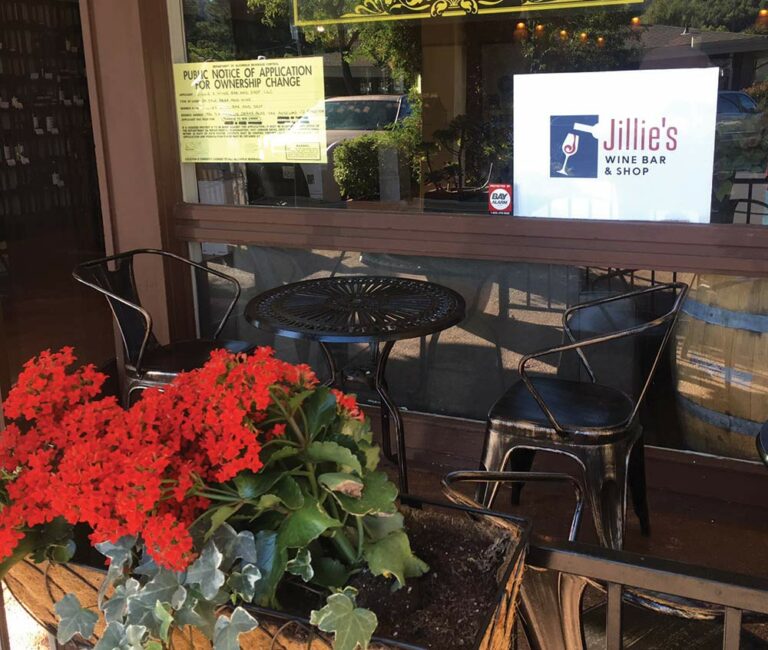
Jill Cordova-Holt exudes energy. Alighting from table to table with boards of cured meats and locally made cheeses, the effusive owner of Jillie’s Wine Bar & Shop is a natural host. So it’s surprising to learn she’s new to the hospitality industry and instead enjoyed a long career in social work, including 12 years at Hospice by the Bay.

“I decided to take a leap of faith—and follow this passion,” Holt says. “I knew that after 30 years in health care I’d find a way to help build and connect to community in a different way.”

Originally from Sacramento, Holt moved to Los Angeles and earned a psychology degree from California State University Northridge. She then earned her master’s and worked in nonprofits with children and older adults for over 20 years in Southern California. In 2007 she moved to Marin with her husband Michael Holt.

“During my time at the bedside I heard so many people express how they wished they’d lived their lives differently—been more brave. It made me think about my life and my purpose,” Holt says.

After more than a decade in hospice, Holt was ready to make a change. She and her husband took over the Vines Wine Shop & Bar in the Redhill Shopping Center in San Anselmo, renamed it Jillie’s Wine Bar & Shop and opened their doors on June 1.

With a fresh coat of paint, the onetime Silver Screen Video store now feels welcoming and light. Along with a 10-seat bar, a comfy couch and a handful of tables, a portion of the room is also dedicated to a wine shop. Wines are available in flights of three two-ounce pours, typically from the bar’s stainless tank system.

Holt aims to introduce customers to a broad variety of wines from Europe and South America. Of course, California isn’t ignored, and some of the closer-to-home selections include a Sauvignon Blanc from Lodi, a Mendocino Rosé and a Rhone blend from Paso Robles.

While wine is on the menu at Jillie’s, the new owner insists she wants her establishment to be an extension of her home. She envisions it as a gathering place for parents, book clubs, celebrations—even just a friendly place to land after work. A small stage, where an open mic and live music will be offered several nights a week, is in the works. Though a far cry from social work, Holt appears to be well on her way to building a new community.

Summer School

The chances of Legally Blonde: The Musical showing up on anyone’s list of “great American musicals” are as likely as the chances of a UCLA sorority president with a bachelor’s in fashion merchandising really being admitted to Harvard Law School. Based on the 2001 novel by Amanda Brown and film starring Reese Witherspoon, it’s the theatrical equivalent of cotton candy—colorful...

Sláinte!

Drawing from his Irish heritage and punk upbringing, Sonoma native and multi-instrumentalist Tony Gibson feels right at home when he’s fronting folk-rock revivalists the Gentlemen Soldiers on stages and at festivals throughout the Bay Area. “We’re a fun band, we really enjoy performing for people, but we also enjoy each other onstage,” says Gibson. The band’s been an Irish-music institution for...

Wise Guys

Are you Weed Wise? The state of California hopes you already have the cannabis smarts. In case you don’t, there’s a new campaign called Get #WeedWise that comes with a $1.7 million budget for online ads and billboards that will read “Support the Legal Marketplace. The Difference is Clear.” and “Find legal retailers at CApotcheck.com.” Curiously, or perhaps not,...

Hero & Zero

Hero Rational humans serving on the California Coastal Commission saved the day, at least temporarily, for the wildlife inhabiting the Farallon Islands. Last week, the commission members told the U.S. Fish and Wildlife Service to reconsider that ill-conceived plan to dump 1.5 tons of poison pellets on the islands to kill non-native mice. The USFWS responded by withdrawing its application...

Hero & Zero

Hero Rational humans serving on the California Coastal Commission saved the day, at least temporarily, for the wildlife inhabiting the Farallon Islands. Last week, the commission members told the U.S. Fish and Wildlife Service to reconsider that ill-conceived plan to dump 1.5 tons of poison pellets on the islands to kill non-native mice. The USFWS responded by withdrawing its application...

Scaling Up

Noah Oppenheim at the Pacific Coast Federation of Fishermen’s Associations has lots to say about a recent move by U.S. Rep. Jared Huffman to get out in front of the reauthorization of a key piece of fisheries law in the U.S. Huffman’s conducting a national “listening tour” in advance of the scheduled spring 2020 re-upping of the Magnuson-Stevens Fisheries Act....

Spice Trade

It’s nice to have your go-to blend of herbs and salt that’s good for potatoes and eggs in the morning, stir-fry in the evening and maybe even Bloody Marys some other morning. I thought I’d found that spice in Bohemian Forest, a mustard-based, lavender-laced number from Santa Rosa’s Savory Spice Shop. Then a contender showed up. Tucked in with a...

Covering Cover Bands

The tell in this tale is the longevity of the these bands (“Running Down a Dream,” July 10, 2019). If it did not pay, the players would not stay. The sad thing is that tribute bands and cover bands have been shouldering aside original music more and more for at least the past decade. While way back in the...

FlashBack

50 Years Ago It would be suicide to mention it out loud, but large number of public officials and lawyers are shaking their heads over the cost of Marin’s drug law enforcement... When the DAB was proposed two years ago, there were fears that it would turn into an increasingly-expensive operation, arresting mainly young people for possession of marijuana, clogging...

Leap of Faith

Jill Cordova-Holt exudes energy. Alighting from table to table with boards of cured meats and locally made cheeses, the effusive owner of Jillie’s Wine Bar & Shop is a natural host. So it’s surprising to learn she’s new to the hospitality industry and instead enjoyed a long career in social work, including 12 years at Hospice by the Bay. “I...
3,002FansLike
3,850FollowersFollow