North Bay Black-owned restaurant list

Indoor dining is on hold in the North Bay for the foreseeable future, dealing a major setback for restaurants and bars that were hoping to salvage summer during the Covid-19 pandemic. Still, there are ways to support the local food industry, and last month, a Santa Rosa teacher launched an endeavor to highlight North Bay businesses and restaurants owned and operated by people of color, giving residents a guide to where they can support Black lives in the community while eating well.

Kelly Cramer, who works as a teacher at Roseland University Prep in Santa Rosa, made the ever-expanding online spreadsheet of Black, Immigrant and People of Color Owned Restaurants and Businesses in Sonoma County after looking for one like it on internet search engines.

“I just thought that it deserved to exist,” Cramer said at the time. “After much thought, I decided to also include all people of color and immigrant-run businesses because, although Black businesses need to be amplified now and always, I simply just wanted to keep this resource all in one place so people can continue to utilize it for the future, long after it’s trendy.”

Black-owned North Bay restaurants on the list include more than 250 restaurants and businesses. For North Bay food lovers in need of some real comfort, four spots stand out in Sonoma, Marin and Napa counties.

Buster’s Southern Barbecue has been serving up authentic Louisiana-inspired cooking in Calistoga since 1965 and has become a staple of the community. The restaurant serves up top quality tri-tip, pork and beef ribs and more with choices of mild or spicy BBQ sauce and their sandwiches, served on garlic toast, are a popular lunch for locals. Outside dining and take-out is available. busterssouthernbbq.com.

Bariadelli Caribbean Gourmet Pizza is located in northwest Santa Rosa, and specializes in authentic Caribbean cuisine, catering, take-and-bake gourmet pizzas and food-truck services. Now open for online orders, Bariadelli brings bold flavors to its menu, with items like Jerk Chicken Pizza and a Caribbean Supreme that features rice and beans, creole chicken, jumbo shrimp and fried plantains. bariadelli.com.

Marin County residents can also find Black-owned restaurants and chefs in their backyard, with locations such as Caribbean Spices Restaurant in San Rafael. Since 2009, Caribbean Spices makes Haitian and Creole cuisine, and the restaurant has been offering outdoor dining in addition to catering options with specialty dishes like oxtail and creole snapper. carribeanspicesdba.net.

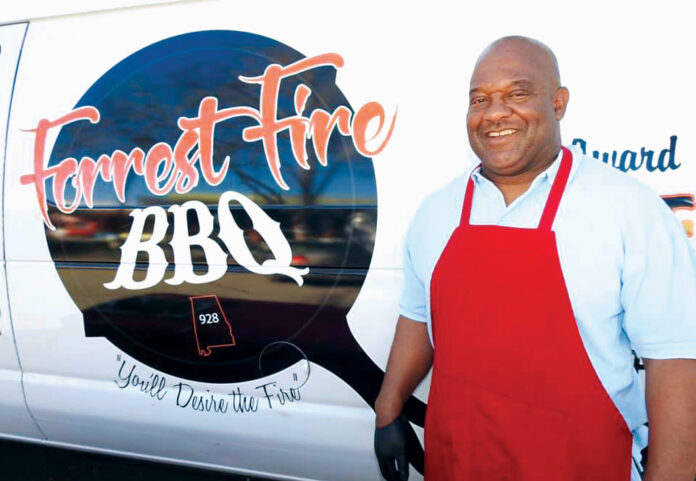
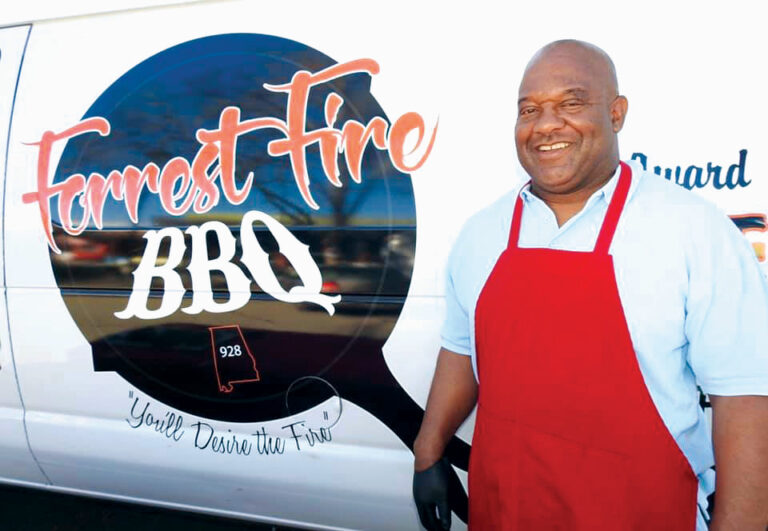
Also based in San Rafael, Forrest Fire BBQ is the culinary soul of owner and pitmaster Forrest Murray Jr. Murray learned to cook from his family, and he puts that familial love into his food. Forrest Fire BBQ is a mobile operation, and Murray caters throughout the Bay Area with a menu that includes St Louis–style pork ribs, sirloin beef ball tip steaks and pulled meat sandwiches with all the sides and sauces. Forrest Fire BBQ also pops up at Marinwood Market on certain weekends, with ribs, hot dogs, corn on a stick and more on hand. forrestfirebbq.com.

“A disproportionate percentage of Black and POC-owned businesses have closed during the Covid-19 pandemic,” Cramer says. “Supporting these places is just ultimately good for everyone. Plus, so much good food and wine is on this list! A ton of places I can’t wait to try.”

Find the full list at bit.ly/SOCOPOC.

History through food

0

Alexandria Brown isn’t a foodie, but she wrote this year’s most compelling North Bay book on food. In fact, Lost Restaurants of Napa Valley and Their Recipes, released in April by The History Press, was written while its author lived in a kitchenless apartment. In it, Brown—a historian—uses restaurants-past as a lens through which to tell stories of the immigrant and people-of-color communities that shaped the esteemed culinary region. 

At first, Brown—who has master’s degrees in library science and U.S. history—wasn’t eager about her press’s proposal to write about restaurants. But she did a bit of research and soon got excited about the project. 

“I found all of these people of color, immigrants and women who were doing really interesting things with food but whose stories had never been told or had been white-washed,” says Brown, who is a Black woman raised in Napa.

While focused on Napa, Lost Restaurants is also a book that traces how “exotic” and “foreign” foods become “American” classics. 

Several of the book’s chapters focus on a specific cuisine. “Chili Queens and Tamale Men” tells the stories of Mexican-American cuisine in the 19th and early 20th centuries. 

The chapter “Chow Chop Suey” explores three 20th-century Chinese restaurants that specialized in the wildly popular dish of the time. Brown’s book couldn’t tell the stories of Chinese food and local restaurants without also telling the story of Chinese immigration to Napa, xenophobia, racism and pervasive “model minority” myths. 

Brown likens her book to Padma Lakshmi’s new Hulu series, Taste the Nation.

“I feel like we’re doing similar things and our audiences are similar,” she says. “We’re both looking at history, food, race and immigration. We’re mixing these topics together in one big pot and doing it in a way that’s approachable but educational at the same time.” 

It’s worth noting that Lakshmi’s show began as a research project on immigration. According to The Atlantic, food was later chosen as a way to become more acquainted with the communities Lakshmi was investigating. Similarly, the intimacy and universality of eating are often what make Brown’s book—including its tough truths about racial inequity—palatable.

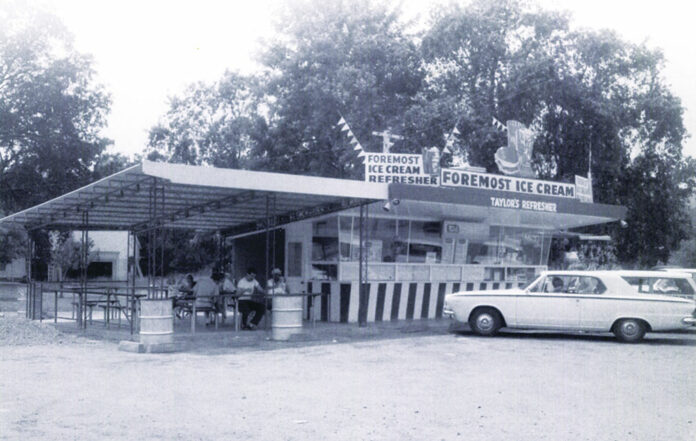
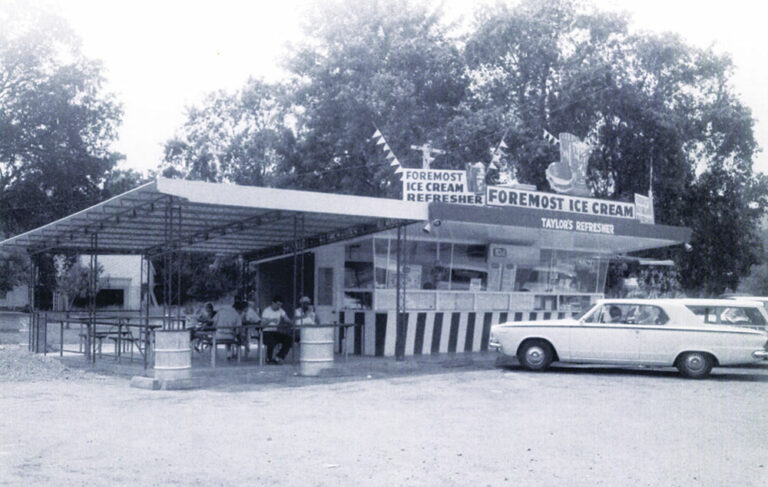
Brown says older locals will delight in the book and may remember going out as children to some of the mid-century restaurants spotlighted, such as the drive-in Taylor’s Refresher. The cover of Lost Restaurants, with its signature ’50s diner-esque font and vintage photographs, evokes this nostalgia. 

One photo on the back cover is meant to bait some readers who may expect a different book. 

“Reagan announced his gubernatorial campaign at the posh Aetna Springs in Pope Valley,” Brown says. “I really like the idea of grumpy conservatives looking and thinking, ‘Ooh, Reagan! Yes!’ Then they’ll open the book and find out that it’s all about immigrants and Black and Indigenous people of color.” 

What Constitutes a Restaurant?

Restaurants, as we think of them today (or as we thought of them throughout our lifetimes until a global pandemic began this March), are a fairly recent concept. 

As readers will learn, the French word restaurant initially described a rich meat broth that would restore one’s health. Later, it came to refer to the places that sold such broth.

In 19th-century Napa and other Western towns, restaurants weren’t places you went out to eat at for a fun time. 

“You ate where you could get food because you weren’t cooking because you were a transient man with no house and no wife or a woman who was working in a hotel,” Brown says.

With this in mind, Brown’s definition of “restaurant” was broad—covering any place that prepared and sold food to the public. That allowed her to talk about bars, resorts, hotels and wholesale vendors.

“We had a lot of home tamale makers,” Brown says. “Latinx women who were Californiana descendants who would make tamales and sell them to bars and markets.” 

Most of Brown’s research began with old newspapers and their advertisements, sometimes as spare as a note saying, “So-and-so is now selling tamales at this local grocer!” Many local newspapers are digitized through the Napa County Library, but Brown’s research also included a trip to the Huntington Library to look at some original Napa newspapers from the 1850s. 

From these leads, she could often learn more about restaurateurs by digging into census data and genealogy research to piece together fuller stories of her subjects’ lives. 

However, she sometimes met dead-ends.

“Old newspapers tend to be fast and loose with facts,” Brown notes.

She was fascinated to learn that two men of Japanese ancestry briefly owned a restaurant on East First Street—near where Oxbow Market is today—in the early 1900s. Their names, listed in two old ads, were spelled differently each time. Brown even looked in the Japanese internment database, but could find no record of them. Since their story is unknown, it doesn’t appear in Lost Restaurants

Brown wishes she knew more about these men.

“We don’t talk about Black people in Napa, but we really don’t talk about Japanese people pre-internment here,” she says. 

Though records of most early Napa restaurants aren’t difficult to find, little has been written about them. Unless someone was really famous, people didn’t write in-depth stories about restaurants of the time.

The Recipes

Brown’s book contains 18 recipes, though not all are user-friendly. Readers should keep in mind that, in many cases, people cooked over fire and their recipes didn’t offer cook times or temperatures.

“There’s a wedding cake recipe that has absolutely no cooking instructions in it and I wouldn’t probably recommend attempting it,” Brown says. 

There are two chop suey recipes presented—one from 1902 and another from 1931.

“Every recipe would be like, ‘This is the official recipe for chop suey—this is exactly how they make it in China,’” Brown says, “and it would be completely different than the next recipe that made the same claim.”

Like many recipes of the time, readers are told what ingredients to combine (mostly animal offal), but not how much of them. 

That said, Brown tasted the parmesan polenta recipe from Caterina Nichelini, the late founder of the still-existent Nichelini Family Winery (established 1895), and it stands the test of time. 

Brown still hasn’t prepared any of the recipes herself, but would love to hear from adventurous readers who do. She can be reached through her website at bookjockeyalex.com

Watch the author read from Lost Recipes of Napa Valley and talk more with Chelsea Kurnick about her book here on YouTube at https://bit.ly/3fvwptP.

When should movie theaters reopen?

0

Netflix fatigue. It’s practically a pandemic itself. The remedy? A shot of real-life cinema—square in the eye—coming soon to a theater near you. Someday. Maybe. Not.

Back in April, the Los Angeles Times reported, “Theater owners have increasingly begun to float the possibility of reopening sometime in July, in the middle of what would normally be Hollywood’s key summer blockbuster movie season.” On Monday, Gov. Newsom made it clear that theaters would not be opening any time soon—and so go the best-laid plans of Mickey Mouse and men. 

Were it not for the recent surge (wear your masks, people!), cinemas could have seen their re-opening “under strict physical distancing protocols,” according to a proposed “Phase One” plan. Frankly, even when that was a possibility, at present writing the prospect of sharing a room full of recirculated air with hundreds of strangers seems so passé. And, you know, suicidal.

I shouldn’t quibble about theater air quality—in the ’80s, I used to work at a theater that still had a smoking section. But even if one takes precautions (like forgoing popcorn to wear an N95 mask), it’s difficult to imagine losing oneself in a film when every cleared throat could be a cornucopia of contagion.

And I love movie theaters; they’ve been good to me and I want them to survive. Besides some kind of quantum reset to get us back on a pre-pandemic timeline (and eliminate Trump and systemic racism in the process), I suppose all we can do is get healthy, which is a group sport (and not everyone is playing). 

Until then, I’ll stay home and experiment. Browser extensions like Netflix Party or Amazon Prime’s new “Watch Party” button are possible pathways to a shared cinematic experience. We successfully ported Happy Hour to Zoom, so why not movies? Last night I laid out $12 to stream Beyond The Visible: Hilma Af Klint, about the under-appreciated inventor of abstract expressionism. At least part of the ticket fee went to the Berkeley Art Museum/Pacific Film Archives (BAMPFA) via a digital daisy chain that included Roku, KinoNow on my mobile phone, and the microchip in my head. It was worth the hassle—and the dough—because cinema is still important. Movies are still big, it’s just, to borrow a line from Gloria Swanson, “the pictures that got small.”

Black journalists are needed now more than ever

0

Last month, The Associated Press announced it would capitalize the “b” in “Black” when referring to people in a racial or ethnic context. In a June 19 blog post, John Daniszewski, vice president for standards, wrote, “These changes align with long-standing capitalization of other racial and ethnic identifiers such as Latino, Asian American and Native American. Our discussions on style and language consider many points, including the need to be inclusive and respectful in our storytelling and the evolution of language. We believe this change serves those ends.”

The Associated Press is the standard language for all journalists, and anyone who has studied in the field must be familiar with The AP Style Guide before graduating. As goes AP, so goes the mainstream press. Though seemingly innocuous at first, the style change is reflective of what is going on in journalism as the result of covering the deaths of George Floyd, Brianna Taylor, Elijah McClain, Ahmaud Arbery, Tony McDade, David McAtee, Nina Pop and countless others—and the resulting Black Lives Matter protests taking place all over the country right now. The heightened “need to be inclusive and respectful” when it comes to not only how Black people are covered in the news, but also an examination into who does the reporting, has inspired a long-overdue “day of reckoning” in mainstream journalism.

In a June 23 New York Times opinion piece, “A Reckoning Over Objectivity, Led by Black Journalists,”” two-time Pulitzer Prize–winner Wesly Lowry wrote, “The view and inclinations of whiteness are accepted as the objective neutral. When Black and Brown reporters and editors challenge those conventions, it’s not uncommon for them to be pushed out, reprimanded or robbed of new opportunities.”

This observation came following a June 6 Washington Post article, “Pittsburgh paper accused of barring Black reporters from covering protests, censoring stories,” which reported that a Black journalist and photographer had been pulled from covering Black Lives Matter protests there. In the article, photojournalist Michael Santiago says, “the paper has barred him and at least one other reporter from covering anti-racism protests in Pittsburgh because they are seen as biased for being Black. Journalists are also accusing the newspaper of removing and censoring at least two articles published online Friday that reported on protests over George Floyd’s death and police abuses, as well as of penalizing reporters who came out in support of their black colleagues,” while pointing out the possible remedy by saying, “With the country gripped by an anti-racism uprising, what’s been unfolding inside the local Pittsburgh newspaper has underscored one of the fundamental challenges American media faces with its coverage: a lack of diverse voices, including of black journalists, in newsrooms. It’s also laid bare the challenges of trying to change that.”

There are challenges ahead in changing the status quo and how we, as reporters and editors, mean to meet them. Former KRON on-air reporter, East Bay Bureau chief and CNN anchor, Soledad O’Brien, cited in her July 4 New York Times Op-ed that, “According to the News Leaders Association in 2019, 21 percent of newspaper employees and 31 percent of online-only news employees belonged to so-called minority groups—that includes African-Americans, Latinos, Asian-Americans and Native Americans.”

In a time when Black journalists are needed most, media outlets, old and new, have failed to meet the rising call for representation, while reinforcing white supremacy in hiring, reporting and access to opportunities. What this “day of reckoning” shows is that this was not done by happenstance, but by design.

As a Black editor in the Weeklys family of newspapers and the first Black, Culture Editor of East Bay Express (the new sibling paper of the Bohemian and Pacific Sun), I am committed to elevating all voices of our diverse community. If you or someone you know is a Black or Brown journalist who has been locked out of the industry, our door is always open.

Email D. Scot Miller at ds******@*****ys.com.

Remembering Carl Reiner

0

“Dying is easy, comedy is hard.”

This quote is purported to have been spoken by an English actor, Edward Gwenn, on his deathbed, when questioned about his health.

Carl Reiner, a comedy giant, has left the stage at only 98 years of age. Most Americans will not recognize his name or his contribution to the world of humor, but the above quote applies to him.

We old-timers have fond memories of the man. He wore many hats: auteur/actor/movie director, 1950s TV comedy writer (during the first days of live television­); creator of the revered 1960s sitcom, The Dick Van Dyke Show; and the man behind comedy albums such as his 2,000 Year Old Man album with fellow comedian/writer, Mel Brooks.

Comedy is hard—just ask any comedian. It is a tightrope, working without a net, thinking on your feet, where pushing the envelope is oftentimes required. It takes years to hone the art and craft of what is funny; to not shy away from topical material; to gauge the audience’s temperament; and to consistently set up, time and deliver the lines that will seduce the audience and melt them into fits of laughter. It takes not only courage, but chutzpah!

For those of us who came of age in the 1950s and ’60s, there were countless comedians who left a mark and influenced future comedians with their distinct styles,  leaving us breathless, tearful and perspiring, our faces and bodies tired and weak from convulsive laughter. These funny people found the humor in their own personal life experiences that displayed the collective human foibles within us all, and encouraged us to take a break from life’s difficulties—to not take ourselves and the world so seriously (not always an easy task).

Or, as Wavy Gravy says, “Keep your sense of humor, my friend; if you don’t have a sense of humor, it just isn’t funny anymore …”

Thank you Carl, for all the years of laughter.

E.G. Singer lives in Santa Rosa.

Signs of the Times

Why did the city allow this against the sign ordinance? When it rains who will clean up the mess! BAD DECISION by Petaluma. Shame on you!!!

Not in the Park!

via Bohemian.com

Good move, Petaluma. The Kindness Committee will certainly take care of the installation—and it never rains in the summer in Sonoma County. #blacklivesmatter #kindnesscommittee

Olive Petaluma

via Bohemian.com

Automobile Investigation

The following were online comments in response to a July 9 online article, “Focus of SR Police’s Investigation Into Porsche-Protester Incident Remains Unclear.”

As a person who was quite literally shoved out of the way of this vehicle after it sped past the front cyclist, yeah. There is a lot more than frustration for how the police handled this, the biased and awful press release, and this faulty, super-flimsy claim of the driver, who had her window up when she nearly hit me and “was punched” AFTER driving through a crowd of more than 150 peaceful people.

AL 1

via Bohemian.com

Two similar incidents at the June 26 march in Healdsburg are currently being “investigated” by HPD. Nothing has been done and now investigating officer Craig Smith has gone silent, not responding to my request for an update. Chief Burke is finessing the city council member who asked for info. So Alex Z gets to just drive right at a group of 50 protesters with impunity. I am disgusted.

Karen Miller

Via Bohemian.com

Marijuana Act reverses Nixonian law

Cannabis groups come and go, but NORML, the granddaddy of cannabis organizations, has been around ever since 1970. The National Organization for the Reform of Marijuana Laws has never wavered from its goal of making weed legal in every state and at the federal level.

Keith Stroup, 76, who founded NORML 50 years ago, still gets pleasantly stoned and still advocates for the rights of marijuana users. I met him in San Francisco in the 1980s and have followed his career ever since.

Stroup tells me: “Right now, NORML is behind the Marijuana Opportunity, Reinvestment, and Expungement (MORE) Act, a federal bill that would remove marijuana from the Controlled Substances Act (CSA), which reefer maniac Nixon signed into law in 1970.” He adds, “We have big support from the recently founded Cannabis Caucus in Congress, though the MORE act won’t pass until we remove Trump from the White House.”

A self-defined “farm boy” from Illinois, Stroup was radicalized by the War in Vietnam and the threat of the draft. He became a public-interest lawyer after meeting Ralph Nader, the consummate consumer advocate.

Stroup remembers that the marijuana future looked bright when Jimmy Carter became president, in part because his sons smoked weed. He also remembers that there was a shift even before the Georgia peanut farmer moved into the White House. In 1973, Oregon decriminalized cannabis. Nebraska followed in 1978.

“Then along came Reagan and there was no progress until 1996, when California legalized medical marijuana,” Stroup says.

When I asked Stroup why the federal government still classifies cannabis as a “Schedule I” drug with no medical benefits, he tells me, “Once something gets into the federal bureaucracy it’s hard to get it out.”

Most Americans, he says, want full legalization of pot.

“The majority of U.S. citizens are anti-Prohibition,” he tells me. “They think that the anti-marijuana laws have created far more problems than marijuana itself, which is increasingly used for a variety of medical reasons.”

In many ways, the U.S. is still in the Dark Ages when it comes to weed. Whites and Blacks smoke it in equal proportions, but across the country, Blacks are arrested 3.6 times as often as whites for possession. In some Ohio and Pennsylvania counties, Blacks are 100 times more likely to be arrested than whites, according to an April 2020 study by the American Civil Liberties Union.

“It’s none of the government’s business who smokes weed,” Stroup tells me. “There’s nothing wrong with responsible marijuana use.” 

Jonah Raskin is the author of “Marijuanaland: Dispatches from an American War.”

Virtual Event Supports Point Reyes Books

0

A pandemic might be a good time to catch up on your reading, but that doesn’t mean it is any kind of boon to local bookstores. Although they generally offer online sales, most local bookstores depend on foot traffic to generate the kinds of sales that put a dent in their rent.

That’s why a group of writers, publicists and others has rallied around Bay Area booksellers under the aegis of #WeLoveBookstores. The group hosts Zoom video conferences with literary guests, and all proceeds go directly to a designated independent bookstore.

#WeLoveBookstores emanated from the Bookstore and Chocolate Crawl events organized by writers and book-lovers Charlie Jane Anders, Maggie Tokuda-Hall and Jackie Risley. The group was organizing its next event when the coronavirus made it clear a May Crawl could not happen.

“You could tell pretty quickly when the shelter-in-place order came down that bookstores were going to be hit hard,” Anders says. “Bookstores have high rents, especially in the Bay Area. They can’t change the prices on the products they sell. They are very vulnerable enterprises in the best of times.”

The group’s fundraising get-togethers feature readings, performances and discussions. The group also helps book lovers find gift cards, start a libro.fm account or place preorders with local booksellers.

“We wanted to help boost authors with books coming out around this time who couldn’t do events in person,” Anders says.

“I love bookstore events—seeing everyone in person, signing hard copies of the book, the glow that you share with your pals. I missed all of that, deeply,” Tokuda-Hall says. While the virtual events may hold an air of bittersweetness to them, Tokuda-Hall adds that the series still offers, “its own kind of magic.”

Recent events in the series include a virtual authors’ pet show with Chuck Wendig, Meg Elison and several other writers hanging out with their furry friends; and a sci-fi author talk between Hugo Award–winners John Scalzi and Sarah Gailey and Michael Zapata, founding editor of MAKE Literary Magazine.

The virtual series’ next event will feature Rachel Khong, R.O. Kwon and Cathy Park Hong in conversation with Evan Karp on July 15 at Noon to benefit Point Reyes Books.

Khong is an editor and writer who recently founded The Ruby, a work and event space for women and nonbinary writers and artists in San Francisco’s Mission district. Kwon is best known for the nationally bestselling novel, The Incendiaries. Hong’s prose and poetic works have earned her a Fulbright Fellowship, a National Endowment for the Arts Fellowship and the New York Foundation for the Arts Fellowship.

The fundraising goal for this event is $2,000, and registration for attending the Zoom meeting is offered on a pay-what-you-can basis.

“One of the unexpected joys of these events has been the way video conferencing makes the conversations feel more intimate,” Newitz says. “I wouldn’t trade live events for online events all the time, but there’s something refreshing about seeing writers in their own homes, talking casually.”

Original article by Michael Berry, with Charlie Swanson contributing to reporting. Welovebookstores.org.

Petaluma approves artwork and mural, dodges legal questions

0

As the nationwide Black Lives Matter protests continue, artwork affiliated with the movement has become a flashpoint for disagreement in cities across the country.

On Saturday, July 4, a woman in Martinez was filmed using a small bucket of black paint and a roller to cover up the first, bright-yellow “L” in the city’s new “Black Lives Matter” mural. During the video, a man accompanying the woman calls racism a “leftist lie.”

The Martinez Police Department is reportedly now searching for this couple who defaced the artwork, which had been permitted by the city.

As nationwide protests continue, artwork has played a central role in Petaluma’s protests, raising conflicts among community members—and legal questions—over the past month. As a result, at a meeting on Monday, July 6, the Petaluma City Council weighed in on several art-related questions but left underlying legal issues largely unaddressed. 

The council approved the creation of a Black Lives Matter street mural without discussion. The artwork, similar to the ones cropping up in cities across the country including Martinez, will spell out “Black Lives Matter” on a yet-to-be-determined public street. 

Next, the council temporarily approved an impromptu art installation at the city-operated Leghorns Park, which, in recent weeks has become the center of a legal debate after a man visited the park multiple times to tear down signs, allegedly hitting one woman in the face with his elbow in the process.

Although numerous protesters witnessed the man in action on June 20, a responding police officer told protesters there wasn’t much he could do.

The officer, caught on film, explains that he cannot arrest or charge the man for removing and destroying the artwork because the artwork exists in something of a legal gray zone.

The city chose, at that time, not to enforce the municipal code that usually bars citizens from installing unpermitted art or signs in many city-owned spaces. Because the art was technically not permitted, the police could not prosecute the man for removing it, the officer says.

“We can’t play favorites, so to speak,” the officer comments. “If we’re charging him with taking down the signs, then we’d have to charge you for putting up the signs.”

In a series of interviews last week, the Bohemian attempted to clarify how the Petaluma Police reached this understanding of the law and who offered them legal advice. 

Deputy Police Chief Brian Miller said in an interview that the man’s decision to remove the art could be considered free speech under the First Amendment. He also said that the District Attorney’s office advised the police department that the man was “acting on behalf of the City” when he tore down and destroyed the signs.

The District Attorney’s Office denies they offered the department that advice, and City Attorney Eric Danly stated in an email, “The person who removed the signs was not acting as an agent of the City.” Nor did the public attorneys advise the police department that the vandalism of the artworks was protected as freedom of expression.

Although it is now caught up in a nationwide political discussion, the Leghorns Park installation had decidedly non-political beginnings.

Back in December, the Kindness Committee, a group founded by local high school students, began installing their artwork on fences at public schools and parks. The early installations included phrases such as “be nice,” “go for it,” and “be happy,” according to a presentation two of the group’s founders gave to the city council.

In June, as the nationwide Black Lives Matter protests began, the Kindness Committee began installing work in support of the movement at parks around the city. Only then did the students’ artwork become controversial, the Kindness Committee’s members and supporters said during the council meeting.

In mid-June, after some of the signs were ripped down, the Kindness Committee organized a “sign hanging party.” Some of those signs were ripped down as well, but local Black Lives Matters activists and sympathizers continued to add their own work to the Kindness Committee’s Leghorns Park display throughout the month.

In letters submitted to the council, a few residents criticized the appearance and political significance of the artwork. One man, speaking during public comment, said that permitting the artwork, even temporarily, could lead the city to slip into lawlessness.

Those statements—and the people who removed the art—seemed racist, supporters of the artwork said.

“I think this art has brought out the racism in our community and I encourage you to pass this resolution,” former councilmember Janice Cader-Thompson said during the meeting’s public-comment period. 

Ultimately, the city council approved the artwork until Aug. 6 with an option to extend until Sept. 15. 

The council did not address the underlying legal issues raised by the June 20 video of the police’s response to the man removing the artwork. But, if he returns to tear down the now-permitted artwork, the police will be obligated to charge him.

Does city-permitted artwork pack the same political punch as unpermitted artwork? Protesters who spoke at the meeting seemed to think the city’s approval signifies a small step in support of the movement, although the city, as with most others in the North Bay, has been slow to embrace the movement’s larger calls for systemic police reform, reallocating funding away from law enforcement or abolishing police departments altogether. 

For their part, protesters continue to use unpermitted artwork as a tool.

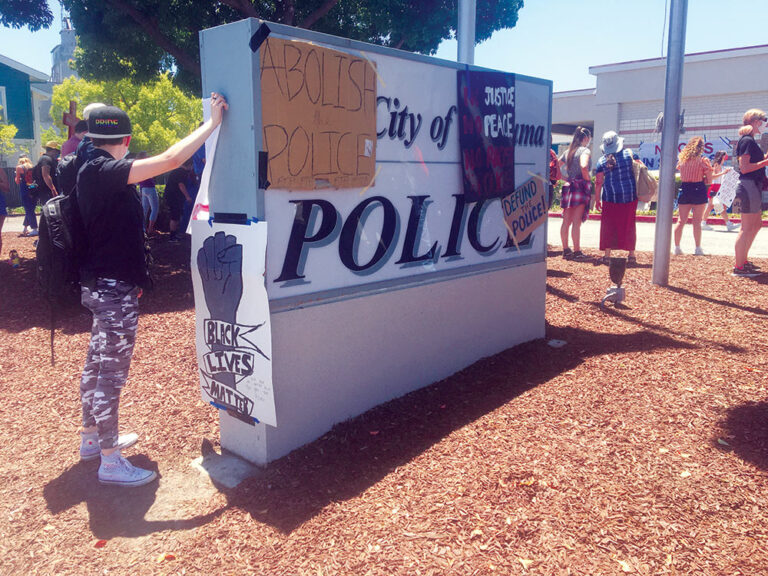
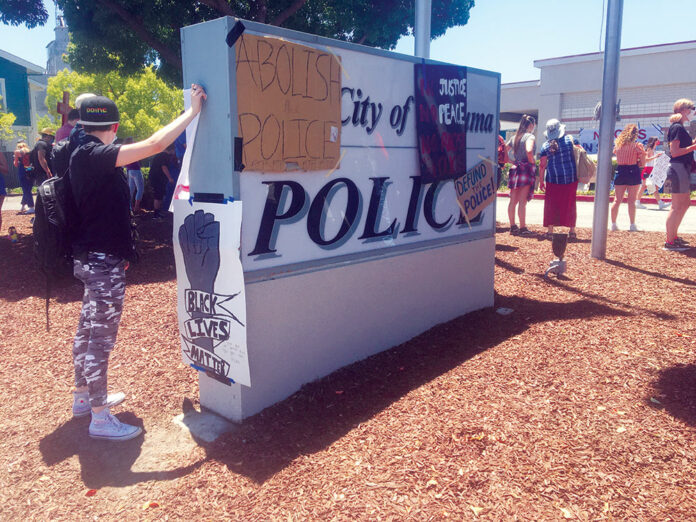
During a march on Saturday, July 4, protesters installed artwork all over the station’s sign and front doors.

“Abolish the police,” one poster taped over a sign in front of the station read.

Although the police did not attempt to stop the installation, the artwork had been removed by Tuesday afternoon.

Nearly a month earlier, on June 12, the Petaluma Police Department took to Facebook with a post featuring artwork in support of police.

“We would like to thank the chaplains, volunteers and community members who showed their support this morning by placing colorful signs on our building… Please know your posters have been moved inside for us to enjoy for weeks to come,” the Facebook post, which was tagged #thinblueline, stated. 

Additional reporting by Peter Byrne.

Ten Years After

0

Deja vú—the feeling that we’ve been here before. What’s caused it this time? Well, the Sonoma County Alliance has been called out, yet again, as a racist organization. Ten years ago an independent expenditure committee, headed by the Alliance, put out a mailer for David Rabbit that was against making Sonoma County a sanctuary county. The overall tone of the mailer was not of a healthy discourse on the topic, but more along the lines of how violent illegal Mexicans would be rampaging and murdering all the white people who are simply out for a nice picnic. In other words, it was a race-baiting mailer that would make Donald Trump proud.

When we add in the fact that many industries represented by the Alliance—such as agriculture, construction and hospitality—are the ones that actually employ high numbers of undocumented people, the true reason for the mailer is obvious. It was made to appeal to people’s base instincts.

Not only did then-Sonoma-County-Alliance-president Lisa Shaffner refuse to dialogue about how the mailer might be problematic, she accused naysayers of simply “liking to fight.” David Rabbit, showing a complete lack of leadership, told the Press Democrat, “It is what it is.” In fact, few community members repudiated the racist nature of the mailer. None of the Alliance organizations that were contacted responded, let alone gave up their memberships. Lisa Wittke Shaffner has gone on to bigger and better things, including sitting on the Sonoma County Board of Education.

The self-proclaimed “Latino Leaders of Sonoma County,” Los Cien, even spoke against the Alliance’s recent tone-deaf letter. Nevermind that 10 years ago they had nothing to say against the racist mailer that targeted their very own community.

Trying to get Sonoma County to act against racism 10 years ago was an exercise in futility, even after articles in the paper, radio interviews and as a Bohemian cover story. If you were silent 10 years ago, it’s time to do some soul searching as to why. That’s what anti-racist work is all about.

Laura Gonzalez is the former president of the Sonoma County Latino Democratic Club.

North Bay Black-owned restaurant list

Indoor dining is on hold in the North Bay for the foreseeable future, dealing a major setback for restaurants and bars that were hoping to salvage summer during the Covid-19 pandemic. Still, there are ways to support the local food industry, and last month, a Santa Rosa teacher launched an endeavor to highlight North Bay businesses and restaurants owned...

History through food

Alexandria Brown isn’t a foodie, but she wrote this year’s most compelling North Bay book on food. In fact, Lost Restaurants of Napa Valley and Their Recipes, released in April by The History Press, was written while its author lived in a kitchenless apartment. In it, Brown—a historian—uses restaurants-past as a lens through which to tell stories of the...

When should movie theaters reopen?

Netflix fatigue. It’s practically a pandemic itself. The remedy? A shot of real-life cinema—square in the eye—coming soon to a theater near you. Someday. Maybe. Not. Back in April, the Los Angeles Times reported, “Theater owners have increasingly begun to float the possibility of reopening sometime in July, in the middle of what would normally be Hollywood’s key summer blockbuster...

Black journalists are needed now more than ever

Last month, The Associated Press announced it would capitalize the “b” in “Black” when referring to people in a racial or ethnic context. In a June 19 blog post, John Daniszewski, vice president for standards, wrote, “These changes align with long-standing capitalization of other racial and ethnic identifiers such as Latino, Asian American and Native American. Our discussions on...

Remembering Carl Reiner

“Dying is easy, comedy is hard.” This quote is purported to have been spoken by an English actor, Edward Gwenn, on his deathbed, when questioned about his health. Carl Reiner, a comedy giant, has left the stage at only 98 years of age. Most Americans will not recognize his name or his contribution to the world of humor, but the above...

Signs of the Times

Why did the city allow this against the sign ordinance? When it rains who will clean up the mess! BAD DECISION by Petaluma. Shame on you!!! Not in the Park! via Bohemian.com Good move, Petaluma. The Kindness Committee will certainly take care of the installation—and it never rains in the summer in Sonoma County. #blacklivesmatter #kindnesscommittee Olive Petaluma via Bohemian.com Automobile Investigation The following were online...

Marijuana Act reverses Nixonian law

Cannabis groups come and go, but NORML, the granddaddy of cannabis organizations, has been around ever since 1970. The National Organization for the Reform of Marijuana Laws has never wavered from its goal of making weed legal in every state and at the federal level. Keith Stroup, 76, who founded NORML 50 years ago, still gets pleasantly stoned and still...

Virtual Event Supports Point Reyes Books

A pandemic might be a good time to catch up on your reading, but that doesn’t mean it is any kind of boon to local bookstores. Although they generally offer online sales, most local bookstores depend on foot traffic to generate the kinds of sales that put a dent in their rent. That’s why a group of writers, publicists and...

Petaluma approves artwork and mural, dodges legal questions

As the nationwide Black Lives Matter protests continue, artwork affiliated with the movement has become a flashpoint for disagreement in cities across the country. On Saturday, July 4, a woman in Martinez was filmed using a small bucket of black paint and a roller to cover up the first, bright-yellow “L” in the city’s new “Black Lives Matter” mural. During...

Ten Years After

Deja vú—the feeling that we’ve been here before. What’s caused it this time? Well, the Sonoma County Alliance has been called out, yet again, as a racist organization. Ten years ago an independent expenditure committee, headed by the Alliance, put out a mailer for David Rabbit that was against making Sonoma County a sanctuary county. The overall tone of...
3,002FansLike
3,850FollowersFollow