Federal agents in Portland, Oregon, essentially kidnapped American citizens using unmarked vans and wearing camouflage. Shades of Chile under Pinochet.
Had those people fought back they might have been badly hurt or killed. White supremacists could do the same thing. That’s why it’s essential that police are identifiable and must have reasonable cause. This is clearly unconstitutional and, I would say, criminal.
President Trump recognizes no limits to his power. He has no interest in governing. He wants to rule. And there seems to be little ability on the part of Congress or the Courts to restrain him.
Senate Republicans are in thrall to him and House Democrats are stymied at every turn in efforts to hold him accountable. He tells his staff not to testify, to defy subpoenas and refuse to provide information requested by House Committees.
A major concern for me is the willingness of officials and various agency personnel, like the CBP, to follow orders. We like to think that Americans won’t commit atrocities like the Germans did in World War II, but there is a slippery slope and we’re on it.
Under prior administrations we have invaded another country, legitimized torture, kidnapping, targeted assassinations and indefinite imprisonment. My Lai, Abu Ghraib, Guantanamo are names that have an ugly ring now. Police brutality against peaceful protesters makes it clear that the militarization of the police has created dangerous conditions as well.
November can’t come soon enough but I worry about the Republican’s ability to suppress votes and throw the process into chaos.
I never thought I’d see the day that democracy in this country was in jeopardy. But I do.
We are still in the dark regarding the implications (of the fact) that the greatest machine known has more than 10 million endocannabinoid receptor cells within and on the surface of the human body that are specific to absorb the healing molecules of marijuana. (“Wanting MORE,” Rolling Papers, July 15).
The main effect is to ameliorate irritation and inflammation including the mind. Cannabis has a plethora of other potential benefits that reverse erectile dysfunction, improving appetite and opening up a new, but related, vision of life itself! But it is not for everyone. Dictators decide for others. Normal took more than half a century to obtain non-stoppable legalization. This is not acceptable but I was not there to notify normal to lead with the positives rather than projecting a defense as though we are guilty. Marijuana is a peace plant and, “war is law, love is almost illegal.”
The deceit of fear and Terror around marijuana may not be unrelated to the fear and Terror of a pandemic that is not a pandemic according to the public health textbooks I studied!
Before kissing put on your mask!
Dr. Joel Taylor, D.C.
Via PacificSun.com.
SCOTUS Push
President Donald Trump and Senate Majority Leader Mitch McConnell have tried to make it clear: Given the chance, they would push through a Supreme Court nominee should a vacancy occur before Election Day.
Interesting, Moscow Mitch used J. Biden’s earlier challenge to block M. Garland’s nomination. Now, he and this Administration want to go back against their earlier challenge and push through another nominee. Moscow and this Administration should leave the status quo and give the winner the opportunity to nominate a candidate to the Court.
In times of crisis, some Westerners are fond of saying that “crisis,” when written in Chinese, consists of the characters for “danger” and “opportunity.” This is an interesting, even optimistic notion, that also happens to be wrong. It’s the kind of aphoristic observation that culty CEOs like making when they go “full guru” in front of their minions. Danger and opportunity aren’t just “two great tastes together at last” for these guys, it’s a panacea for nervous shareholders at best and justification for profiteering at worst.
Victor H. Mair, professor of Chinese language and literature at the University of Pennsylvania writes that the “crisis” misnomer is the province of “pop psychology” and “hocus-pocus.” So why does it endure? Because it contains a kernel of truth. A crisis can present an opportunity—an opportunity to say the right thing, the right way, at the right time. But don’t worry, that’s not going to happen right here, right now. I’m still trying to wake up from history.
As they say, if you don’t have anything nice to say, sing it unintelligibly over some power chords. Barring that, my generation—X—has a professed preference for bluntness over rapier wit, so if I say anything, whatever it is, it will just sound rude. And dull. I mean, why glide one’s intellect over the fine-grain sharpening stone when you can bang your head against a wall instead?
Speaking of self-soothing, you have to remember that none of us expected to outlive the Reagan era. The world was supposed to end in a nuclear holocaust and the pandemic du jour was AIDS, which arrived in time to stymie a generation’s sexual awakening (didn’t work). And when we weren’t waiting for death to arrive, we waited for our parents, hunkered down in front of afterschool specials that taught the horrors of moralizing between commercial breaks, as we turned a latch key in our Cheeto-stained fingers.
“As the generation raised in the age of stranger danger and Just Say No, our inherent risk aversion is finally being recognized as a great strength and asset to the survival of the species,” wrote Megan Gerhardt for an NBC News think-piece.
Agreed.
Crisis is my brand. In fact, I understand that the word “Crisis” is actually the combination of the expressions “cry for help” and “isolation tank.” Crysis—why is this not a band already? Let us be, so that we may scream silently in our hearts.
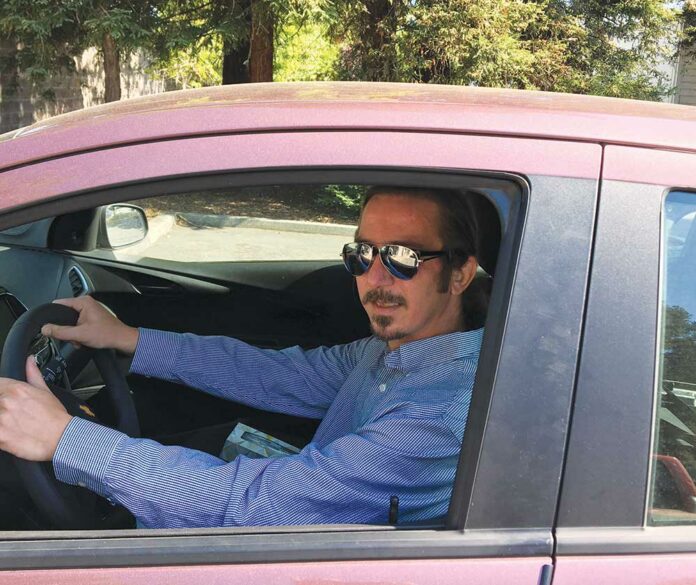
“Drive!” Kevin McEachern tells his team. The delivery manager at the Sonoma Patient Group (SPG), the oldest and longest-operating cannabis dispensary in the county, McEachern has his hands full during the pandemic. More folks of all ages, including senior citizens at Oakmont, want more weed delivered to their doorsteps than ever before. The demographics have definitely changed big time.
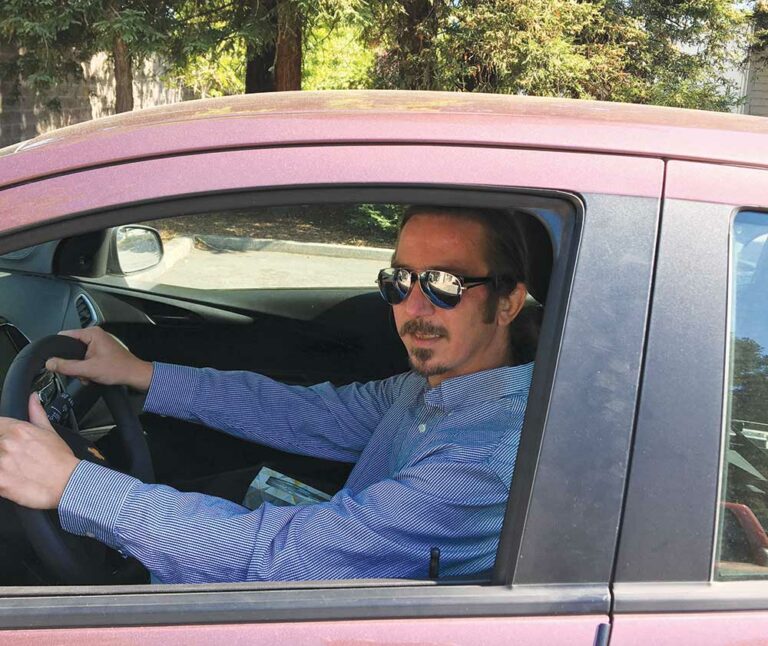
On Wednesdays, McEachern himself gets behind the wheel of a Chevy Spark and brings topicals, edibles and flowers—the same items that are for sale in the store—to users who wear smiles when he arrives.
“I typically cover one hundred miles—I listen to KDFC because you can get it almost everywhere and classical music is calming,” he tells me. “Ordering weed is similar to ordering pizza; the customer looks at the menu online, makes selections and adds an address. The driver goes on the road with the product; the GPS automatically sends the ETA. Payment is at the destination.”
There’s no delivery fee, but to qualify a minimum dollar amount is required.
Born in 1982 and raised in Sonoma County, McEachern attended Sac State and majored in social science. For four years he worked as a teacher, then decided he wasn’t meant for the classroom. Before landing at SPG, he worked for Green Light Alternatives, a dispensary in Novato.
“I never thought I’d be in this industry,” he tells me. “In many ways it’s a dream come true. I’m not doing any harm to the planet or its inhabitants. In fact, cannabis helps a lot of people.”
McEachern remembers the days when users needed a doctor’s recommendation to purchase weed. How quaint!
Most of his deliveries are in Santa Rosa, though he also ventures as far west as Monte Rio.
“I never know what to expect,” McEachern tells me. “An older woman wanted weed with high THC, which I normally associate with young guys.”
To be employed as a driver, one needs a valid license and a clear head. The company car comes with documents that protect the driver from an arrest for trafficking. Going on the road under the influence is against company policy. McEachern says he uses cannabis at home.
“I like flowers and edibles,” he tells me.
Are there issues?
“Yeah, a while ago a kid tried to pay with his dad’s checkbook, behind dad’s back,” he says. “That wasn’t cool. Otherwise, it’s a fun job.” Jonah Raskin is the author of “Marijuanaland: Dispatches from an American War.”
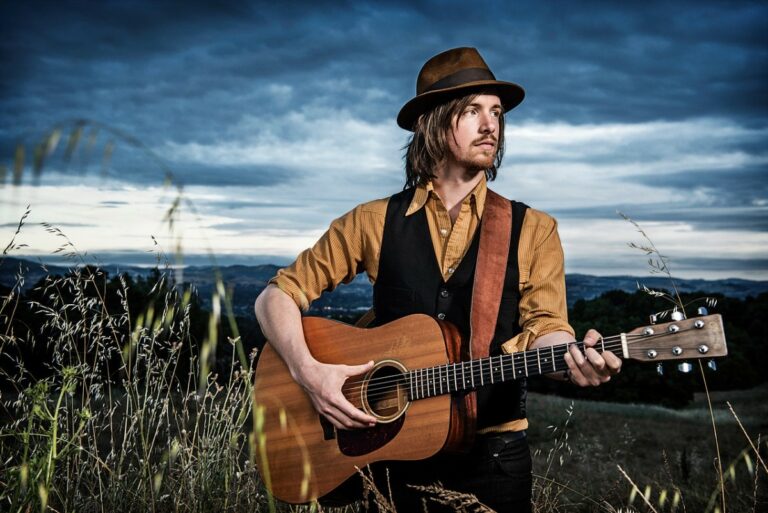
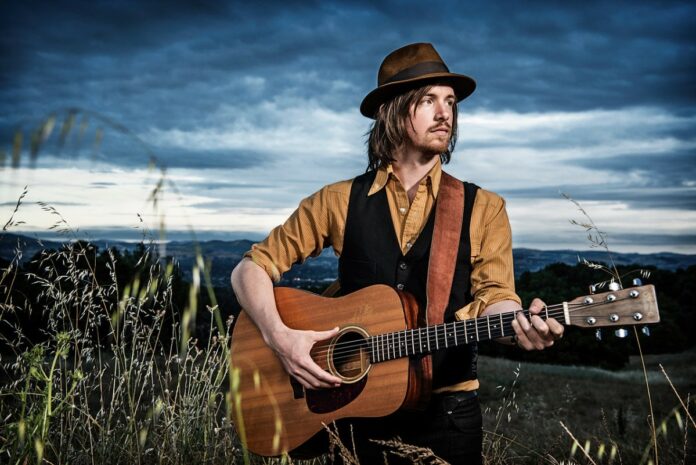
With a musical resume a mile-long, Narada Michael Walden is one of the most prolific and popular musicians, composers and producers working in the worlds of jazz, soul and world music.
Best known for producing platinum-selling songs for iconic singers like Aretha Franklin and Mariah Carey, Walden is also an accomplished drummer who just recently joined legendary rock band Journey and he produces and records his own original music at his Tarpan Studios in San Rafael, where he created his latest solo album, Immortality.
On August 8, Walden will release Immortality via Quarto Valley Records. The eight-track LP boasts a killer blend jazz-fusion and progressive-rock.
“‘Immortality’ is an album for that part of my fan base,” Walden says in a statement. “I love pop music, but I come from a world in which we mix it all up together; jazz, rock, pop, funk, soul and R&B. That’s what fusion is all about. A lot of my early fans still want to hear me stretch out and fly, so this record is me drumming and singing and putting my heart out to them. People can hear the love that’s inside of me when they listen to this record.”
Walden and longtime engineer Jim Reitzel collaborated on producing the album, which features Walden singing and playing drums and keyboards along with his band Thunder, made up of keyboardist Frank Martin, bassist Angeline Saris and guitarist Matthew Charles Heulitt.
“This is one of the best bands I’ve ever had the pleasure of playing with,” Walden says. “The joy they bring to music is remarkable, and there’s literally nothing they can’t play.” Guesting on the record is guitarist Jackson Allen, whom Walden calls “a sensation. He played on a session with me, and I really enjoyed the sounds he got. Bringing him in on the album felt natural to me.”
Immortality begins with the spiritual rock ballad “Aretha Dances in Heaven,” dedicated to the late Queen of Soul. Walden produced several hits for Franklin, including her chart-topping single “Freeway of Love,” and he wanted to celebrate the music legend in an exuberant and jubilant way. “There’s a bell pattern in the song that, to me, sounds like Aretha being welcomed into heaven,” Walden says. “I want people to experience that feeling when they hear the song.”
Other inspirations found on the album include Led Zeppelin drummer John Bonham, jazz piano great Horace Silver, multi-instrumentalist Charley Drayton and drummers Chick Webb and Cindy Blackman Santana.
Throughout Immortality, Walden takes listeners through a visceral and emotional odyssey that includes highlights like the ballad “Michael Anthony Kadillac Walden,” named after Walden’s four-month old son, as well as tracks like the thrilling orchestral prog-rock epic “The Real Baptism” and album-closer, “Immortality, Part 2,” which offers a veritable master class in percussion when Walden lets loose with precision and passion.
“The title ‘Immortality’ is significant to me on a couple of levels,” says Walden. “I have a family whom I love deeply, so I’m inspired to take care of my body, mind, soul and energy so that I can live as long as I can. The second part of the meaning is from a musical standpoint. Music comes from our soul, and we need to acknowledge and love that spirit inside of us. It’s something we get from our creator, and it’s everlasting.”
In addition to making music, Walden is also known for his nonprofit organization the Narada Michael Walden Foundation, which is dedicated to making a difference in the lives of young people through music. The foundation’s projects include the Music Grant Program, which is available to Marin County students in grades K to 12. The program assists students in pursuing music by helping them to purchase musical instruments, obtain tuition for music camps and coordinate private lessons.
“We are honored to include the multi-talented Narada in our Quarto Valley Records family of artists,” label founder and CEO Bruce Quarto says in a statement. “‘Immortality’ is filled with the spiritual and soulful energy that makes his music so transportive and unique, yet universally appealing.”
‘Immortality’ is available on August 8 on vinyl, CD and online. Pre-orders can be placed at Amazon.com.
Much like at one’s favorite bar or diner, patrons often have a long-standing relationship with their hair stylist or barber, making the recent health-order-mandated business closures difficult for patrons along with workers and business owners.
Unsurprisingly, hair salons and beauty parlors are just a few of the many businesses that have been impacted by Covid-19 health orders.
Indoor salons were allowed to operate during California’s short-lived reopening but, on Monday, July 13, Gov. Gavin Newsom ordered salons in the 30 counties on the state’s watchlist—including Marin County and the rest of the Bay Area—to stop offering indoor and outdoor service.
After push-back from beauticians, politicians and the Professional Beauty Federation of California, anindustry advocacy group, Newsom clarified at a Monday, July 20, press conference that salons, barbershops, massage parlors and a few other related business will be allowed to move their operations outdoors, provided they follow safety protocols.
The latest rule change likely won’t save every business but, for those who do have the ability to move outside, the new order might give them the ability to scrape by.
The Pacific Sun spoke to two North Bay business owners to gain an understanding of the struggles of the state’s hairstyling industry—and what they think of the state’s latest order.
San Rafael Salon
On Tuesday, July 14, San Rafael salon owner Ann Brewer, 61, walked into her building to grab some supplies for clients requesting at-home service.
Just days before, the well-maintained Brewer-Phillips Hair Design had been singing with the snip of scissors, the hum of blow-dryers and slightly muffled conversations behind face-covering masks.
After the initial California shutdowns of non-essential businesses in March, Brewer talked to her team and other Marin salon owners about how they could create safe plans to re-open their businesses.
When sanctions were lifted for two weeks in July, a horde of clients—all wearing mandatory face masks—flooded in to find temperature screenings, self-reporting waivers of symptoms and socially distanced stations. The salon received compliments on cleanliness and safety from doctors who came in for appointments, Brewer said.
Yet, by July 14, Brewer’s self-described “big, beautiful” salon in downtown San Rafael had once again fallen silent due to the new rules for counties on the state’s watchlist.
“It’s hard to just look at all that, and say, is it really unsafe to be here?” Brewer said in a phone interview.
“I’ve found that basically, everybody is self-policing, like if somebody sees somebody pull their mask below their nose, we go and tell them, ‘Put that back up,’” Brewer said. “There’s not one thing that people get away with, because everybody’s watching.”
Yet, despite the precautionary measures taken by Brewer-Phillips and other establishments, Newsom shutdown salons and other businesses in 30 counties on July 13. The order came during a statewide spike in Covid-19 reportings, with Marin in particular being a hotspot, as average daily cases in July have nearly doubled that of prior months.
After a process of staying afloat following the first wave of shutdowns due to funding from her husband and Small Business Administration loan programs, the future of the salon remains unclear.
“At a certain point, I might lose everything,” Brewer said.
On July 20, following Newsom’s latest announcement, the California Department of Consumer Affairs clarified that hair salons may offer outdoor haircuts but not other related procedures, including shampooing, electrolysis and coloring.
Brewer said roughly 80 percent of clients received coloring during their appointments, a procedure which is not allowed under the new state guidelines. However, while she’d have to check with staff and clear the service with both the state board and city planning, Brewer said jumping through hoops wasn’t a problem.
“I’ll do anything I can to keep things moving,” she said.
Sonoma County
Up in Sonoma County, another county on the state watchlist, a Graton-based hairstylist may have unintentionally lucked out.
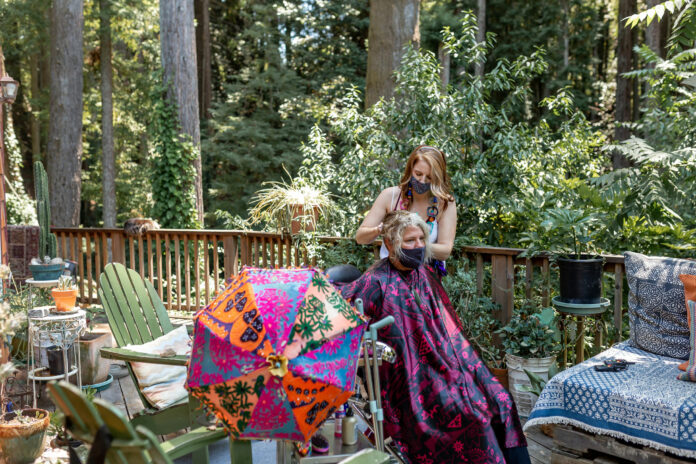
Months before Covid-19 struck, Ramona Camille, 39, began refurbishing a 1974 VW van with the dream of offering haircuts and other outdoor services at festivals, weddings and elsewhere through her company, Ramona Rainbow Hair Art.
While the North Bay’s wedding and party industries probably won’t recover for a long time and Camille still hasn’t completed the VW van, she started cutting friends’ and clients’ hair around the county before the pandemic, including at some on-site weddings.
Camille, a single mother, saw another benefit to at-home visits before the pandemic, describing the services she provides to some clients as childcare and haircare combined. Even before the pandemic, more than half of her clients, many of them single mothers, asked her to make at-home visits, she said.
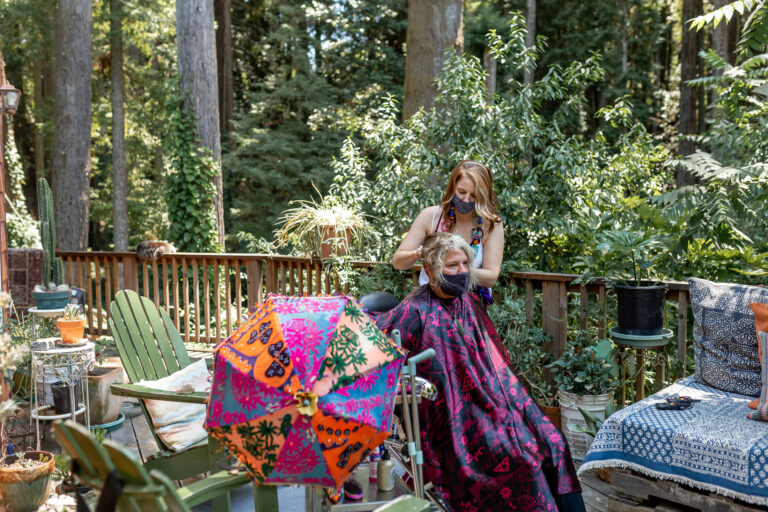
As a result of her previous experience, Camille mastered the art of to-go appointments long before the July 20 reopening. She is able to gather all of her equipment—including a collapsible chair, an umbrella, outdoor lights, a trash can and disinfectant supplies—in her car.
“[Offering outdoor service] is really completely possible,” she said.
Camille was inspired by a trip to Hawaii where she saw residents offering a variety of services outside.
“People were outdoors and they seemed to be having so much fun,” she said.
Under the state’s new order, Camille plans to cut hair on her front porch in Graton and continue offering clients at-home visits.
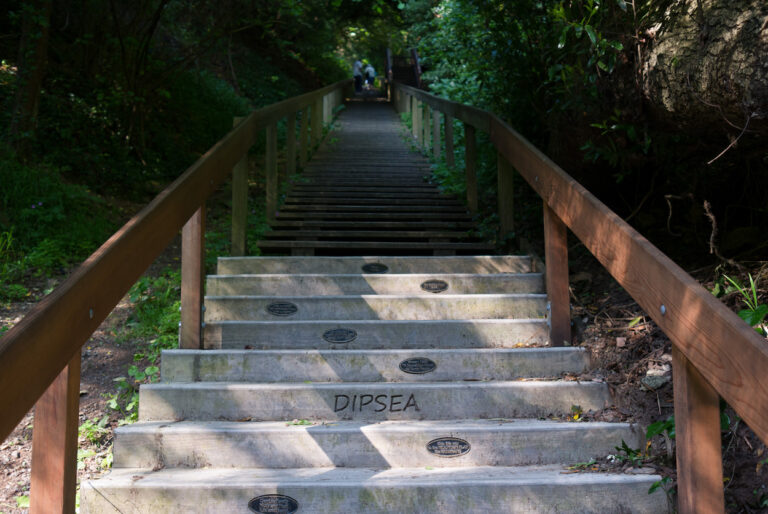
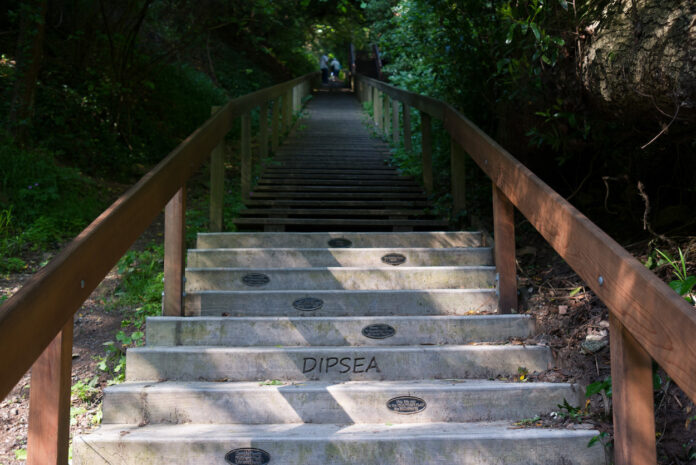
As scenic as it is challenging, the Dipsea Race in Marin County—first run in 1905—is the oldest trail race in America and one of the most popular events of the summer, inviting runners to take on a grueling and gorgeous seven-and-a-half-mile course spanning Mill Valley to Stinson Beach.
The Dipsea Race is regularly run every year on the second Sunday in June, though this year’s Covid-19 pandemic and the shelter-in-place orders that went into effect in March forced the Dipsea Race Committee to make the difficult decision to cancel the planned 110th annual race, which each year attracts a packed field of 1,500 runners. This marks the first summer since 1945 that the race has not been run—it was last canceled from 1942–1945 because of World War II and military operations on Mt. Tamalpais.
“We reached out to Marin County Health and Human Services Public Health officials and decided it would be best to be proactive in the event of sudden changes that might be required in response to a need for containment,” wrote the committee in March on the race’s website. “Our priority is to assure our competitors, our volunteers, their family and friends and all people along the race route and in the community that the Dipsea race, which consists of runners of all ages, would not pose a health risk faced with growing concerns and uncertainties about Covid-19.”
As the pandemic stretches out into the late summer season, the race committee recently transitioned the 2020 event from an in-person race to a virtual event that will allow runners to either race the course safely on their own time or to run the equivalent of the Dipsea’s course anywhere in the world.
The Dipsea Virtual Run is open for free online registration now, and the event is geared towards runners who missed this year’s race, or those who have always wanted to run in the race but never got the chance.
Open for participation now until Sunday, Sept. 6, the Dipsea Virtual Run invites anyone of any age at any time anywhere in the world to participate in one of two ways.
Each registered runner will have the option of running, either by themselves or in a group of no more than four people, on the seven-mile Dipsea trail course which, for the purpose of the virtual run, starts in Old Mill Park in Mill Valley and ends where the Dipsea Trail meets Panoramic Highway in Stinson Beach. Runners on the trail must note that the plank bridge in Muir Woods is not currently in place and runners must detour to the Deer Park Fire Road. The committee also notes that runners on the Dipsea course need to be aware that no support or security measures are in place to monitor runners’ safety.
Participants who can’t make it to the trail can also record their time running on a 10-mile flat course of their choice, even on a treadmill. The race committee has chosen to make the virtual run a 10-mile course in order to provide as close to an equivalent to the Dipsea trail’s unique handicapping system of steep trails and stairs placed throughout the course. The committee determined that the approximate time to run the seven-mile Dipsea trail is equivalent to running a flat 10 miles. The race committee asks remote participants to follow local safety and health regulations when running in public.
Through the virtual run’s website, registered runners will be given a link to record their miles and times. A list of participants and logged results will be viewable on the Dipsea Virtual Run’s website. On Saturday Sept. 12, the race committee will host an online honor ceremony for all who have completed the Virtual Dipsea Run.
If you want to watch the stars, there’s no better place on Earth to do so than the massive Gemini Observatory telescopes located in Chile and Hawaii. The two optical telescopes are among the largest in the world, each measuring more than 26 feet in diameter, and collectively, the system can access nearly the entire Northern and Southern range of the sky.
This month, the Gemini Observatory announced it is inviting College of Marin physics and astronomy professor Antonino “Nino” Cucchiara, Ph.D., to perform research with his team at the Chilean observatory.
Both Gemini telescopes employ a range of technologies to provide world-class optical and high-quality infrared observations, and Cucchiara’s team plan to use the two telescopes to study other galaxies in an effort to better understand the beginning of the universe.
Given that a night on each Gemini telescope is worth tens of thousands of U.S. dollars, several panels of scientists study hundreds of different research proposals with strict scientific evaluations in order to choose the top submission, which is then invited to use the telescopes to conduct research.
For this research proposal, Dr. Cucchiara teamed with a set of collaborators from around the world including his post-doc researcher, Dr. Robert Strausbaugh, from the University of the Virgin Islands.
Dr. Cucchiara’s main astronomical interest is the study of the early stages of the universe using the most powerful explosions known to humankind, Gamma-ray Bursts (GRBs). He and his team will have access to both Gemini-North (in Hawaii) and Gemini-South (in Chile) to conduct research for their proposal, entitled “High-Redshift Gamma-Ray Bursts as Probes of Cosmic Dawn.”
For the layman, the research project will focus the telescope’s modern technology on gamma-ray bursts from the most distant galaxies in the night sky in order to better understand how the universe first formed chemically.
“One of the most exciting things is we will be able to study the very first stars born at the beginning of the universe and hopefully learn how chemical elements formed in combination with the evolution of the most powerful explosions occurring in space called gamma-ray bursts,” Dr. Cucchiara says in a statement. “They hide the true secrets of stellar evolution and the story of the first moments in which matter combined to form stars.”
For this project, Cucchiara and his team will be able to unlock those stellar secrets with the main Gemini telescope and its instruments in Chile, which uses a sophisticated digital camera to accurately measure the intensity of light from very faint objects in the sky. The team will also employ a spectrograph, which uses near-infrared technology to measure the chemical makeup of gas in and around these distant gamma-ray bursts.
Once the research is complete, Dr. Cucchiara plans to bring the data back to his classes and give students the opportunity to learn basic and versatile skills in astronomy and physics while gaining a better understanding of the science behind the research and its importance.
This is not Dr. Cucchiara’s first foray with the Gemini Observatory, and he recently joined another collective of researchers to coauthor a news release, “Gemini Observatory’s Quick Reflexes Capture Fleeting Flash,” that will be presented in a paper to appear in Astrophysical Journal Letters.
While in-person student services are still on hold at the College of Marin due to Covid-19 restrictions, Dr. Cucchiara encourages students to connect with the College’s learning communities, which have remained active through video conferencing during remote instruction.
Over the course of a decade, Petaluma’s Rivertown Revival—dubbed the Greatest Slough on Earth—has become one of the North Bay’s most beloved annual summer events.
The planned 11th annual Rivertown Revival was originally scheduled to happen this summer on Saturday, July 18, on the Petaluma River to benefit the conservation and education organization Friends of the Petaluma River. But Covid-19 and the North Bay’s shelter-in-place orders forced the one-day festival to cancel the show in the name of public health and safety.
In place of the one-day event, organizers instead took to the internet to present a free online venture, Living Room Live, which has showcased all of the best parts of the festival over the course of four streaming weekly concerts since late May.
This weekend, on July 18—the date Rivertown Revival was scheduled to take place—Living Room Live concludes it’s online run with its biggest and best show of the summer, a 3-hour virtual variety show headlined by popular North Bay singer-songwriter David Luning.
“The concert series has been a lot of fun and a way to create community when both things are needed so badly right now,” Friends of the Petaluma River executive director Stephanie Bastianon says, in a statement. “With the original date for the Rivertown Revival festival coming up on July 18th, we wanted to mark this day of celebration for Petaluma with one last show.”
“The Rivertown Revival festival has always been about more than one sunny day in July,” says Rivertown Revival music director Josh Windmiller. “It is an ongoing effort from within the community to celebrate life, support the arts and raise awareness and funds for environmental protection and education.”
To that effect, the Living Room Live series embraces Rivertown Revival’s fundraising mindset, and has raised almost $10,000 for Friends of the Petaluma River to support their conservation and education work in the Petaluma Watershed.
For this final showcase, Windmiller will once again play Johnny Carson by hosting and interviewing musicians, artists and others from the comfort of his living-room couch.
This weekend’s show boasts a stellar lineup, headlined by North Bay singer-songwriter David Luning, who has climbed the ranks from open mics to headlining gigs and major festival appearances over the past decade. The Forestville native performs with a passionate streak, offering up Americana music that both kicks out the lights and tugs at the heartstrings.
Other performers appearing online as part of the upcoming variety show include Maya Leon, a Santa Rosa singer-songwriter who was a contestant on the Spanish-language television talent show Tengo Talento, Mucho Talento. Eclectic blues-rock ensemble Lee Vandeveer Band, energetic folk-punk trio Snaps for Sinners, North Bay hip-hop artist Kayatta and blues singer-songwriter Layla Musselwhite—daughter of blues legend Charlie Musselwhite—are all scheduled to appear as well.
In addition to the music, Living Room Live’s final showcase encapsulates the whimsical and fun-loving spirit of the Rivertown Revival festival with non-musical interludes such as “Our Town is Magical” with Gio Bennedetti, a show-within-a-show journey through the weird and magical happenings in the Bay Area. The variety show also invites Bonnie Cromwell of the educational outreach program ‘Classroom Safari’ to share her lemurs, sloths and bobcats, and will feature additional visual arts and family-friendly fun.
Windmiller hopes folks will continue to hit the donate button on the live stream this weekend to support the Friends of the Petaluma River.
“Stuff like Rivertown, it’s these crossroads, these meeting points, where you get to encounter your own community, and we still want to be that,” Windmiller says. “I’m really happy, and Rivertown is really happy, to provide another place where people and the artists can meet and build something stronger. That’s what the event has always been, so this is the same thing. A different time, different conditions, but the same thing.”
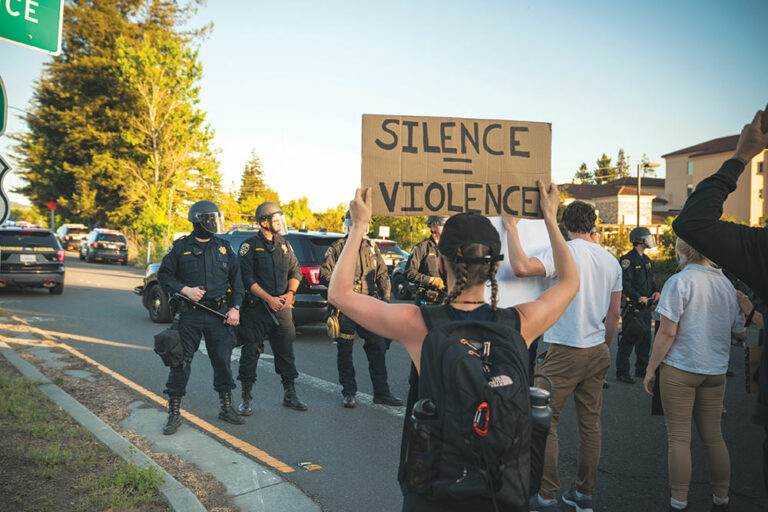
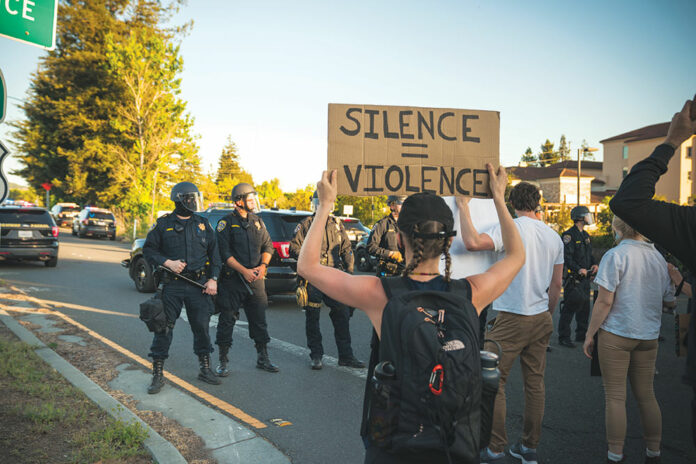
A 40-page report published by a Sonoma County commission this week offers the most comprehensive account so far of how police handled local racial justice protests in May and June.
At a meeting Friday, July 10, the Sonoma County Commission on Human Rights voted to publish and distribute a report titled “Human Right Violations in Santa Rosa California – Policing the Black Lives Matter Protests.”
In addition to detailing numerous alleged human rights violations by law enforcement officials during the recent protests, the report summarizes several high-profile police-involved deaths and other incidents dating back to the 2000 publication of a U.S. Commission on Civil Rights report titled “Community Concerns About Law Enforcement in Sonoma County.”
All together, the Human Rights report describes the protests as the latest chapter in a decades-long history of distrust between residents—particularly people of color—and local law enforcement agencies.
“We felt it was really important to place these Black Lives Matter protests within the context of the history of white supremacy and racism in the county as well as the strained relationship between law enforcement and BIPOC (Black, Indigenous, and people of color) communities,” D’mitra Smith, the chair of the commission, said in an interview.
“When there’s a narrative of not really wanting to dig into that, you’ll see things posed in a kind of ‘Wow…where did these protests come from in idyllic Wine Country?,’” Smith added. “We felt that it was an opportunity to really talk about this stuff in a comprehensive way, because ever since I’ve been on the Commission (since 2012), we’ve been receiving reports of racist actions and assaults by police.”
The Human Rights report was prepared after the Commission hosted a June 19 meeting in which protesters described their experiences—some of which are detailed in the report—to local officials, including Santa Rosa Mayor Tom Schwedhelm, Police Chief Ray Navarro and Sonoma County supervisors Susan Gorin and Lynda Hopkins.
The commission, which had a $12,000 budget this year, is tasked with “Creating awareness of human rights issues faced by members of our community”; “Advocating for policy changes necessary to better protect human rights”; and “bringing attention to human rights issues of concern to County residents,” according to the Commission’s mission statement.
In line with the Commission’s mission, the report amplifies protesters’s demands, including having the city hire an “individual of impeccable and publicly recognized independence and integrity” to complete an independent review of the police department’s use of force policies, use of military-grade weaponry on residents and the human rights abuses described in the report.
The protesters also demand that police stop using tear gas, rubber bullets, grenades and other projectiles on residents, especially during peaceful protests. They also demand that SRPD discipline officers for the behavior detailed in the report, “with a minimum standard of termination of employment.” Lastly, the protesters demand that SRPD stop using kettling, a crowd control technique which involves compressing marchers into smaller and smaller spaces, which can lead an otherwise-peaceful protest to turn confrontational.
In a statement about the report released Tuesday afternoon, Navarro, the police chief, highlighted the city’s actions so far, including beginning work on a “Community Empowerment Strategy,” establishing a city council subcommittee, and banning the use of the Carotid restraint, days after Gov. Gavin Newsom announced that he would remove the controversial neck restraint from the state law enforcement training manual.
“We take allegations of violence against protestors and/or misconduct very seriously and investigations related to filed complaints are underway,” Navarro stated, before adding that the city is in the “final selection process” of hiring a contractor to complete an After Action Report (AAR).
A review of the city’s Request For Proposals, a document used to hire an outside contractor, indicates that the scope of the AAR will be limited to the first week of protests—May 30 through June 5—and be subject to edits by Police Department and city staff prior to presentation to the City Council.
Additionally, the RFP states that although the SRPD “received mutual aid from several Sonoma County agencies and the CHP (during the timeframe covered by the report). This AAR should remain focused explicitly on the Santa Rosa Police Department’s planning and response to the events.”
Proposals for the RFP were due on June 30 and the city expects to select a contractor in July, according to an estimated timeline included in the RFP.
[UPDATE: The Sonoma County Commission on Human Rights has released a statement in response to Chief Navarro’s July 14 statement.]
Historical Matters
The timeline laid out in the Human Rights report begins in 2000 when the Citizens Advisory Committee to the U.S. The Commission on Civil Rights published a report outlining community concerns about local law enforcement agencies’ practice.
“At a September 24, 1997, meeting in Santa Rosa with Commission staff, community spokespersons detailed their frustration with officers who, they allege, view deadly force as the only alternative; questioned the methods of investigation of shootings; noted their lack of confidence in the system; alleged the district attorney allowed the department whose officer perpetrated the shooting to investigate; suggested that officers are not trained to deal with mentally impaired individuals; alleged the departments try to ‘criminalize’ their victims and marginalize their critics; generally noted that the police departments and county sheriff have poor communications with the communities they serve; and alleged the police are not accountable to anyone,” the 2000 Human Rights report states.
According to the Human Rights report—and the concerns local protesters have raised during recent protests—little has changed in the past two decades.
High profile cases over the past 20 years described in the Human Rights report include the 2007 killing of Jeremiah Chass, a 16-year-old Black youth, in Sebastopol; the 2013 shooting of Andy Lopez; a 2015 lawsuit against the county over the Sheriff’s “yard counseling” policy; the 2017 killing of Branch Wroth in Rohnert Park; and, most recently, the killing of David Ward on the morning of Nov. 27, 2019. According to a count cited in the Human Rights report, Sonoma County law enforcement officers have been involved in the deaths of 91 people since 2000.
Despite the continuation of high-profile deaths involving local agencies, the law enforcement agencies named in the 2000 Civil Rights report—Santa Rosa, Rohnert Park and the Sonoma County Sheriff’s Office—have not fulfilled one of the report’s central recommendations: creating civilian review boards, the Human Rights report states.
Instead, in the years after the 2013 killing of Andy Lopez and associated protests, the county created the Independent Office of Law Enforcement Review and Outreach (IOLERO), an independent office with limited powers to review internal investigations by the Sonoma County Sheriff’s Office.
In 2016, Santa Rosa hired an attorney to review the Police Department’s policies and internal investigations but, in late 2018, after a public disagreement with the City Council, the city declined to renew the attorney’s contract. So far, the city has not hired a new auditor.
On top of the high-profile cases, the report cites decades-long community concerns about racist policing grounded in the region’s Confederate roots.
“This Commission has received numerous reports that law enforcement agencies regularly engage in arbitrary stops and questioning of BIPOC (Black, Indigenous, and People of Color) residents, and that racial profiling is understood to have been the standard procedure of all (Law Enforcement Agencies) in Sonoma County for generations,” the report states.
The report also describes similar community reports of white supremacist behavior by law enforcement, which “is believed by many to correlate to the deep historical relationship to the Confederacy that exists in Sonoma County,” as recorded in newspaper archives, oral histories and apparent today in the ongoing use of Confederate flags.
Protest Accounts
The report goes on to detail law enforcement agencies’ response to local protests over the past six weeks, including several protesters injured by law enforcement’s “less-lethal” weapons and the June 2 mass arrest of over 100 protesters during Santa Rosa’s short-lived curfew order.
In addition to the agencies’ actions during protests, the report also raises concerns about statements by local officials—including the District Attorney and Santa Rosa Police Department—which protesters believe suggest that local law enforcement hold a bias against protesters.
“The lack of adequate investigation of… incidents (involving protesters), combined with the violent policing tactics used by SRPD against peaceful protesters, has created an environment of extreme distrust among community members, who believe SRPD has displayed an institutional bias against peaceful protest of police violence, and in favor of those who would harm protesters,” the report states.
Some of the cases which have caused distrust between law enforcement and protesters involve motorists threatening protesters with their vehicles. The Human Rights report lists eight instances of possible vehicular assault reported by protesters, beginning on May 30 when a red truck drove through a protest in downtown Santa Rosa. So far, local law enforcement have only made an arrest in the May 30 incident, according to the report.
The most recent high-profile case happened during an evening march in Santa Rosa on June 20, when multiple protesters filmed a white Porsche SUV directly towards the crowd. The driver, ignoring protesters’ pleas to slow down and drive around the march, accelerated into the crowd instead. When a protester stopped her car, she called the police to report that a protester had punched her.
In a press release the next day, the SRPD published an account of the incident slanted in favor of the driver.
Nearly a month later, despite several videos of the incident and dozens of accounts by protesters, it remains unclear whether the police investigated the protesters or the driver. The Sonoma County District Attorney’s office began reviewing the case on July 7.
The 40-page report includes more stories than we can fit in the newspaper this week. The full report is available below.
Federal agents in Portland, Oregon, essentially kidnapped American citizens using unmarked vans and wearing camouflage. Shades of Chile under Pinochet.
Had those people fought back they might have been badly hurt or killed. White supremacists could do the same thing. That’s why it’s essential that police are identifiable and must have reasonable cause. This is clearly unconstitutional and, I would...
We are still in the dark regarding the implications (of the fact) that the greatest machine known has more than 10 million endocannabinoid receptor cells within and on the surface of the human body that are specific to absorb the healing molecules of marijuana. (“Wanting MORE,” Rolling Papers, July 15).
The main effect is to ameliorate irritation and inflammation including...
In times of crisis, some Westerners are fond of saying that “crisis,” when written in Chinese, consists of the characters for “danger” and “opportunity.” This is an interesting, even optimistic notion, that also happens to be wrong. It’s the kind of aphoristic observation that culty CEOs like making when they go “full guru” in front of their minions. Danger...
“Drive!” Kevin McEachern tells his team. The delivery manager at the Sonoma Patient Group (SPG), the oldest and longest-operating cannabis dispensary in the county, McEachern has his hands full during the pandemic. More folks of all ages, including senior citizens at Oakmont, want more weed delivered to their doorsteps than ever before. The demographics have definitely changed big time.
On...
With a musical resume a mile-long, Narada Michael Walden is one of the most prolific and popular musicians, composers and producers working in the worlds of jazz, soul and world music.
Best known for producing platinum-selling songs for iconic singers like Aretha Franklin and Mariah Carey, Walden is also an accomplished drummer who just recently joined legendary rock band Journey...
By Luca Evans and Will Carruthers
Much like at one’s favorite bar or diner, patrons often have a long-standing relationship with their hair stylist or barber, making the recent health-order-mandated business closures difficult for patrons along with workers and business owners.
Unsurprisingly, hair salons and beauty parlors are just a few of the many businesses that have been impacted by Covid-19...
As scenic as it is challenging, the Dipsea Race in Marin County—first run in 1905—is the oldest trail race in America and one of the most popular events of the summer, inviting runners to take on a grueling and gorgeous seven-and-a-half-mile course spanning Mill Valley to Stinson Beach.
The Dipsea Race is regularly run every year on the second Sunday...
If you want to watch the stars, there’s no better place on Earth to do so than the massive Gemini Observatory telescopes located in Chile and Hawaii. The two optical telescopes are among the largest in the world, each measuring more than 26 feet in diameter, and collectively, the system can access nearly the entire Northern and Southern range...
Over the course of a decade, Petaluma’s Rivertown Revival—dubbed the Greatest Slough on Earth—has become one of the North Bay’s most beloved annual summer events.
The planned 11th annual Rivertown Revival was originally scheduled to happen this summer on Saturday, July 18, on the Petaluma River to benefit the conservation and education organization Friends of the Petaluma River. But Covid-19...
A 40-page report published by a Sonoma County commission this week offers the most comprehensive account so far of how police handled local racial justice protests in May and June.
At a meeting Friday, July 10, the Sonoma County Commission on Human Rights voted to publish and distribute a report titled “Human Right Violations in Santa Rosa California - Policing...