Covid Travel: My Pandemic Road Trip

0

Fear and loathing in the age of quarantine

Life during Covid is introverted and boring. So am I, for that matter. But even I need to get the hell out of Dodge once or twice a year or I start to go bonkers. Unfortunately, 2020 made that quite difficult. While I whiled away the shutdown for most of last year, I quietly prayed for an escape.

So when I spoke to my sister in late November and out of the blue she asked, “When are you coming up for Christmas?” I thought for a moment and replied, “Yes.”

She lives on Vashon, a hippie island north of Tacoma, Washington. It’s 800 miles away. 

Because she’s preggers and nursing a 17-month-old rug rat, she set very strict rules for my visit. She required me to quarantine for two weeks prior to leaving and to get Covid tested four days before leaving. My truck is old so I needed to rent a car for the journey—she ordered me to spray disinfectant in the rental and air it out before getting in. Furthermore, she forbade from riding in someone else’s car to pick it up, from using public bathrooms on the drive north and from entering any buildings whatsoever—other than my house—for the duration of quarantine.

I’m not high maintenance; I’m Gen X. My idea of vacation under the best of circumstances is dressing in Mad Max costumery and parading around the Painted Desert with my friends Ghost Line and Yeti in dune buggies in the blistering sun for a week at a time.

So my only real concern was, could I drive 800 miles without going No. 2? And if not, what would I do?

Because there’s a way. There’s ALWAYS, usually, a lot of the time, a way. After all, I survived my childhood.

So, I did due diligence. Starting on Dec. 9 I went into quarantine, in anticipation of leaving on Dec. 23. It wasn’t difficult; like I said, I’m an introvert. Besides, frightening stories of spiking Covid cases filled the news. Winter might kill us all. What more motivation could I have to stay safe? Yes, I missed going to Retrograde Coffee Roasters and then walking Sebastopol’s back alleys in the mornings. Instead, I made my own drip coffee and took walks down the local back country roads. I also ate a whole lot of home-cooked food, worked on my ETSY store and read a lot for two weeks. If nothing else, I saved money.

The day before I was scheduled to leave, I borrowed my neighbor’s electric bike and rode the 12 miles to Enterprise Rent-A-Car in 40 minutes without pedaling once. Then I fumigated my new Nissan pickup truck, aired it out, drove it home, placed two gravel-filled sandbags in the bed and loaded it with a folding shovel, tire chains, a case of water and a zero-degree sleeping bag. Because one never knows what weather Southern Oregon will present this time of year. I then loaded my clothing, books and food, and went to bed at 9pm.

I hit the road at 4:45am, after saying goodbye to my cat. I was very un-stressed—I relished the opportunity to get away, anywhere, for any amount of time. Is 800 miles a long drive if a person has absolutely nothing better to do and also gets to see their delightful little sister and her sweet family? I think not.

The first couple of hours were blissful. I made good time in the predawn darkness, driving Route 116 to Route 37 to Interstate 80 to Interstate 505.

Dawn loomed as I drove north up I-5. The Central Valley is, in many ways, a blank space. It lacks visual appeal. The small farm towns are quietly forgettable, as is the straight-line interstate. But I can, and do, find beauty in most things. Barns, old sheds, feral cats in roadside fields, rice paddies—all were a breath of fresh air.

Mount Shasta appeared in the distance, white-capped and majestic. The mountains north of Redding brought welcome relief to the monotonous driving. Up I drove, crossing Lake Shasta and passing the tiny river town of Dunsmuir.

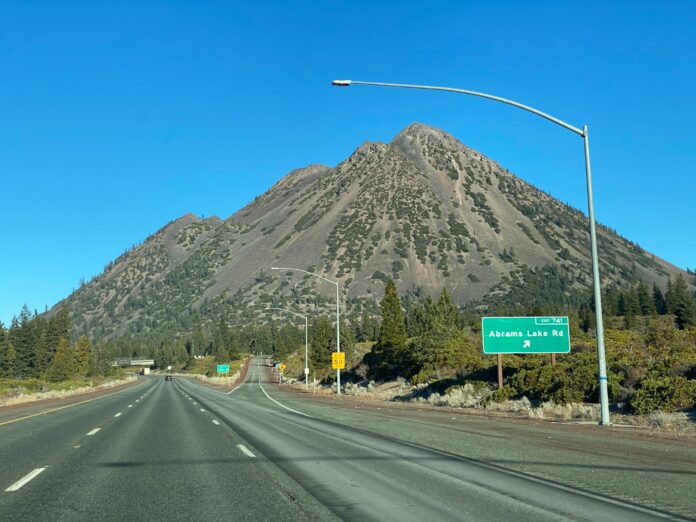
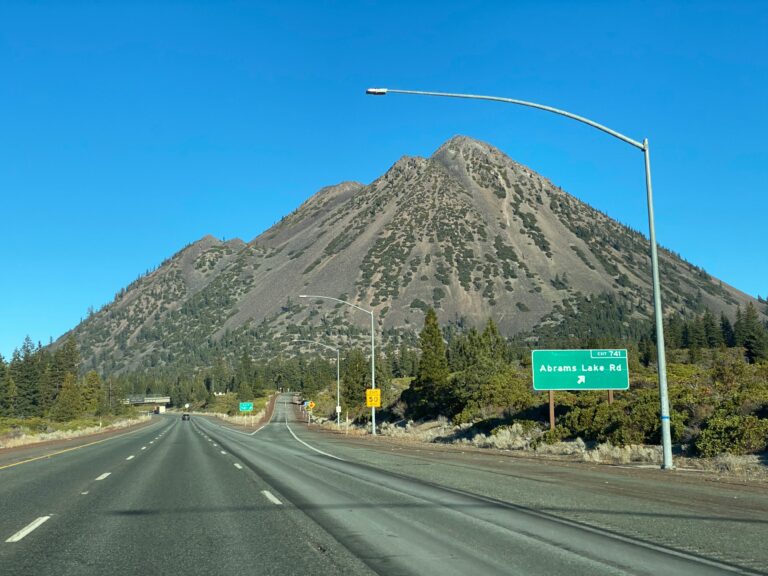
Mount Shasta loomed ever larger. There is a much smaller, cone-shaped mountain next to it, along I-5. It’s called Black Butte, and it reaches a paltry height of 6,325 feet, in comparison to Mount Shasta’s own 14,820-foot peak. My sister tells me that for many years she mistook Black Butte for Mount Shasta, quietly wondering what all the fuss was about. Knowing her story, I, too, quietly pondered the volcano-shaped dirt pile as I drove by it.

Passing the tiny town of Weed, north of both mountains, I was reminded of a young man I met 20 years ago. He drove from Los Angeles to Weed on a moped, taking Route 1 as far as possible. Turned out we were both signed up for the same week-long primitive skills class at Headwaters Outdoor School on the outskirts of town. He wanted to learn some survival skills before he hit Southern Oregon to hunt for Sasquatch. While his name is now lost in the dustbin of history, I remember that, sadly, he didn’t encounter any cryptids in remote Oregon.

I didn’t believe in Sasquatch back when I met the Sasquatch Hunter from L.A. My conversion happened quite recently, after I read a book about cryptids and stumbled upon the only rational explanation for countless Bigfoot sightings coupled with a total lack of any physical evidence besides possible footprints: they are interdimensional beings. Yes, I believe in wearing masks AND in Bigfoot. Chew on that, America.

My favorite stretch of I-5 is the high-desert range surrounding Yreka. There is something about that stretch that makes me very happy. The golden fields stretch off through rolling hills to the forested horizon, filling me with a sense of freedom. I can only think of potential as I traverse that length of highway. Beauty stretches from horizon to horizon. Then, Oregon.

My afternoon sojourn up I-5 past Ashland solidified my newfound belief in Sasquatch. The dense green forests pressed against the highway from each side. It’s only fitting that hairy monsters should inhabit woods this cold, this deep, this impenetrable, I mused. On a less oppressive note, there was no weather to speak of, and my paranoid snow preparations—chains, water, shovel, etc.—proved unnecessary.

During this whole time I ate modestly—a hard boiled egg, some cheese, some chocolate. My decision to ration water to one hefty sip every half hour proved an intelligent way to stay hydrated while avoiding the need to pee. But eventually I had to pull over at a rest stop, where I relieved myself in an olive orchard far from the madding parking lot.

The rest of the drive north was pleasantly forgettable. Portland traffic was heavy and slowed me down. I eventually hit up another rest stop, where I peed in a quiet patch of forest.

No. 2 never happened; whether through sheer willpower, coincidence or some kind of generational Gen-X magic, I’ll never know.

I met my sister and her family in downtown Olympia at 6pm, about the same time I began to lose cognitive abilities. Somehow we ate tacos at a Jack-In-the-Box drive-thru, caught the ferry at Point Defiance in Tacoma, and arrived at her house on Vashon at 7:45pm. All in all, 15 hours behind the wheel. A beer and two incoherent whiskeys later, I fell asleep.

I awoke feeling hungover and stayed that way all day. My nephew had grown exponentially since I’d last seen him—no longer a rug-rafting squirmer, he now walked. I took one look at his tiny, adorable toddler form and immediately nicknamed him Pumpkin Eater.

Life settled into a peaceful routine. We went for drives on the island. The many treehouses, yurts, tiny homes and small farms appealed to my West County sensibilities. Back roads wound through forests and along hillsides, past abandoned greenhouses, a cidery and a cattle farm. Some roads turned to dirt. Some ended in clusters of vacation cottages.

We played Monopoly. We worked on a 1,000-piece puzzle. We watched movies.

I received daily cat reports from my cat sitter. Kitty missed me, he didn’t miss me, he played hard-to-get, he decided to be friendly, he was angry at me, he would never forgive me.

We went on walks, winding through redwood groves on country lanes. Some of the houses were clearly inhabited, while some were vacation cabins. Some were abandoned. We walked on the local beaches.

We day-tripped to Seattle. The ferry is always invigorating. Georgetown, Fremont, Ballard, Gasworks Park, the Cut—we hit upon my favorite parts of town.

At night I lay on my bed on the couch and listened to the rain drum down and relished the coziness of it all.

In the background, on the news, the UK viral mutation was identified and began to spread. Covid cases continued to spike throughout the United States. We continued to use caution whenever in public, always wearing masks, always wiping down any purchased items, including food wrappers. My most recent Covid test came back negative. We were all in good health.

I’d brought a box of hemp joints, and one day my brother-in-law and I camped ourselves on an old concrete piling at the beach and lit up. They were harsh smokes, but not as harsh as 2020. If only we could collectively cough the whole year away.

I am an adept dishwasher, but my brother-in-law is a better cook. He served eggs every morning, but dinners were best. We ate spaghetti carbonara, with out-of-this-world bacon—the kind that smells so good, even uncooked, that you drool. His Brussels sprouts were exquisite. On Christmas day he cooked up buttermilk-marinated chicken … it was to die for.

It was the first Christmas my sister and I had ever spent away from the rest of our family, and our first Christmas since our father died. It was much better than spending it alone. We opened presents in the morning and watched Pumpkin Eater have the time of his little life. The taco blanket I gave him went over well. We skyped other family members later in the day.

Only the thought of my kitty cat back home kept me from staying indefinitely. As it was, I postponed my return trip not once, but twice. Vacation stretched from seven to 10 days.

I watched my sister interact with Pumpkin Eater and felt very happy for the sweet little guy. And I came to understand the importance of the boob. It is the panacea for all things. One evening I mused that sentiment aloud and she replied, “He just sucked on it for 40 minutes. There’s nothing left.”

She was exhausted, three months pregnant in addition to being a first-time mom. Morning sickness and motherhood were a full-time job.

I could only hope that my presence made life for her family easier, for the few days I was there. It was the best Covid break I could have asked for. In times like these, the warmth of family and friends is what keeps us going. It’s the most important thing. Yes, Gen X-ing the pandemic is probably easier than Millennialing or Gen Z-ing or Boomering it, given that we X-ers tend to sit things out without asking for much. But the truth is, it’s hard on us, too, damn it. 

And then, abruptly, it was time to leave. I caught the 6:20am ferry off of Vashon on New Year’s Day, making excellent time on the near-empty interstate.

The drive home is always easier, especially if you’re headed south. Why? It’s easier to fall down the side of the earth than to climb up it. This is a scientific fact. The car moves so much faster. So what if I had to use the brakes more? It was a rental, and the mileage was great.

It rained in Oregon, but again, no snow. Again, I ate and drank frugally. I didn’t have to be quite as careful on this trip, I only had a kitty—a precious kitty, yes, but a kitty nonetheless—waiting at the end of the line. I allowed myself the use of public bathrooms. Again, No. 2 never happened. I’m going to bravely assert it was, in fact, due to Gen X generational magic.

I arrived home in Sebastopol at 8pm, 14 hours hours after I started the car. Kitty appeared to have no idea who I was, but also warmly snuggled me like never before. We slept all the next day, curled together, both of us purring like mad, and then I sat down to write, and here I sit now.

So, was driving 800 miles in one day each way to see my sister and her family during the pandemic lockdown worth it? Absolutely. In fact, I recommend it to anyone who feels up to the challenge. Do it, but play it safe. Be paranoid. Plan for snow if you head through snow country. WEAR YOUR MASK. Bring hand sanitizer and wipes, and use them. Bring drinks and snacks; don’t expose yourself unnecessarily on any level. Don’t go to restaurants, don’t go to a hotel. It’s not worth it. Wherever you stop, be it a gas station or a rest stop, you are sure to encounter someone not wearing a mask. 

But more importantly, wait til you’ve been cooped up for at least nine months before going on your car trip. Stretch that bowstring way, way back before letting it fly. Because the sheer joy of being on the road will carry you halfway to your destination. And for God’s sake, don’t make the journey by yourself—bring your significant other or your best friend or even a perfect stranger for that matter, split the driving, catch up with each other and relish your time together. Unless, of course, you’re a Gen Xer.

Mark Fernquest lives and writes in West County. A Mad Max fan from way back, he spends his free time roaming the wasteland at post-apocalyptic desert festivals. He also travels, gardens and runs an eclectic ETSY store at www.etsy.com/shop/GasTownWest. He loves all things mysterious.
Novato Homeless Activists Push for 9.2-acre Land Trust

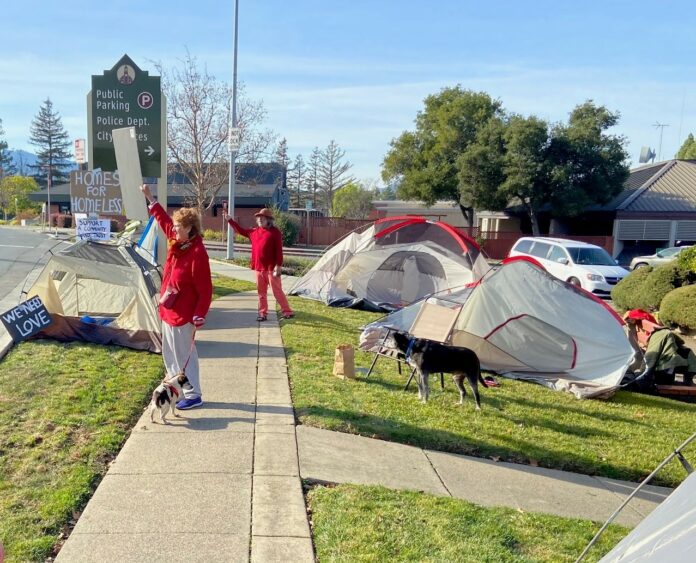
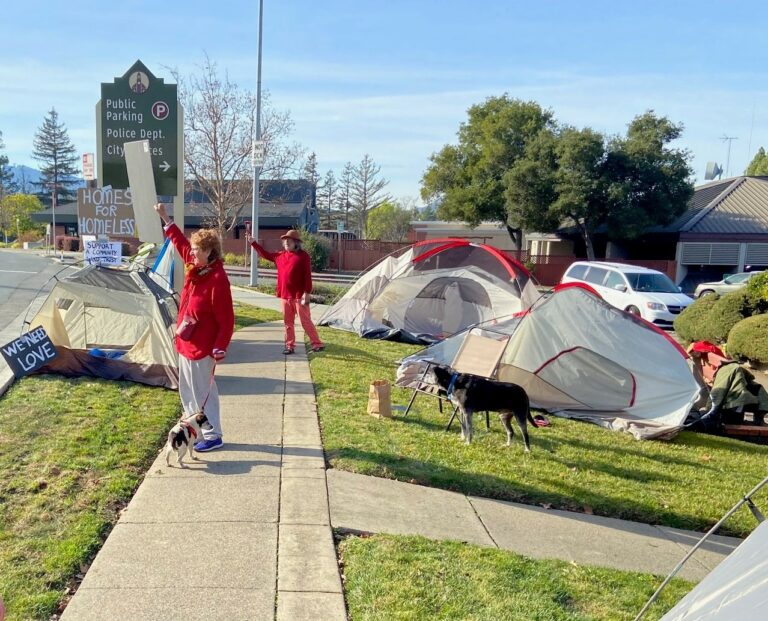
As cars drove by Novato City Hall on Jan. 11, horns blared in support of the homeless people demonstrating in front of the municipal building. The protestors, who live at two tent encampments in Novato, objected to the dearth of housing for Marin’s homeless.

Marin County’s Homeless Coordinated Entry System allocates beds by prioritizing the most vulnerable people and veterans. However, due to the county’s shelter and housing shortage, a single adult in Marin experiencing homelessness who isn’t a veteran and doesn’t have serious health issues may wait indefinitely for temporary shelter, let alone permanent housing.

“Prior to the Coordinated Entry System, resources went to the luckiest people,” said Carrie Sager, a homelessness program coordinator with Marin Health and Human Services (Marin HHS). “The vulnerable weren’t getting the resources they needed. Now, it’s a federal requirement to assess people and prioritize based on objectives.”

Apparently, a handicapped 58-year-old homeless man wasn’t vulnerable enough to make the cut. A county caseworker dropped him off recently at the encampment in Novato’s Lee Gerner Park, where about 20 people live in tents. Other park residents provided him with a tent and a sleeping bag, as he lacked provisions of his own.

“We do not have a standard procedure of dropping clients at homeless encampments,” said Connie Moreno-Peraza, a division director with Marin HHS. “Each of these decisions are made with the client on a case-by-case basis.”

The data reflects the disparity in the number of people experiencing homelessness versus the number of beds available in the county. The picture is bleak.

During the 2019 Point-in-Time Count, a biennial estimate of local homeless populations, Marin County tallied a total of 1,034 individuals.

Sixty-eight percent of Marin’s homeless population remains unsheltered, according to a 2019 Marin HHS survey of homeless individuals. In typical times, that meant more than 700 people were left out in the cold. Unfortunately, with the pandemic raging, even fewer beds are available due to the necessary social-distancing measures.

“I will acknowledge we don’t have enough services and housing for everyone,” said Ashley Hart McIntyre, a homelessness policy analyst with Marin HHS. “There are not enough housing resources. I hear the frustration of those who badly need assistance.”

A small group of activists believe they have a partial solution to the county’s problem: establish a land trust and build a shared equity housing cooperative for up to 200 people on a 9.2-acre property located at 201 Sunset Dr. in Hamilton. They want to buy the city-owned land and use tiny homes to serve as temporary housing. Eventually, the historic Bachelor Officers’ Quarters would be renovated, and new buildings constructed, to provide permanent housing.

Activists Jackie Cutler, 56, Jason Sarris, 51, and Robbie Powelson, 26, all experiencing homelessness, say they are working with community groups to make their plan a reality. The trio, along with a few other unhoused individuals, began a tent and vehicle encampment on Dec. 18, at the very site they covet.

Then the City of Novato stepped in to curtail their activities.

On Dec. 22, city employees erected chain link fencing around the property and posted tow away signs, making it impossible for vehicles to continue parking on the property. According to Novato City Manager Adam McGill, the fencing is necessary to limit growth of the camp, because occupants were inviting people with vehicles from as far away as Santa Rosa to join them.

To emphasize the point, the city also served a 72-hour eviction notice to the occupants of Sunset Drive, which demanded they vacate the premises by Christmas Day. McGill says they have not yet enforced the eviction, as the city is still assessing its legal options.

Though overnight camping is illegal in Novato, the city’s hands may be tied. In Martin v. Boise, the United States Court of Appeals for the 9th Circuit affirmed that people cannot be punished for sleeping outside on public property when a city cannot offer them an alternative shelter option. 

The situation is further complicated by the city’s intention to put the Sunset Drive property on the market.

“That property has been in the process of being put up for sale for the last few months,” McGill said. “The preparations are nearly complete and it will soon be offered for sale. The city has an obligation to protect the property’s value, so that the residents of Novato have the greatest benefit upon sale of the property.” 

Not only does the City of Novato want the occupants off the Sunset Drive property, some Novato residents also don’t appreciate their presence. Social media posts lambast the campers and at least one vandal has destroyed their property on several occasions.

“Community backlash has been really bad,” Sarris said.

That’s putting it mildly. On Dec. 23, a tire on Cutler’s van was slashed. Tents were slashed on Christmas Eve. Five days later, Powelson was followed to his father’s home in Novato and his tire was slashed. Tents were again sliced on Jan. 30. Adding insult to injury, the vandal also sprayed a skunk-like scent inside the tents.

The campers installed a hidden surveillance camera to catch the culprit in action and they captured video of a masked man slashing tents on Jan. 3. Although the police received the video footage and issued a public notification, the man has yet to be identified.

Still, the activists are undeterred by the actions of the city and disgruntled members of the community. They continue with plans to purchase the property. In fact, they have attempted to communicate with McGill about their project, but so far, he has declined to speak with them.

“The property is valued at nearly $8 million,” McGill said. “If the sender of those emails can demonstrate, like any buyer would have to, that they have the financial means to purchase the property, then the city will meet with that potential buyer. Meeting with those clearly not capable of purchasing the property is not a productive use of my time.”

The activists maintain money is available to help them purchase the property. They say the federal government is putting more money into community housing and their group is building robust support from community groups.

“This has been done before,” Powelson said. “People in Oakland occupied a house and continued the occupation through eviction. Ultimately, they purchased the property.” 

With the Sunset Drive property going on the market in the near future, the clock is ticking for the activists to raise the necessary funds. Whether they succeed or not, it’s clear that the county must step up its game to care for our residents experiencing homelessness.

“Housing people in Marin one at a time isn’t going to cut it,” Sarris said. “A thousand people are homeless right now.”

Adam Traum Embraces His ‘Legacy’ on New Record

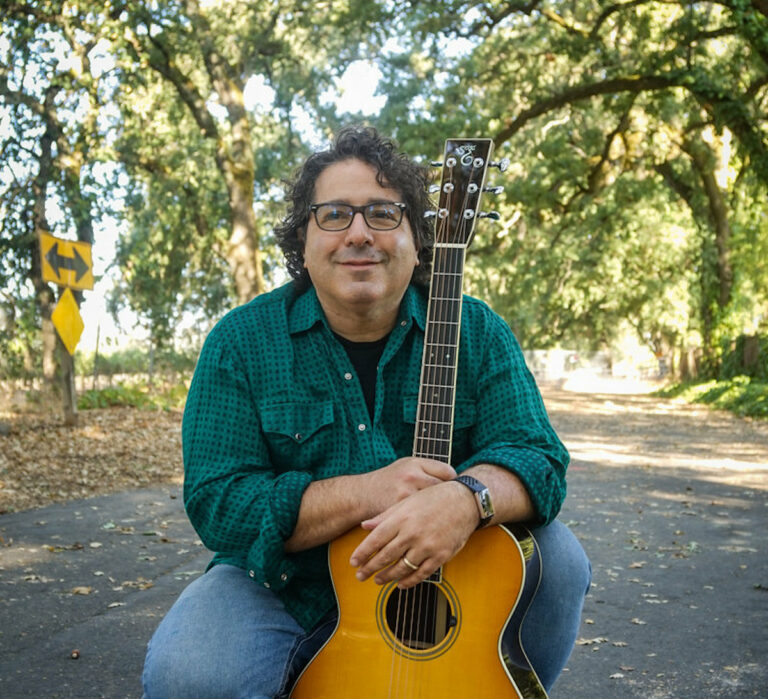
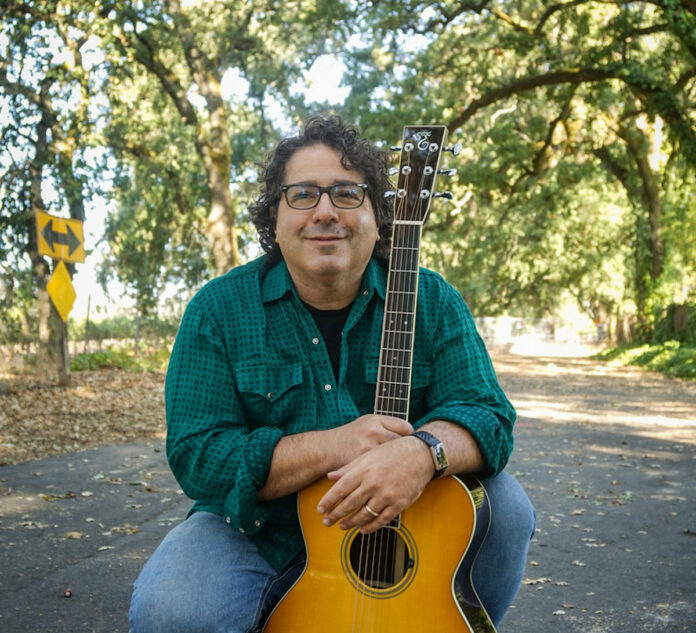
Many musicians grew up in a house of song, but North Bay–based guitarist and singer-songwriter Adam Traum still creates music with his father, Happy Traum.

Happy became a figure in the Greenwich Village scene of the ’50s and ’60s, performed with his brother Artie Traum in a popular duo and lived in Woodstock, New York, when Adam was growing up.

“It was an exciting time to be coming of age, there were iconic musicians and visual artists coming around the house, and I was the kid taking it all in,” Adam Traum says.

The younger Traum began playing guitar at age nine with a steady diet of folk and blues in the house. As a teen, he dove deep into rock ’n’ roll and studied jazz guitar. In his 20s, Traum began seriously studying the acoustic guitar after attending MerleFest, a roots-based music festival located in North Carolina’s Blue Ridge Mountains.

Now, all those styles of sound come together on Traum’s new album, Legacy.

Available online and on CD, the record is Traum’s most personal output to date, and the 13 tracks all tell stories from his own life and celebrate his family’s musical traditions.

The album’s production began in February of last year, when Happy visited Adam in Sonoma County, where Adam has lived since 2003.

Happy appears on two songs on Legacy, including the album’s title track, in which Adam lyrically recalls musical memories from his childhood.

The father-son pair has performed together onstage and on record before, though Traum says this album’s collaboration is especially meaningful due to the personal material.

“Some guys play catch with their dad, we play guitar,” Traum says. “I feel totally honored and proud to be following in that family tradition, but also, just getting to connect with my dad at that level has strengthened our relationship.”

Other tracks on Legacy demonstrate what Traum calls his musical ADD, with washboards and mandolins that evoke Appalachian music, telecaster guitars that lend classic country-rock vibes and pedal steel guitars that build Southern Blues foundations.

Legacy also tells stories about Traum’s late uncle Artie Traum (“Thanks For Stopping By”), his family’s struggles through the last year of pandemics and wildfires (“Ash on the Windshield”) and his wishes to pass along his love of music to his own teenager.

“This record was also as much about my sanity as anything else,” Traum says. “It allowed me to express myself and it was a chance for me to explore and stretch and see what I could do.”

“Legacy” is available at Adamtraumguitar.com.

Top Torn Tickets of 2020

’Tis the time for critics of all ilks to release their “end of year” lists. For almost 20 years, this publication has presented a “Top Torn Tickets” list featuring the year’s best North Bay theatrical productions. 

Those years, however, had the advantage of having an entire calendar year’s worth of shows to consider. With the pandemic-necessitated shut-downs and closures initiated in mid-March, there were but a fraction of shows produced live in 2020 upon which to look back.

But look back I did, and I want to give the fine work of local theater artists their due. Adhering to the belief that that it’s “quality, not quantity”, here—in alphabetical order—is my truncated list of the best and/or most interesting stage work done in the North Bay in the past year:

Enchanted April–Sonoma Arts Live  The North Bay is gifted with many fine theatrical designers, but it’s rare for a stage design to receive its own applause. Such was the case when the curtain opened on ACT II of this production to reveal Carl Jordan’s breathtaking scenic and lighting design for an Italian villa. Bravo!

Five Course Love–Lucky Penny Productions  Short, sweet and incredibly silly, this is the kind of show we are all going to desperately need when we’re past this current mess.

Ghosts of Bogotá–Alter Theater  Ghosts haunted a vacant San Rafael storefront in this very interesting production that was both gut-busting and gut-wrenching.

Mary’s Wedding–Main Stage West  This incredibly effective, dream-like piece was part memory play, part fantasy and part Ken Burns PBS documentary-influenced World War I drama.

Ripcord–Cinnabar Theater  A terrific cast brought the funny to this look at a couple of mis-matched Senior Center roommates.  

Silent Sky–Ross Valley Players  This well-mounted production of Lauren Gunderson’s look at America’s first female astronomers was a healthy reminder that there was a time in this country when the pursuit of truth through science was something to be respected.

The Wolves–Raven Players  Whenever this company goes “outside the box” (and converts their cavernous theater into a black box), they do really interesting work. A fine, young ensemble brought the sting of accuracy to the conversations among the members of a girls’ soccer team.

With no “opening” date for theaters in sight, many local companies have turned to streaming while others just continue to hold their breath. Here’s to 2021 giving us all the chance to gather safely and breathe again.

Open Mic: Googling the Truth

By Cliff Zyskowski

Recalling a recent headline from The Washington Post, “Armed protesters alleging voter fraud surrounded the home of Michigan’s Secretary of State.” Jocelyn Benson is Michigan’s chief election officer and as secretary of state, in charge of certifying Michigan’s presidential election. 

According to the latest count, Biden won the state by more than 154,000 votes. Am I missing something? Wait, let me check … is the Post a credible news source? Fox news says they have a left-wing liberal bias and are not to be trusted to tell the truth.

So I check out the YouTube video portraying about 25 rabid protesters terrorizing her family’s home shouting “Stop the Steal” and one distinct voice yelling into a megaphone, “You’re Murderers.” Now I question whether I can trust this video to be accurate. Will Sean Hannity claim that this video was produced by out-of-work actors from a Socialist group of whack-jobs residing in Hollywood? Perhaps they staged the protest in order to draw sympathy for the Secretary of State as she’s “decided to completely ignore all the credible fraudulent evidence that has been continually pointed out since the election.”

A Google search for such evidence. Google is unbiased, right? Every state election official has gone on record claiming that steps were taken to ensure that this election was the most accurate and valid vote count in the history of all presidential elections. But Google knows my political bias leans to the left. Their data rubric and my past history of search results dictates that they only bring up search results that feed into my set belief system and comply with what I want to hear. Their data shows that a happy searcher buys more products and selects more click-bait.

Does the truth to this story lie hidden between WikiLeaks files and Hillary’s email server?

To be called “Murderers” while sipping hot chocolate watching a Christmas movie with her 11-year-old son. I’m going to protest outside these truth murderers’ homes, holsters armed with hand sanitizers, chanting “Om” 24/7 till the truth rises up, and the Christmas star shines our path forward to 2021.

Cliff Zyskowski is a Chicago native transplanted to Sonoma via the blue highways circa 1978. He’s a retired psychiatric technician, Napa Valley College Professor Emeritus and part-time howling-at-the moon practitioner.
This essay was written before the Capitol Riots on Jan. 6. To have your topical essay of 350 words considered for publication, write to us at op*****@********un.com.

Letters to the Editor: Forests on Fire

This is a plea, to the Sonoma County Board of Supervisors and Dept. of Forestry, from a tax-paying citizen who has now raised 3 tax-paying citizens in this county: please stop treating our forests with fuel. Please stop burning them and cutting them down.

As a lifetime citizen here, those forests are as much mine as they are yours. We have coexisted my entire lifetime, and I feel them calling to me, screaming for help. We have an agreement. We keep each other alive. So, please, stop. I know what those beautiful hills used to look like. Water used to flow through here. I used to swim in Mark West Creek. What have you done to our beautiful landscapes, and who on earth do you think you are to sell it? As if it was yours. Just like the water. While you create a pricing index for our every flaw, to further gauge us. Everyone has lost sight of what we truly value. What nurtures us. What sustains us. 

Every closure in Sonoma County you will find under the title of quality of life on the Santa Rosa city webpage. So don’t you think for a second I don’t know that you are fully aware of what it is you take from us daily, over time. We have become that boiling frog. Sonoma County are you going to continue to be boiled to death? When are we going to jump out of the pot?

Danielle Divine

Santa Rosa

Write to us at le*****@********un.com.

Green Music Center Announces Virtual Season of Shows

The Green Music Center–Sonoma State University’s live music venue and educational complex made up of Weill Hall, Schroeder Hall and more–is accustomed to packing the halls with concerts and various live events featuring culturally significant musicians and other top-tier performers.

The last several months have been quiet ones at the Green Music Center, as the Covid-19 pandemic closed the halls and classrooms in March of 2020. After missing the summer season due to the extended social-distancing orders, the center transformed their 2020 fall season into an online experience dubbed ‘The Green Room.’

The venue’s green rooms, where performers hang out backstage, inspired the virtual program of events. Now, ‘The Green Room’ returns for a spring 2021 season featuring more performances and conversations with artists streaming online, beginning this month.

The spring season starts with the renowned Jazz at Lincoln Center Orchestra Septet featuring trumpeter and composer Wynton Marsalis on Saturday, Jan. 30. The ensemble presents “The Democracy! Suite,” a new work written by Marsalis during the ongoing Covid-19 crisis as a response to the political, social and economic struggles facing the United States.

Following that, ‘The Green Room’ virtually hosts performances by groups ranging from San Francisco classical foursome Kronos Quartet to hip-hop ambassadors Alphabet Rockers.

Kronos Quarter continues its “50 for the Future: The Kronos Learning Repertoire,” a project commissioning 50 new works for string quartet composed equally by women and men, with a virtual concert on Feb. 20.

Alphabet Rockers share their mission of shaping a more equitable world by giving youth a way to express themselves positively through hip-hop in a family-friendly show on Feb. 27.

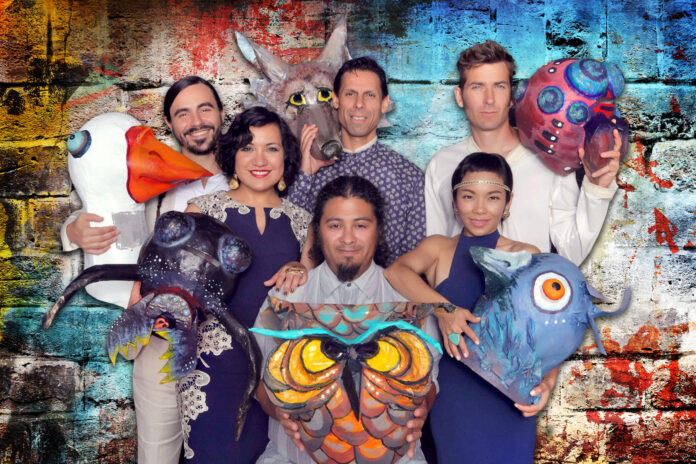
Other exciting entertainers virtually visiting ‘The Green Room’ include Los Angeles-based band Quetzal, who mix musical styles such as R&B and Chicano rock when they perform online March 11; and Clear Creek Creative, who appear in a discussion of their environmentally, culturally and spiritually-conscious theatrical work, “Ezell: Ballad of a Land Man,” on April 1.

The spring offerings also include two new performances from “Chamber Music Society of Lincoln Center Front Row: National.” The mouthful of a series is curated by Chamber Music Society of Lincoln Center co-artistic directors David Finckel and Wu Han, to celebrate chamber music with the public. First, the Calidore String Quartet performs virtually on Feb. 6. Next, musicians from the Chamber Music Society of Lincoln Center perform Bach’s iconic “Brandenburg Concertos” on April 3.

In addition to these online concerts, ‘The Green Room’ online spring programming also features the return of Michael Mwenso’s Black Music Series, featuring culturally significant discussions with a diverse group of artists.

Last fall, Mwenso and special guests delved into a wide range of topics surrounding the Black experience though discussion, historical recordings, and performance.

Now, the acclaimed musician and self-described cultural guide is back for two more installments of the series. On Feb. 4, Mwenso connects how making music in his group Mwenso & The Shakes helped shed light on his own experiences. On April, 8, Mwenso leads a roundtable talk with prominent artists Vuyo Sotashe and Jules Latimer on the artist perspective of the LGBTQ+ experience in America.

Tickets for The Green Room’s spring 2021 season of shows opens to the public on Jan. 19. $10 for individual performances; $70 for the full season. Sonoma State  students are Free. Green Music Center donors and subscribers to the Spring 2021 Season will receive access to one additional performance on March 6. Visit gmc.sonoma.edu for more details.

‘Immersive Van Gogh’ Exhibit Will Let You Step Inside the Art

In the 1990 film Akira Kurosawa’s Dreams, an art student is transported to within a painting by Vincent van Gogh. There, he meets the famous Dutch artist (as played by Martin Scorsese). Van Gogh relates the story of how he lost his ear before the student wanders through a series of van Gogh’s most famous and most visually-striking Post-Impressionist landscape paintings.

Soon, Bay Area art lovers will have the chance to experience that same enchanting art walk when the “Immersive Van Gogh” exhibit takes over San Francisco’s SVN West. The show features several massive art projections that will let audiences see Vincent van Gogh’s works from the inside-out.

Following several weeks of advance ticket sales, event organizers Lighthouse Immersive recently announced that “Immersive Van Gogh” will open for an extended run on March 18 and be available to view through September 6, 2021.

“The reception we have received from San Francisco Bay Area ticket buyers has been enthusiastic and welcoming,” Lighthouse Immersive co-producer Corey Ross says in a statement. “Despite the setbacks and challenges of Covid-19 this past year, one thing is clear—the arts will be coming back stronger than ever in 2021. We look forward to welcoming audiences through our doors beginning in March.”

Utilizing the SVN West’s massive size, the show invites visitors to seemingly step inside some of van Gogh’s masterpieces. The works on display include “Starry Night,” “Sunflowers,” and “The Bedroom.”

Admissions will be limited and in line with the City and County of San Francisco’s capacity guidelines. There will be touchless ticket-taking and temperature checks upon arrival. Hand sanitizer stations and social distancing markers will be prominent throughout the venue. Finally, digitally–projected social distancing circles on the gallery floors to ensure appropriate spacing. All guests must wear a face covering at all times during their visit to SVN West.

The paintings will be projected as how van Gogh described the way he first saw them: actively moving landscapes turned into sharp yet sweeping brushstrokes. The exhibit’s creative director and Italian film producer Massimiliano Siccardi worked with art director Vittorio Guidotti to bring these works to moving life.

In addition, Italian multimedia composer Luca Longobardi provides a score that combines experimental electronic music with ethereal piano. Audiences will see a new view of the artworks and gain new insight into van Gogh’s emotional and chaotic inner consciousness through the mixture of art, light, music and movement.

“Immersive Van Gogh” first debuted in Toronto in July 2020, and will also be shown in Chicago in February 2021. Tickets for all dates of this West Coast premiere go on sale Saturday, Jan. 16. $24.99-$39.99 and up. vangoghsf.com.

Newsom Unveils State Budget Proposal With Billions for Education, Covid-19

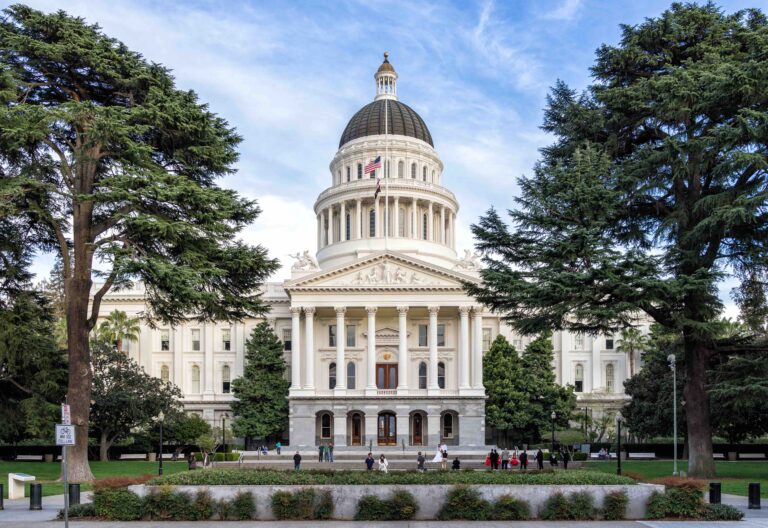
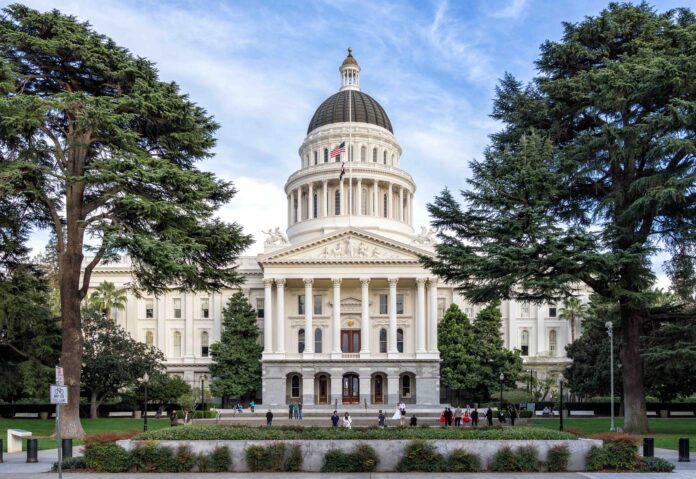
Gov. Gavin Newsom unveiled his proposed budget for the 2021-22 fiscal year Friday, touting record investments in education and a $15 billion budget surplus in spite of the economic uncertainty wrought by the coronavirus pandemic.

The $227 billion proposed budget, with a $164.5 billion general fund, represents a stark difference in the state’s financial outlook from last year, when plummeting sales, personal income and corporate tax revenue during the pandemic’s early days resulted in a $54 billion budget deficit.

According to Keely Bosler, the state’s Director of Finance, the state received more revenue than expected over the last year after misjudging the depth of the pandemic-induced recession and that the stock market would maintain its strength. 

“Not an easy journey,” Newsom said Friday about the process of developing the proposal. “A challenge the likes of which we’ve never experienced in such a contracted period of time. Numbers changed but our values did not.”

Newsom said his focus when drafting the budget centered on getting state residents vaccinated against the virus as quickly as possible while spurring the state’s economic recovery and reopening schools across the state.

The budget includes $85.8 billion for the state’s schools, the largest investment in education in the state’s history, according to Newsom. 

The proposed funding would allow the state to avoid making permanent education cuts or layoffs while recruiting and training new teachers, keeping college and university tuition and fees at current levels and ensuring all school staff and students have access to coronavirus testing and vaccination in the coming months. 

At the end of December, Newsom announced that the state would invest some $2 billion in reopening schools in February for students in transitional kindergarten through second grade and progressing into higher grades later into the spring.

While schools in 41 counties across the state were holding in-person classes to some extent, as of November, Newsom said state officials aim to use the $2 billion and incentives for additional resource allocation to resume in-person classes statewide.

Newsom added that officials wouldn’t shy away from taking a more heavy-handed approach with school districts that have been more hesitant to reopen in the coming months.

Superintendents from seven of the state’s largest school districts, including those in San Francisco and Oakland, expressed such hesitation earlier this week in a letter to Newsom, suggesting that the $2 billion plan would be implemented inequitably and included vague markers for reopening such as what constitutes a “safe school environment.”

“I think this budget reflects the vast majority of their concerns,” Newsom said Friday about the letter, adding “we share the same goal for safe reopening of in-person education.”

The proposed education budget also includes funding for mental health services for students, extending when schools are in session to make up for the learning lost as result of the pandemic and the development of open-sourced textbooks as a way of disrupting “the racket that is textbooks in this country,” Newsom said.

The budget would utilize $6.7 billion in federal education funding as part of its allocation to the state’s schools. 

California State University Chancellor Joseph Castro said the budget “provides a welcome reinvestment in the California State University and demonstrates his continued belief in the power of public higher education in developing future leaders of our state and improving the lives of the residents of California.”

The California Faculty Association, which represents staff at all 23 CSU campuses, described its reaction to the proposal as “encouraged.”

“This proposal is the opening move in the budget process that includes a May revise and final approval in June,” the CFA said in a statement. “CFA looks forward to working with the California state legislature and Gov. Newsom over the next several months to secure necessary funding to enable us to best serve CSU students.”

Outside of education, the proposed budget includes $4.4 billion to continue the state’s expansion of coronavirus testing, contact tracing and vaccination efforts.

Newsom lamented that California has lagged behind many other states in its coronavirus vaccination efforts, arguing that it is somewhat out of his control and that the state itself has not received any vaccine doses, which are being distributed directly to local health jurisdictions and health care systems. 

State officials have set a goal of administering 100 million vaccines by the end of next week, according to Newsom, who noted roughly 2 million vaccine doses have been received in the state as of Thursday.

“The predicate in terms of our focus on a budget is the reality of getting out of the freezers, and administering into peoples’ arms, these vaccines,” Newsom said. “We must do that in order to safely reopen, for in-person instruction, our schools; to reopen our small businesses as well as businesses large and small all across the state of California.”

Newsom said he has asked the state legislature to pass an immediate funding package by the end of the month to allocate funding for reopening schools, issuing grants and fee waivers to small businesses and extending the state’s moratorium on evictions, which expires Jan. 31.

Assemblyman David Chiu, D-San Francisco, who authored the eviction moratorium bill last year, lauded Newsom for his proposal, including the $1.75 billion allocated to sheltering the state’s unhoused residents long-term.

“Despite an ongoing pandemic and difficult economic circumstances, Governor Newsom has used this budget to make wise investments and safeguard our social safety net,” Chiu said, adding “while no budget is perfect, this proposal is good news for California.”

The immediate funding package would also include $600 stimulus payments to 2019 taxpayers who received an earned income tax credit from the state and 2020 taxpayers who have Individual Taxpayer Identification Numbers.

Residents with an annual income of $30,000 or less are eligible for the tax credit, while ITIN taxpayers include people like undocumented residents who were not eligible for federal stimulus payments.

California Republican Party Chair Jessica Millan Patterson suggested Newsom should have also used the state’s one-time surplus to support residents who have been hit hard in their wallet by the pandemic.

“His shutdowns and lack of leadership in handling COVID-19 has put many Californians in dire situations – foreclosures, evictions, isolation from family and friends and a lost academic year for millions of school children,” Millan Patterson said in a statement.

Bay Area leaders praised Newsom’s budget for investing in the state rather than making dramatic cuts amid the pandemic. 

“In addition to all the challenges we have been facing for years, right now in this moment, our workers, families, and young people are in desperate need of immediate relief,” San Francisco Mayor London Breed said. “By proposing direct investments to working people, small businesses, and our schools, the governor is doing just that.”

“Even amid this pandemic, homelessness will persist as the lasting crisis of our generation,” San Jose Mayor Sam Liccardo said. “Mayors throughout the state urged Governor Newsom to remain steadfast in his commitment to housing solutions, and he stepped up.”

“This budget wisely commits to assistance for small businesses, greater support for public health programs, a good working plan to reopen schools, as well as addressing non-COVID related threats like climate change impacts,” state Sen. John Laird, D-Santa Cruz, said.

The full budget proposal – which also includes billions in funding for wildfire preparedness, tax credits and loans for businesses and early childhood care – can be found here

Mollie Stone’s Makes Contribution to Marin Health Hospital

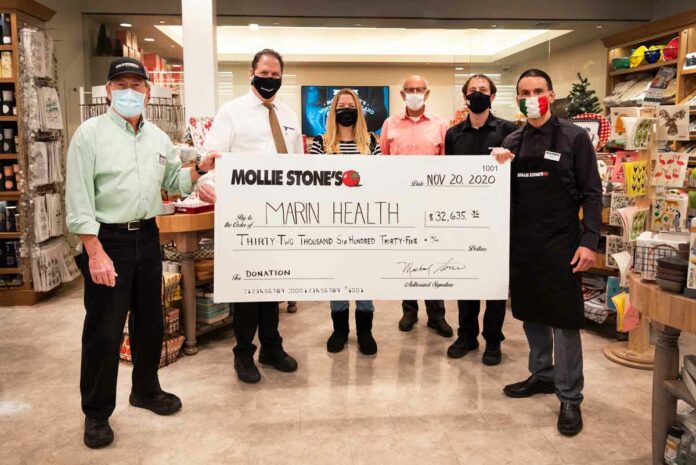
Last April, Mollie Stone’s Markets launched a hospital fund drive to help support local hospitals and healthcare workers who are working on the frontlines. The family-owned markets raised $32,635.36 through customer donations via its Marin-based stores in Greenbrae and Sausalito and a 100% company matching program. The funds were donated to Marin Health Hospital this December. 

“As we all do our best to navigate the COVID-19 pandemic, we wanted to make sure our local hospitals have the support they need to continue to fight and help our community navigate this unprecedented time,” said Mike Stone, CEO of Mollie Stone’s Markets, in a statement.

Since its inception in 1986, the family-owned grocers has advocated for corporate responsibility in terms of sustainability and a progressive work environment. The chain offers organic and natural food, national brands, special dietary foods, and a variety of hard to find products.

“We are proud to support our community and these heroes during this crisis.” Stone added, “I would also like to thank our wonderful employees who played a significant role in getting contributions at the store.”

Covid Travel: My Pandemic Road Trip

Fear and loathing in the age of quarantine Life during Covid is introverted and boring. So am I, for that matter. But even I need to get the hell out of Dodge once or twice a year or I start to go bonkers. Unfortunately, 2020 made that quite difficult. While I whiled away the shutdown for most of last year,...

Novato Homeless Activists Push for 9.2-acre Land Trust

As cars drove by Novato City Hall on Jan. 11, horns blared in support of the homeless people demonstrating in front of the municipal building. The protestors, who live at two tent encampments in Novato, objected to the dearth of housing for Marin’s homeless. Marin County’s Homeless Coordinated Entry System allocates beds by prioritizing the most vulnerable people and veterans....

Adam Traum Embraces His ‘Legacy’ on New Record

Many musicians grew up in a house of song, but North Bay–based guitarist and singer-songwriter Adam Traum still creates music with his father, Happy Traum. Happy became a figure in the Greenwich Village scene of the ’50s and ’60s, performed with his brother Artie Traum in a popular duo and lived in Woodstock, New York, when Adam was growing up. “It...

Top Torn Tickets of 2020

’Tis the time for critics of all ilks to release their “end of year” lists. For almost 20 years, this publication has presented a “Top Torn Tickets” list featuring the year’s best North Bay theatrical productions.  Those years, however, had the advantage of having an entire calendar year’s worth of shows to consider. With the pandemic-necessitated shut-downs and closures initiated...

Open Mic: Googling the Truth

By Cliff Zyskowski Recalling a recent headline from The Washington Post, “Armed protesters alleging voter fraud surrounded the home of Michigan’s Secretary of State.” Jocelyn Benson is Michigan’s chief election officer and as secretary of state, in charge of certifying Michigan’s presidential election.  According to the latest count, Biden won the state by more than 154,000 votes. Am I missing something?...

Letters to the Editor: Forests on Fire

typewriter opinion newspaper
This is a plea, to the Sonoma County Board of Supervisors and Dept. of Forestry, from a tax-paying citizen who has now raised 3 tax-paying citizens in this county: please stop treating our forests with fuel. Please stop burning them and cutting them down. As a lifetime citizen here, those forests are as much mine as they are yours. We...

Green Music Center Announces Virtual Season of Shows

The Green Music Center–Sonoma State University’s live music venue and educational complex made up of Weill Hall, Schroeder Hall and more–is accustomed to packing the halls with concerts and various live events featuring culturally significant musicians and other top-tier performers. The last several months have been quiet ones at the Green Music Center, as the Covid-19 pandemic closed the halls...

‘Immersive Van Gogh’ Exhibit Will Let You Step Inside the Art

In the 1990 film Akira Kurosawa’s Dreams, an art student is transported to within a painting by Vincent van Gogh. There, he meets the famous Dutch artist (as played by Martin Scorsese). Van Gogh relates the story of how he lost his ear before the student wanders through a series of van Gogh’s most famous and most visually-striking Post-Impressionist...

Newsom Unveils State Budget Proposal With Billions for Education, Covid-19

California Capitol Building, Sacramento
Gov. Gavin Newsom unveiled his proposed budget for the 2021-22 fiscal year Friday, touting record investments in education and a $15 billion budget surplus in spite of the economic uncertainty wrought by the coronavirus pandemic. The $227 billion proposed budget, with a $164.5 billion general fund, represents a stark difference in the state's financial outlook from last year, when plummeting...

Mollie Stone’s Makes Contribution to Marin Health Hospital

Mollie Stone's
Last April, Mollie Stone’s Markets launched a hospital fund drive to help support local hospitals and healthcare workers who are working on the frontlines. The family-owned markets raised $32,635.36 through customer donations via its Marin-based stores in Greenbrae and Sausalito and a 100% company matching program. The funds were donated to Marin Health Hospital this December.  “As we all do...
3,002FansLike
3,850FollowersFollow