Two young women, Carol Joan Klein, age 79, and Anna Mae Bullock, age 81, will join the pantheon of performing artists being inducted as solo performers into the Rock & Roll Hall of Fame.
Who are these two women? Both came from families that arrived from distant shores to America. Both were born and raised here, but in dissimilar environments—one in the urban enclave of New York City’s streets, the other in the rural, unincorporated community of Nutbush, Tennessee—both developing the styles and musical sensibilities that reflected their respective places and cultures of the time.
Perhaps they would be better recognized by their stage names: Carole King and Tina Turner!
Ms. King was a fixture at New York City’s legendary Brill Building—which housed numerous songwriters and publishers—writing dozens of pop hits for solo performers and groups; while Ms. Turner’s persona blossomed onstage in steamy nightclubs and on the Chitlin’ Circuit. Both put their life experiences into their music, front and center, before their audiences.
During the late 1950s and into the 1960s, these two women began their illustrious careers—along with their male partners at the time. Ms. King, with her formidable song-writing skills and melodies, and Ms. Turner, with her physicality and voice, prompted us to stop, look and listen up.
And as they each jettisoned the past—and took the risk to go solo—their fans and the universe applauded.
They both achieved well-deserved success during their careers; were forced to remake themselves, as all true artists do; and suffered the “slings and arrows” that life hands everybody—whether it be through difficult relationships or coping with illnesses.
And they survived—and more than survive, they thrived—and are still revered. These are two tough and tender women! And brilliant examples for women and for men—how to be honest and humble, to believe in oneself and one’s abilities, and to be generous in spirit, in sharing oneself with the world.
You Go, Girls!!!!
E. G. Singer lives in Santa Rosa.We welcome your contribution. To have your topical essay of 350 words considered for publication, write le*****@********un.com.
Marin County and the City of San Rafael maintain they are successfully addressing the issue of unhoused individuals with the assistance of Andrew Hening, the City of San Rafael’s director of homeless planning and outreach, who has pledged to “end homelessness.”
Hening, a fresh-faced man with an MBA, was hired by San Rafael in 2016, and is rumored to be writing a book about the County’s many successes. Hening has won awards and presented the city’s successes at speaking engagements. And he is consulting other counties, cities and agencies on how they, too, can “end homelessness.”
On June 7, several weeks after the Pacific Sun initiated this investigation, Hening abruptly announced his resignation from his position with the City of San Rafael, effective June 30, according to an email obtained by the Pacific Sun. Hening’s email does not explain why he decided to leave his position, and Hening did not immediately respond to a request for further comment.
But while the County and San Rafael continue to tout dated claims of having dramatically reduced homelessness in the wealthy San Francisco suburb, unhoused individuals challenge the numbers present by local officials. Neither San Rafael nor the County have current numbers for unhoused individuals, as the biannual point-in-time count scheduled for 2021 was delayed until 2022 due to the pandemic. The 2019 point-in-time estimate for the total number of homeless in Marin County was 1,034—a 7% drop from the previous count. However, a recent estimate by the County found that the number of people living in their cars since the last point-in-time count had increased by 91%.
The fact that Hening said he was “disappointed” in the Ninth Circuit Court’s Martin v. Boise decision, which restricts public agencies’ ability to move people camping on public property unless they offer adequate alternative shelter, and his repeated claims about how many people the county has permanently housed, raised questions within the community of unhoused individuals and their allies. Using crowd-sourcing and public records requests, members of the homeless community began an investigation. The results were alarming.
Despite proclamations of their generous and effective approach to homelessness, documents obtained by the investigating group and shared with the Pacific Sun show that San Rafael officials, including Hening, worked to cut essential services that not only would have helped unhoused people survive until they could find housing, but would have alleviated some of the issues that property owners routinely criticize homeless people for.
In the midst of a punishing pandemic, some of the failures of San Rafael and the County to provide basic services to the homeless might be understandable. But with services for unhoused people having been dramatically slashed by San Rafael beginning in 2017, unhoused individuals were in a particularly compromised position when the pandemic struck.
Mail delivery, which is essential for applying for state and federal public benefits, as well as for staying in touch with family and friends, was ended for 500 unhoused people through a 2017 agreement created by Hening and San Rafael’s current Mayor, Kate Colin.
As Hening later described this action in a Sept. 15, 2020 email: “4-5 years ago we completely overhauled our approach to homelessness. Tactically, we shut down mail service at the Ritter Center, which had been serving 500+ people…. That doesn’t exist anymore. Ritter has shut down their showers (300+ visits per week), and we have no (sic) convinced Novato, Sausalito, and Fairfax to offer new homeless services in the form of Downtown Streets Team’s mobile shower program.”
The idea behind the January 2017 agreement, formally known as a Memorandum of Understanding (MOU), is that mail and shower services, once offered at the Ritter Center near downtown San Rafael, would be provided by other entities. However, to date those other entities provide only a fraction of the services previously supplied, and in locations that make it difficult or impossible for many unhoused individuals to access.
A lack of access to restrooms has been another long-running problem for people without shelter in Marin County. Prior to the pandemic, there was already a severe shortage of publicly accessible bathrooms, porta-potties and handwashing stations. Then, once the March 2020 shelter-in-place order took effect, access to the scant few publicly accessible bathrooms at local businesses, homeless care nonprofits and city buildings abruptly ended. San Rafael then worsened the problem by failing to provide compensatory porta potties.
One of the most common complaints made by angry homeowners about the homeless—as evidenced in the correspondence obtained through public records requests—is “filth,” including valid concerns regarding defecation and urination in the streets. But neither the City of San Rafael nor the County made any effort to explain to complaining residents why so few toilets were made available to the homeless once restrooms in private businesses closed due to the pandemic.
As of the date of this writing, Ashley Hart McIntyre, the homelessness policy analyst at Marin Health and Human Services, was unable to provide any actual number for how many porta potties are available in the County, nor how often they receive maintenance.
An email sent by Sara Hunt, a Ritter Center case worker, made the situation at the start of the pandemic painfully clear: by the end of March 2020, four functional porta potties throughout all of San Rafael, with an extra unit ordered by Ritter Center on March 26, several weeks into the lockdown. Estimates of at least 200 people experiencing homelessness in San Rafael at that time would indicate that roughly 50 people had to share each porta potty station in the early weeks of the pandemic.
To make matters worse, photos provided to the Pacific Sun by people who used the porta potties show they were haphazardly serviced, and often unusable.
Given this context, it is not at all surprising that some people without shelter resorted to relieving themselves in public spaces.
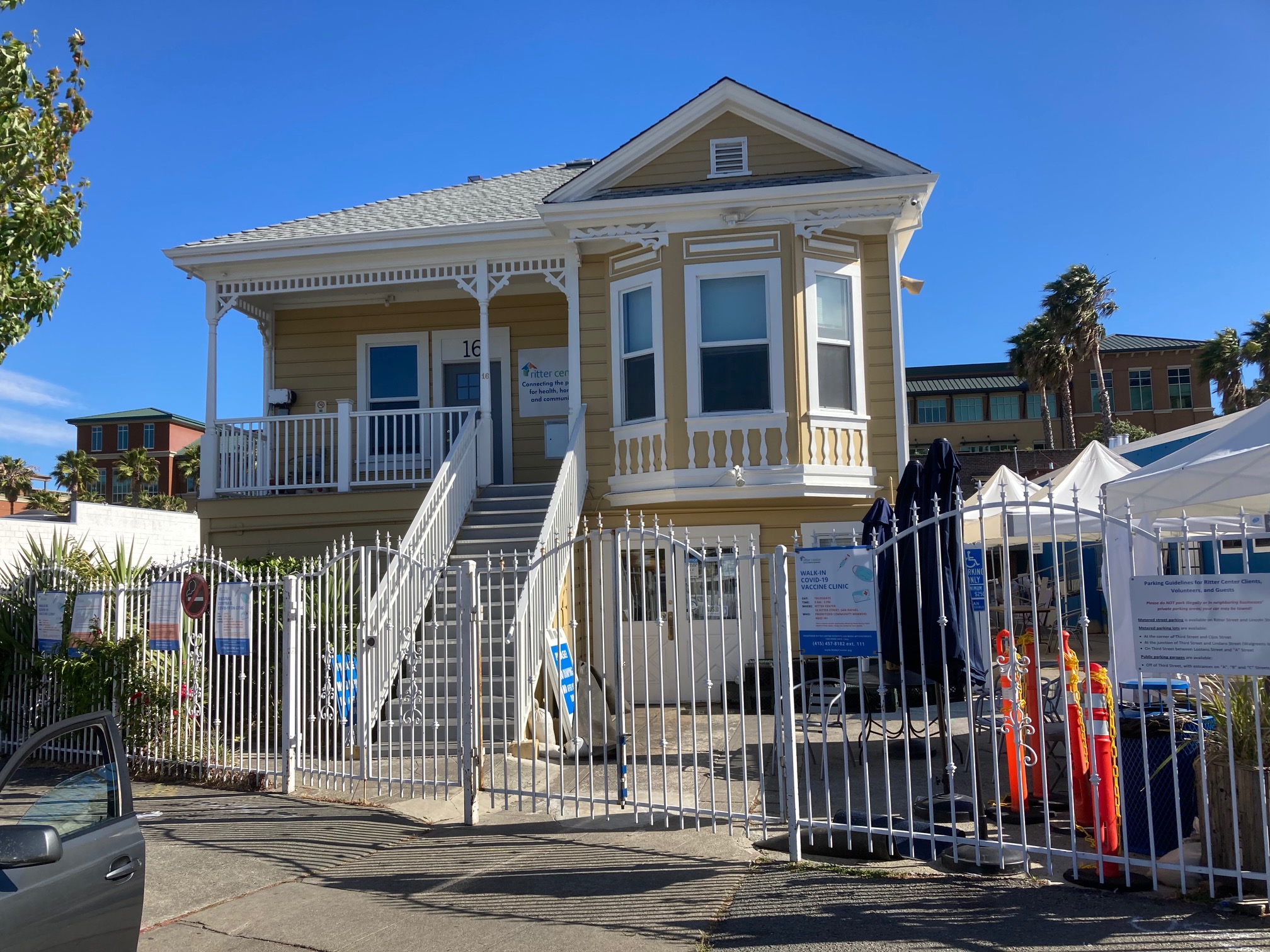
RESOURCES San Rafael’s Ritter Center used to offer houseless people access to mailboxes and showers before city officials decided to move the services elsewhere. Photo by Eva Chrysanthe
Relocated
During the pandemic, San Rafael continued to relocate encampments. While many Bay Area cities did the same, Marin and San Rafael were comparatively more aggressive in their tactics, according to emails obtained by the Pacific Sun.
On May 12, 2020, Hening sent an internal email stating that Marin remained the only county in the Bay Area that had not provided food or water to unhoused encampments. “I’m not sure if this is good or bad,” Hening continued, “but San Rafael remains hands down the most proactive on encampment cleanup of any jurisdiction in Marin.”
Further correspondence indicates that Hening and Colin well understood that such “encampment cleanups” or “sweeps” merely pushed unhoused individuals out of one area of the city and into another.
In one notable case, an enforcement action moved an encampment a mere block. “Many had assumed that the homeless encampment cleared under the freeway earlier this week would result in individuals being settled into housing. It was disappointing to see that the encampment was only moved a block away,” a resident emailed public officials on Jan. 22, 2021.
Other emails show that San Rafael officials spent time requesting that Caltrans, the state transportation agency, define the minimal amount of temporary housing the city was required to provide to homeless people before the state agency would agree to relocate an encampment.
In a carefully worded response, a Caltrans official finally wrote back that the agency did not have such information at the ready because San Rafael was the only municipality to inquire what the minimum provision was.
In a November 2020 email, now-Mayor Kate Colin revealed that then-President of the Board of Supervisors Katie Rice opposed temporarily housing five people camping on a Caltrans property because she was concerned that offering services would attract more homeless people. “What is to prevent these 5 people (if they got beds) from getting the word out to their buddies in Berkeley and then there will be 5 more and so on,” as Colin described Rice’s statement.
Supervisor Rice’s email record seems to reflect the County’s overwhelming concern with an increase in the next point-in-time count, as opposed to attempts to get people housed as winter approached. Her concerns were stated just two weeks prior to the death of a 56-year-old woman living under a freeway underpass.
In a Marin Independent Journal opinion article, Lynn Murphy, San Rafael Police Department’s mental health liaison, took pains to characterize the woman’s death as being related to mental illness. Murphy did not mention that the Marin County Coroner’s log book lists the cause of death as “Acute Metabolic Ketoacidosis due to Insulin Dependent Diabetes Mellitus,” a description which suggests that the deceased lacked a supply of insulin. Murphy also does not mention that on the night of the woman’s death, temperatures in Marin County dipped below freezing, which may have made it difficult for her to self-administer insulin and/or made the insulin unusable.
On May 8, 2021, the Pacific Sun wrote to Rice asking if the 56-year-old woman who died might have been one of the individuals to whom Rice had denied a temporary room in mid-November 2020. She has not yet responded.
CITY HALL During the pandemic, San Rafael continued to relocate encampments. While many Bay Area cities did the same, Marin and San Rafael were comparatively more aggressive in their tactics, according to emails obtained by the Pacific Sun. Photo by Eva Chrysanthe
City’s Response
After reviewing Hening’s correspondence, the Pacific Sun reached out to Murphy on May 10. Regarding the elimination of mailboxes at Ritter Center, Murphy said that Hening “had worked very hard” to create substitute mail services at another location, and some of the displaced had been able to retain their mail services at the Ritter Center.
I asked Murphy how many unhoused people had used mail services at Ritter, and how many had been provided mail service at another location. Murphy told me she didn’t know. Hening and San Rafael Mayor Kate Colin didn’t know either.
On May 27, Deputy City Attorney Lisa Goldfien released the City’s 8-page response to the Pacific Sun’s question. Instead of answering the questions, the letter mostly repeats talking points about the City’s successes in reducing homelessness in San Rafael. What few direct answers the letter does provide are contradicted by the emails obtained through public records requests, and by interviews with unhoused individuals who maintained their own records of what actually occurred.
Some of the claims that San Rafael made in their response are obviously not credible.
On May 25, 2021, the County approved a $795,751 contract with the Ritter Center to provide a myriad of services to the homeless. The staff report summarizes the services as including “mail and showers” but Mark Shotwell, the Ritter Center’s executive director, confirmed that showers remain totally unavailable at Ritter Center and that mail services are only available for approximately 50-100 individuals at Ritter.
The city also claimed to be providing 260 showers per week through Downtown Streets Team’s mobile shower unit. But as several unhoused individuals made clear, that wasn’t even possible in the limited time and with the limited mobile units that were employed.
As one unhoused Marinite immediately responded in an email to the Pacific Sun: “260 showers per week? There is no shower service this week in Fairfax. Service was canceled at least once last month. Usually there are 6-10 showers per week in Fairfax. They are running two of the three units since the first of the year. At 20 minutes per shower that is 6 showers per hour max and they only run 3 hours so 20 showers is not even possible.”
That disconnect resonated with homeless activist Jason Sarris, who said the Downtown Streets Team mobile shower service doesn’t actually go to encampments in Novato. Instead, Sarris says, the team parks the vehicle in a lot several miles from the city’s largest homeless encampment.
In her eight-page response on behalf of the city, Goldfien, the deputy city attorney, stated that San Rafael restored P.O. Box service for 200 individuals at the post office on Bellam Boulevard, and that anywhere from 60 to 110 individuals had been, on an unspecified fluctuating basis, able to retain service at Ritter Center. Because 500 individuals were dependent on mail service at the Ritter Center, approximately 300 mailboxes were lost in the transition, according to the city’s estimates of current mailbox availability and Hening’s Sept. 15, 2020 email to a constituent.
Goldfien did not concede that there are still approximately 200 individuals who lost mailbox access through the 2017 MOU, nor that there was a significant lag time between the elimination of the Ritter Center mailboxes and the provision of the Bellam Boulevard P.O. boxes.
This is important, because Hening claimed in his May 2020 email that the elimination of mail service at the Ritter Center, like the elimination of showers, was “tactical”—designed to drive down essential services to unhoused individuals in San Rafael in order to reduce homelessness in San Rafael.
But one elderly homeless man asked me to consider San Rafael’s insistence that the post office location, for those who were able to retain mail service, could only be Bellam. “They won’t let you get a P.O. Box at the D Street post office. They won’t let you have one at Civic Center. It has to be Bellam.”
“Why Bellam?” I asked.
“Services for the homeless are being moved into the Canal District,” he said. “Look at the Project Roomkey hotel locations. Canal residents can’t push back.”
This makes sense, given that, in all the angry homeowner correspondence which the City of San Rafael released in response to public records requests, there was no correspondence from any Canal District residents. From high Covid-19 deaths, to exploitative jobs which don’t pay a living wage, many Canal residents barely stayed afloat during the pandemic, despite the County’s self-laudatory claims of assistance and “equity.”
Activist Robbie Powelson made a separate records request into Hening’s correspondence with the Richardson Bay Regional Agency, the state agency which, during the past two years, has started clearing “anchor-outs,” the people who live on boats in the bay, with increasing speed. Powelson’s request turned up an email in which Hening promised that by housing anchor-outs in their marinas, a marina owner could potentially profit from Project Homekey and matching funds, at a per unit—per slip—benefit of up to $350,000. “So basically if the slips cost more than $100,000, a local match could get all the way up to $350,000,” Hening wrote.
Asked about the cost, Ashley Hart-McIntyre, a lawyer for Marin Health and Human Services, explained that an affordable housing unit in Fairfax’s recent Victory Village had cost $600,000 per unit. But what boat slip, which normally provides only a water and electricity hookup, can compare in cost to an entire apartment? In such an exchange, how would any of these resources actually benefit the essentially homeless anchor-out?
Questions like these need to be answered. Otherwise, San Rafael and other cities using their playbook may just continue to push the local people experiencing homelessness around, instead of “solving homelessness.”
It’s been 15 months since local audiences set foot inside a theater.
Pandemic-necessitated closures and restrictions limited performing arts organizations to streaming their shows online to remain active and connected to their patrons. Try as they might, though, that “style” of production is simply not a replacement for live, in-person theater.
With the availability of vaccines and the loosening of state- and county-mandated restrictions came the possibility of a return to live, indoor performances. The question was, “Who’s gonna take the first leap?”
The answer in the Bay Area is Santa Rosa’s Left Edge Theatre. Improved conditions led the company to make the decision to open their doors and invite audiences back inside. Originally planned as a filmed production, Wendy MacLeod’s Slow Food closes out their 2020/2021 season and marks the long-awaited return of some semblance of normalcy for the theater-going community.
There are still restrictions. Patrons must buy their tickets in advance; they must bring proof of full vaccination to the box office before they will be admitted—and the Theatre is enforcing this, as two parties were asked to return to a future performance after they failed to bring their vax cards; and patrons must remain masked through the entire performance.
The 72-seat theater is limiting capacity to 50% and encouraging distance between parties. The theater upgraded its HVAC system, implemented strict cleaning and disinfecting protocols, and eliminated concession sales. The entire company’s staff is vaccinated, as is the crew and cast—who perform unmasked, but remain at least six feet from the audience.
With all that in mind, 22 theater-starved people joined me on opening night to witness a three-dimensional performance. We were rewarded with laughs and perhaps the opportunity to see the footlight at the end of the tunnel.
Slow Food is a simple show. A middle-aged couple (Argo Thompson & Director Denise Elia-Yen) embark on an anniversary trip to Palm Springs. They arrive late, the only car available at the rental agency is basically a tank, the hot tub at their swanky resort is broken and the only place open to eat late on a Sunday night is a Greek restaurant staffed by Stephen (David L. Yen), the world’s worst waiter.
Based on a real-life experience, playwright MacLeod (The House of Yes) takes what is in essence an SNL sketch and expands it into a 90-minute, intermission-less play. There are laughs to be had among the conversations about spanakopita, salads, Sam Adams beer and a dead cat; along with a smidgeon of family drama as the two vacationers face a new stage in life as empty-nesters—all as the couple wait endlessly for their food to arrive.
The cast obviously had fun with the material, as did the audience. It’s basically a silly show that takes a silly premise and makes it sillier with silly accents, silly flirtations and silly situations.
Slow Food just may be the appetizer to hold us until main-course theatrical meals are served. Let’s just hope Stephen isn’t assigned to our table.
“Slow Food” runs live through June 13 at Left Edge Theatre. 50 Mark West Springs Rd., Santa Rosa. Fri–Sun, 7pm; Sun., 2pm. $45. Available for streaming June 15–20 for $15. 707.546.3600. leftedgetheatre.com
As the Marin County Superintendent of Schools, as a parent, and as a grandparent, I am proud that the Progress Pride Flag, recognizing LGBTQ+ communities, including marginalized communities of color, will be flying over the buildings of the Marin County Office of Education as we commemorate June as LGBTQ+ Pride Month.
It is the primary and most important responsibility of all educators to make sure that their students feel safe, healthy and secure in school. Yet, we know that for LGBTQ+ students those feelings are rare, if they get to feel them at all. Studies and survey results indicate that our schools, and our greater community, can and must do more to provide for the social emotional needs of LGBTQ+ youth.
The Trevor Project, a suicide prevention and crisis intervention organization for LGBTQ+ youth recently released the results of a survey of 35,000 LGBTQ+ youth aged 13 to 24. The survey showed that 43% of the responders seriously considered suicide over the past year. The survey results were over 50% seriously considering suicide for transgender and nonbinary youth.
The Gay Lesbian Straight Educational Network has been conducting climate surveys of youth for more than 10 years. An October 2020 report of 17,000 LGBTQ+ youth revealed that nearly 60% felt unsafe at their schools because of their sexual orientation; 70% had experienced verbal harassment; 60% of those harassed or assaulted did not report the incident because they did not trust that an effective intervention would occur.
These statistics are a call to action for our community. So are the experiences of our local LGBTQ+ youth. This past week, the Marin Wellness Collaborative, a group of mental health professionals and educators working with Marin schools, heard firsthand from a group of students who presented Teach Pride, Reach Wide!, the Spahr Center’s Toolkit LGBTQ+ Inclusive Schools. The toolkit provides guidance on implementation of LGBTQ+ youth best practices for inclusion, how school staff and families can become active allies, lesson plans and classroom resources, and guidance for advocating for LGBTQ+ students. The toolkit is a deepening of the outstanding resources and support that the Spahr Center provides to youth and all LGBTQ+ members of our community and their families.
Resources like Teach Pride, Reach Wide!, along with bullying prevention initiatives and programs insuring a positive social climate underway in our schools, can help make a real difference for LGBTQ+ youth. So can statewide actions like that of the Association of California School Administrators which is designing a certification program to train school leaders on creating gender inclusive schools. These actions need to be supported and expanded. We must continue to work with our children, at home, in school, in their sports and other activities and in their places of worship to help them understand the beauty and strength of a community that does not just tolerate diversity and individual choice; but embraces, encourages and nurtures it.
Some may believe that flying the Progress Flag will cause concerns, or lead to requests from multiple causes to fly a flag or hang a banner in support. However, there is a difference. This is not just an act an act of support, acknowledgment and affirmation for a group of young people feeling forced to live in silence, to be invisible, and in some cases, to live in physical or emotional fear of revealing their real selves. This is in direct furtherance of California statues that create an “affirmative obligation to combat” bias based on “gender identity, gender expression or sexual orientation”.
We must be committed to doing much more. It would be naive to think that the act of flying of a flag will bring about substantive change. If, however, just one young person arrives at their school campus and sees the Progress Flag flying, and says, “I belong here, I feel supported here, I am proud to be who I am” . . . then it is an act well worth taking.
Mary Jane Burke is the Marin County Superintendent of Schools. We welcome your contribution. To have your topical essay considered for publication, write le*****@********un.com.
As the largest nonprofit in Marin County serving older adults and people with disabilities, Vivalon (formerly known as Whistlestop) has seen it all in 67 years, including now the Covid-19 pandemic.
At the start of Marin County’s shelter-in-place order in March of 2020, Vivalon had to temporarily close the doors of the Healthy Aging Center and adjust to social distancing measures. Undaunted, the staff and the nonprofit’s volunteers expanded existing services and created new pandemic-related programs to better assist older adults, individuals with disabilities, people experiencing homelessness, low-income families and individuals with other access and functional needs in Marin County.
This week, Vivalon announced that its Covid-19 pandemic response program has provided 500,000 services to Marin County’s highest risk residents.
These half-million pandemic-related services include phone check-ins, social phone and in-person visiting programs, distribution of personal protective equipment(PPE), and the creation and distribution of face coverings and activity packets.
In partnership with Marin Health and Human Services, Vivalon also created a new call center to aid in vaccine registration and transportation, led the county grocery delivery program, and led intake for the Great Plates Program–in which older adults can get three free, restaurant-quality meals delivered to their home.
Additionally, Vivalon enhanced its transportation services, expanded its food assistance and home delivered meals programs to serve the unprecedented number of people in Marin County in need of food during the pandemic, and hosted hundreds of virtual classes and events by video and phone to help thousands of older adults stay active and connected.
“When Vivalon had to temporarily close the doors of the Healthy Aging Center last March, our staff pulled together to find new and creative ways of continuing our essential work,” said Anne Grey, Vivalon CEO in a statement. “We are grateful to our staff and our volunteers, who went above and beyond on countless occasions to ensure that nobody in the community went hungry, that nobody felt alone, and that older adults in the community had opportunities for engagement and connection while sheltering in place. We are grateful to our many community partners who worked with us to create new programs so that we could reach more people in need. And we are grateful to our donors for their generous financial support, allowing us to focus on providing these critical services. We are inspired by the power of community.”
Currently, Vivalon is in the process of reopening the doors to its Healthy Aging Center and welcoming vaccinated members of the public back. As of now, the center is hosting limited in-person classes, and on June 14, the center plans to reopen its Jackson Café for indoor dining Monday to Friday, 11:30am–2pm. More information on safety procedures and protocols will be made available closer to reopening based on Marin County Public Health and California State guidance at that time.
For more details on Vivalon’s reopening plans, and for information about Vivalon services, programs, and volunteer opportunities, please visitwww.vivalon.org.
While brewpubs in Marin and Sonoma counties have reopened after the last shutdown in January they haven’t recovered to their pre-pandemic levels.
With Marin and Sonoma counties now in the Orange Tier of the state’s Blueprint for a Safer Economy, further restrictions have been removed. This allows more people to drink indoors at brewpubs.
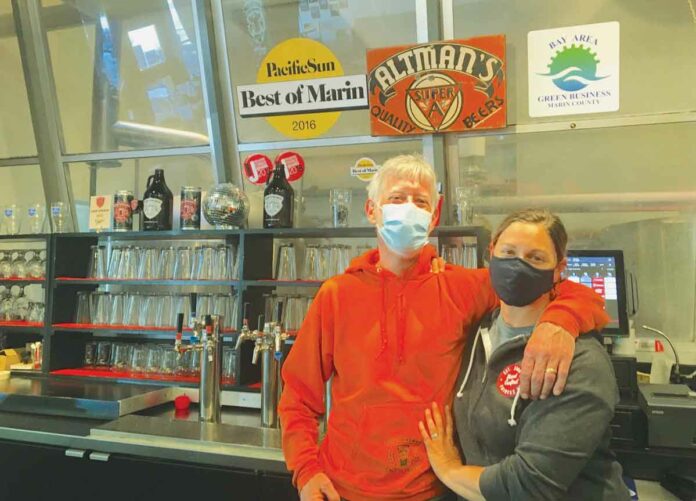
“We’re starting to see things open up with more and more people coming out, especially the elderly segment because they got vaccinated first,” Michael Altman, owner of Iron Springs Pub and Brewery in Fairfax said. “They’re coming out a lot more. People aren’t as hesitant to eat indoors.”
Altman is optimistic on returning to his pre-pandemic level of customers.
“The fall is a really busy time, September and October. I think we’ll be able to do live music, the bar is open, and people are back.”
Pond Farm Brewing Company in San Rafael isn’t using the state’s planned reopening date of June 15 to return to normal but will go at their own pace.
“Just because California decides that all restrictions are no longer required doesn’t mean that for us we’re not going to still continue to practice some of these and do what we feel safest,” Pond Farm Brewing Company co-owner Stephanie Martin said
Brendan Moylan, who owns Marin Brewing Company in Larkspur and Moylan’s Brewery and Restaurant in Novato, has a similar mindset.
“We’re going to prepare that there are good things that are going to happen down the road but we’re also moving forward with caution,” he said.
It’s too early to know when things will pick up as there is a shortage of staff. As a result, Moylan’s is only open five days a week, and Marin Brewing is open seven days but closes at 7 p.m rather than midnight.
“The number one obstacle to us being open for more hours right now is employee workforce, it is not available” Moylan said.
It’s not just Marin Brewing and Moylan’s that are shorthanded; Iron Springs was also affected.
“We are understaffed to do all the things we are trying to do as we roll out of this year-long pandemic,” Altman said.
Unfortunately, his Iron Springs Public House in San Rafael has closed permanently. Altman described it as a “Covid casualty.”
“The size of that location was not conducive to be able to do any numbers. When they allowed it to reopen, the footprint in there is so small we’d only be able to have five people inside. Downtown San Rafael is very office driven, so it’s not like we’d be able to do a big to-go (service),” he said.
Russian River Brewing Company has been gradually bringing back some of the 162 employees who they laid off from their Santa Rosa and Windsor brewpubs.
“It was really difficult,” the brewery’s president and co-owner Natalie Cilurzo said. “We ended up laying off almost everybody. We kept some employees on for takeout and we were able to repurpose some employees into other positions, but for the most part we ended up laying off most of our staff unfortunately.
“When we reopened for outdoor dining we were able to invite several employees back which was really wonderful. Because indoor dining is ramping up again we were able to invite more people back and we’re now staffing up again, so it feels really good.”
Each February 25,000 people come for the world-renowned Pliny the Younger Triple IPA. They cancelled the two-week event this year. This was the first time the beer was available in bottles.
“We did not want to have any super-spreader events here for any kind of curbside pickup so it was only available for shipping throughout California online. We sold out I think in four minutes. We had 8,500 cases in sales.”
“Each case had four bottles of Younger in it. We won’t be offering that again, it was a one-time-only deal,” she said.
They fared better than some, as they don’t rely solely on brewpub sales.
“We’re very different from a traditional restaurant because we manufacture and distribute beer. We also sell directly to the consumer online and we also have our pubs, we have many different revenue streams. So what we were able to do was completely change our business model, increase our wholesale sales and direct to consumer sales. That revenue made up for the lost revenue in the pub,” Cilurzo said.
Although Marin Brewing made slightly higher income from sales to stores, the pandemic substantially reduced their wholesale profit.
“All the bars and restaurants are closed, that’s half our business. Supermarket sales went up a bit compared to how much we lost on bars. It’s a shame to not keep that business rolling,” Moylan said.
Pond Farm Brewing’s customers’ demand for takeaway beer has been helpful, even though profits are less than sales of draft beer in the taproom.
“I think that’s something that customers and the community doesn’t fully understand. Even though it looks good, we’ve been operating a different business model where the product makes profit margins really, really different. Canning is expensive and you’re selling the beer for a lower price point. So the amount you get left over to pay the team and do everything else like pay all of our bills, it’s really thin. So we’re excited to be doing more drafts on site,” Martin said.
She is pleased that their customers supported them during that time.
“We’re super grateful for the response and it’s been wonderful that we were able to do to-go. If we couldn’t then it would have been really tough, a totally different story,” she said.
Altman at Iron Springs expressed a similar sentiment.
“The community has been extremely generous in tips for the staff. People were really chipping in and doing things to keep us open. The love and support we got, especially early on, was really heartwarming,” he said.
Those having beer inside are happy to be back. Kevin Pauls of Mill Valley is a long-time customer of Marin Brewing. It was welcome news to Pauls and his friends when they heard the Larkspur brewpub was serving indoors.
“We were so excited to be in here,” Pauls said. “We were commenting how beautiful it was outside but it was so lovely to be inside drinking.”
Moylan is happy to see Marin Brewing busier and that more people are coming back.
“You get to hang out with your pals again, connecting with other people is good for the mind. I enjoy seeing people again. It was damn scary what we went through.”
Sacramento native Scott Hansen makes music as Tycho and visual art as ISO50, and he combines both forms with his first live shows in over a year this weekend. Tycho will be in the North Bay for a four-night residency-performing two shows each night–courtesy of Blue Note Napa and Another Planet, which are teaming up to present world class entertainment outside on the grounds of Napa Valley’s Oldest Wine Estate this summer. See (and hear) Tycho live from Thursday to Sunday, June 3–6, at Charles Krug Winery, 2800 Main Street, St. Helena. 5:30pm and 8:30pm each night. $55–$85. Bluenotenapa.com.
Live Event
Napa Valley invites residents and visitors alike to partake in small town specials at the weekly Yountville Locals Day, starting this week and featuring special offers from the town’s shops, restaurants, tasting rooms, spas and resorts. Culinary offers include complimentary corkage, treats and cocktails at several of the town’s Michelin-starred restaurants, as well as wine tastings and other deals. In addition, retail deals and spa experiences abound in town, and locals can see it all in a leisurely stroll on Thursday, June 3. For more information, including a complete list of Yountville Locals Day offers, visit Yountville.com/localsday.
Live Theater
Left Edge Theatre, the resident company of the Luther Burbank Center for the Arts, performed online for most of its 2020-2021 season. Now, the company returns to the live stage with in-person performances for its final show of the season, Slow Food. The relationship comedy looks at a couple in the midst of an anniversary meal that turns to an examination of their past and future with the help of a wacky waiter. Experience Slow Food in person with performances June 4–6 and June 11–13. 50 Mark West Spring Rd., Santa Rosa. Fri and Sat, 7pm; Sun, 2pm. $15-$20. The show will be online June 15-20. Leftedgetheatre.com.
Online Theater
Even with no live audience in attendance, Novato Theater Company is moving in the right direction to reopening when it takes the stage to present the romantic drama, The Last Five Years, in live broadcast performances. Carl Jordan directs Robert Nelson and Amanda Morando Nelson in this uplifting and heartbreaking depiction of the life and death of a young couple’s relationship. The common story is told in an uncommon manner when The Last Five Years broadcasts live online June 4–6. Fri and Sat, 7pm; Sun, 2pm. $15, free to NTC members. The show streams on June 7–13. Novatotheatercompany.org.
Live Event
Discover a curated selection of handmade goods by more than 75 local makers, crafters and artists at the Patchwork Modern Makers Festival. Attendees to the live, outdoor shopping experience can find artisanal clothing, home goods, accessories, art, ceramics, and even apothecary items. In addition, the Patchwork Junior booths feature young entrepreneurs and several hands-on craft stations let participants bring home their own handmade treasures. The family-friendly show adheres to Covid-19 safety guidelines when it commences on Sunday, June 6, at Sonoma County Fairgrounds, outside the Hall of Flowers, 1350 Bennett Valley Rd., Santa Rosa. 11am to 5pm. Free admission. Dearhandmadelife.com/patchwork-show.
Every June, Pride Month celebrates the LGBTQ community with events across the country.
Last June, Pride was all but canceled due to the Covid-19 pandemic, though the North Bay is slowly returning to normal and several groups are hosting safely distanced Pride events throughout the North Bay this June.
Sonoma County Pride is used to hosting big parades and parties. This year, the organization has adopted the theme “Beyond the Rainbow: Surviving, Reviving, and Thriving,” and is reimaging its month-long schedule of events and activities with offerings such as the “Beyond the Rainbow Drive Through Parade” on Saturday, June 5.
Sonoma County Pride welcomes back Graton Resort & Casino as the Annual Title Sponsor of this year’s Pride celebrations, and the resort will host the drive-through parade, in which dozens of local organizations and sponsors will set up stationary floats and displays in the resort’s parking lot for parade attendees to enjoy from their cars.
The drive-through parade is one of several “micro-events” that Sonoma County Pride will host in June. Other planned events include an outdoor comedy show featuring openly gay standup star Jason Stuart at Deerfield Ranch Winery in Kenwood on June 18; the “Behind the Curtain” dinner and TheWizard of Oz sing-along hosted by Jan Wahl at Sally Tomatoes in Rohnert Park on June 19; and the “Rainbow City Concert” featuring openly gay singer, rapper, choreographer and lifelong TheWizard of Oz devotee Todrick Hall at the Sonoma County Fairgrounds in Santa Rosa on June 26. (sonomacountypride.org)
After being limited to its Pride Cruise Night and March in June 2020, Napa Valley LGBTQ Pride also boasts a variety of live events scheduled this June.
To keep things socially distant, Napa Valley Pride once again will host a Pride Cruise Night on Saturday, June 5, along Jefferson Street in downtown Napa. They invite the public to decorate cars and blast KVYN 99.3 FM The Vine, which will broadcast Pride music by DJ Rotten Robbie. Following the parade, the after-party kicks off at the Hollywood Room at Napa Valley Distillery.
Other Napa Valley Pride events include the LGBT Q&A panel for parents and teens on June 11, the Rainbow Play Date for families with little ones at Fuller Park on June 12, the Wine & Pride concert featuring Grammy-winning artist Jody Watley outdoors at the Charles Krug Winery in St. Helena on June 26, and the American Canyon Pride Pop-Up on June 27. (napavalleypride.org)
In Marin County, the Spahr Center–which serves the LGBTQ+ community and supports those affected by HIV–is holding an LGBTQ+ Pride rally at noon on Saturday, June 26, at Novato City Hall, 901 Sherman Avenue in Novato. The event is being held to thank City and Town Councils throughout Marin, as well as the Board of Supervisors, for flying the LGBTQ+ Pride Flag during the month of June, and to present the center’s LGBTQ+ agenda for Marin County. As with all events, they encourage masks and social distancing. (thespahrcenter.org)
First I want to acknowledge and congratulate Peter Byrne for his outstanding articles regarding the Point Reyes National Seashore issues, including its dairies.
Rather, contact the U.S. Department of the Interior online at www.doi.gov directly, as I did on May 7, 2021, stating the following:
“Honorable Secretary Haaland, it is long past time that leases for cattle ranches in the referenced protected place managed by the National Park Service should cease, expiring at the next termination dates rather than being further extended. The properties involved have been owned by the US for decades. Any “historic” uses related to cattle are trivial compared with the Coast Miwoks claims. While I often agree with positions taken by the local Congressmember Jared Huffman, on this issue of public policy his usual environmental ethos has apparently been forgotten. Please listen to pleas of those seeking to better serve the national interests for protection of archeological sites specifically and the environment generally.”
I’ve been corresponding with an intelligent, quick-witted Pacific Sun reader for more than a decade. Tony Good lived on the streets of San Rafael. Although just 44, he suffered from several medical conditions and disabilities, and sometimes from drug addiction. He recently told me he thought he was going to die. Two weeks ago, I found out his demons got the better of him. He passed away.
Tony was born in San Antonio, Texas, and attended the University of Texas at Dallas. An avid writer, he previously worked for the Dallas Morning News, Digital Press Magazine and Electronic Games Magazine. You could also frequently read Tony’s musings in the Pacific Sun’s Letters to the Editor section.
Well-read and up on current events, Tony was always prepared for a rousing debate on politics. I was forever on the losing end, even though we both leaned to the left.
Tony was a regular visitor at video arcades, where he loved playing classic video games. He often boasted he held the world record on his favorite game, Do! Run Run, and consistently played for one to two hours on a single quarter. He once jokingly asked me to include these achievements in his obituary.
My world has dimmed with Tony’s passing. I didn’t realize what a big part of my life he occupied, but his messages popped up every time I turned on my computer. In the same email, he could completely frustrate me and then make me laugh out loud. Until today, I didn’t know that Tony could also bring me to tears.
Tony is survived by his mother Lupe Bueno and sister Wendy Askew. His father, Antonio Bueno, preceded him in death.
Rest easy, Tony. You will be missed.
Nikki Silverstein writes a weekly news column for the Pacific Sun.We welcome your contribution. To have your topical essay of 350 words considered for publication, write le*****@********un.com.
By E. G. Singer
Two young women, Carol Joan Klein, age 79, and Anna Mae Bullock, age 81, will join the pantheon of performing artists being inducted as solo performers into the Rock & Roll Hall of Fame.
Who are these two women? Both came from families that arrived from distant shores to America. Both were born and raised here, but...
It’s been 15 months since local audiences set foot inside a theater.
Pandemic-necessitated closures and restrictions limited performing arts organizations to streaming their shows online to remain active and connected to their patrons. Try as they might, though, that “style” of production is simply not a replacement for live, in-person theater.
With the availability of vaccines and the loosening of state-...
As the Marin County Superintendent of Schools, as a parent, and as a grandparent, I am proud that the Progress Pride Flag, recognizing LGBTQ+ communities, including marginalized communities of color, will be flying over the buildings of the Marin County Office of Education as we commemorate June as LGBTQ+ Pride Month.
It is the primary and most important responsibility of...
As the largest nonprofit in Marin County serving older adults and people with disabilities, Vivalon (formerly known as Whistlestop) has seen it all in 67 years, including now the Covid-19 pandemic.
At the start of Marin County’s shelter-in-place order in March of 2020, Vivalon had to temporarily close the doors of the Healthy Aging Center and adjust to social distancing measures....
Most brewpubs survive the pandemic
While brewpubs in Marin and Sonoma counties have reopened after the last shutdown in January they haven't recovered to their pre-pandemic levels.
With Marin and Sonoma counties now in the Orange Tier of the state's Blueprint for a Safer Economy, further restrictions have been removed. This allows more people to drink indoors at brewpubs.
“We're starting to...
Live Concert
Sacramento native Scott Hansen makes music as Tycho and visual art as ISO50, and he combines both forms with his first live shows in over a year this weekend. Tycho will be in the North Bay for a four-night residency-performing two shows each night–courtesy of Blue Note Napa and Another Planet, which are teaming up to present world...
Every June, Pride Month celebrates the LGBTQ community with events across the country.
Last June, Pride was all but canceled due to the Covid-19 pandemic, though the North Bay is slowly returning to normal and several groups are hosting safely distanced Pride events throughout the North Bay this June.
Sonoma County Pride is used to hosting big parades and parties. This...
First I want to acknowledge and congratulate Peter Byrne for his outstanding articles regarding the Point Reyes National Seashore issues, including its dairies.
Your May 26 issue included a letter which closed with the following inquiry: "How do we get Deb Haaland to shut down this cow-shXX show once and for all?" With due respect to the letter writer and...
I've been corresponding with an intelligent, quick-witted Pacific Sun reader for more than a decade. Tony Good lived on the streets of San Rafael. Although just 44, he suffered from several medical conditions and disabilities, and sometimes from drug addiction. He recently told me he thought he was going to die. Two weeks ago, I found out his demons...