A recent survey by the Leadership Now Project, a bi-partisan pro-democracy group of 400 corporations, reveals that 85% of business leaders believe a well-functioning democracy is essential to a healthy business climate, and 78% are concerned about the condition of American democracy today. Hey, no kidding.
Another way of looking at it is that 15% don’t care about democracy, and 22% are worried and don’t know what the hell to do about it. The other stuff we are all facing is disinformation campaigns managed by the Russians and others and threats of violence against poll workers and election officials, jobs that heretofore have never required riot gear, Glocks and armored cars. When one adds in some AI, the whole shebang gets really messy.
Business is often a late adopter of truth, justice and the American Way. It is tardy to recognize when shit is going wrong. And for one reason or another, business leaders are not the first ones to feel the effects of social decline. They live in nice, sheltered communities like Hillsborough, Piedmont, Woodside, Blackhawk, Ross, Kentfield, Tiburon and Belvedere. Once things erode too much, they learn that putting the country back together is tough.
Standing up for democracy is not a partisan exercise. Give your people time off to vote. This is a major signal about how you feel about earning a living versus exercising the right to vote.
Educate your people about how to avoid the profligate political misinformation machine. Voters have never been barraged by bullshit as heavily as they are now. Remind your people to stick to established, legitimate information sources.
As a company, review your political spending and trade group memberships. Too much of what’s discussed in the business community right now is about responding to trends and rhetoric, and not enough is about hardcore, sustainable democratic values.
Americans today are no wiser than the Europeans who saw democracy lose out to fascism and communism last century. Our single advantage is that we can learn from their experiences. Let us not ignore the legacies of Mr. Churchill and Mr. Orwell.
The PG&E-owned Public Utilities Commission approved a PG&E rate hike last Thursday that will add about $5 a month to the average bill, and it could begin as soon as next month.
Why are Californians continuing to pay for inept “leadership” at PG&E? Why is the governor packing the CPUC with compliant members at the expense of a coherent energy plan?
First, there was the SmartGrid initiative, which led to SmartMeter (not successful as rates increased), then “improvements” to the power grid (CAISO), again not successful as rates went up again, and now a “flat” user rate, which hurts the poor and those on limited incomes.
This is needed (says the CPUC), as previous efforts were not successful, and ratepayers had to pick up the shortfall from a lack of quality programs authored by incompetent PG&E and an equally ineffectual CPUC and cowardly governor, beholden to out-of-state investors who are guaranteed a posted rate of return.
California should terminate PG&E and make PG&E a state-run utility.
Larkspur’s The Lark Theater continues its revue, Side by Side by Sondheim, featuring a collection of Stephen Sondheim’s most beloved songs, through May 25. The show includes classics like “Send in the Clowns” (A Little Night Music), “Side by Side” and “Company” (Company), “I’m Still Here” and “Broadway Baby” (Follies) and more. The songs, performed by a cast of five (Ashley Rae Little, Ken Brill, Maureen McVerry, Simon Barrad and Emma Roos), are interspersed with stories about Sondheim’s career and the shows from which the songs originate. Showtimes are Saturdays at 7:30pm and Sundays at 2pm through May 25. Tickets are $50 and available at bit.ly/sidebyside-lark.
Petaluma
Wine & Song
Featuring Petaluma bassist and vocalist Dorian Bartley, The Dorian Mode delivers “elegance in classic American music,” from vintage jazz and swing to early R&B via bass, vocals, piano, saxophone and drums. The combo plays from 6:30 to 8:30pm, on Friday, May 17, at Brooks Note Winery and Tasting Room, 426 Petaluma Blvd. N., Petaluma. Music nights are first come, first served, and there’s no cover charge. Guests are encouraged to enjoy a glass (or bottle) of wine paired with a cheese plate, and/or bring their own dinners. More information can be found at instagram.com/thedorianmodecombo and brooksnotewinery.com.
San Rafael
Trivia Café Live
What 2020 Netflix series with the name of a game in its title has been viewed 750 million hours? What deaf performer won the Best Actress Oscar in 1986, and for her work in which film? For the answers to these and other questions, proceed to page 32. To experience Weeklys’ own trivia king Howard Rachelson’s trivial pursuits live, venture to San Rafael’s Cafe Villa for an evening of competitive trivializing (that’s the verb, right?). There, Rachelson’s unique brand of arcane knowledge becomes a team sport. No reservations required (though there is a 32-participant maximum). The games begin at 5pm, Saturday, May 18, at Cafe Villa Trattoria & Bar, 1602 Lincoln Ave., San Rafael. For more information, visit cafevilla.net or call 415.459.6161.
Sonoma
Global Tasting
Tony Moll of Three Fat Guys Winery offers a special blind-tasting of six Italian wines from different regions of Italy paired with an Italian-themed dinner catered by San Francisco’s A16 restaurant, as part of its “The Global Tasting Series.” Sonoma County’s “sommelier to the stars,” Christopher Sawyer, leads the pairing and gastronomic experience accompanied by A16 proprietor Shelley Lindgren, who recently authored Italian Wine: The History, Regions, and Grapes of an Iconic Wine Country. Wines in question will be revealed after the tasting. The dinner and tasting commence at 6:30pm, Thursday, May 23, at Three Fat Guys Winery, 20816 Broadway, Sonoma. Tickets are $135 and are available via bit.ly/sawyer-global-tasting.
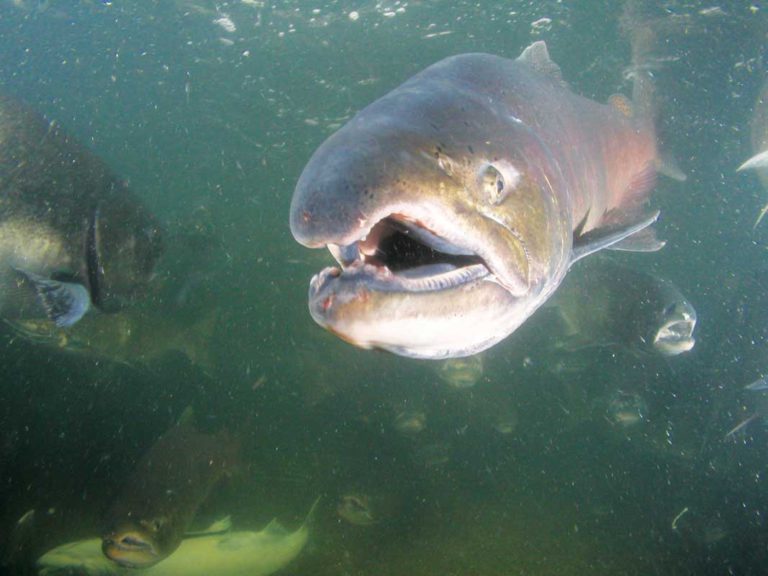
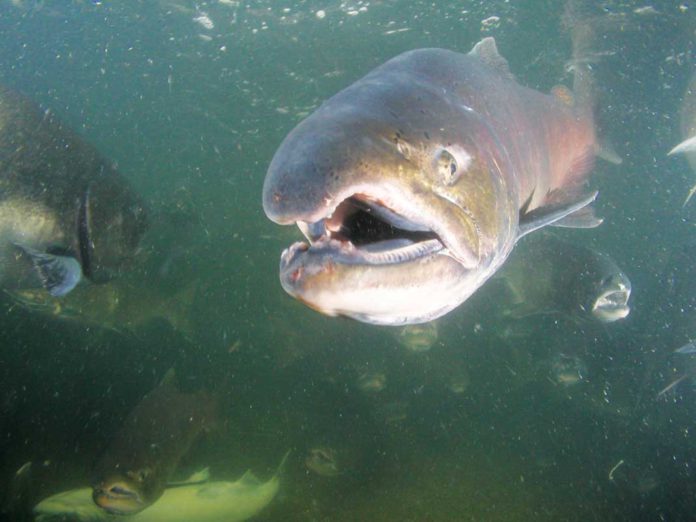
As California’s native Chinook salmon populations dwindle, prompting a shutdown of the fishing industry, environmentalists are pleading with water supply managers for a change of course that they say could save the keystone fish.
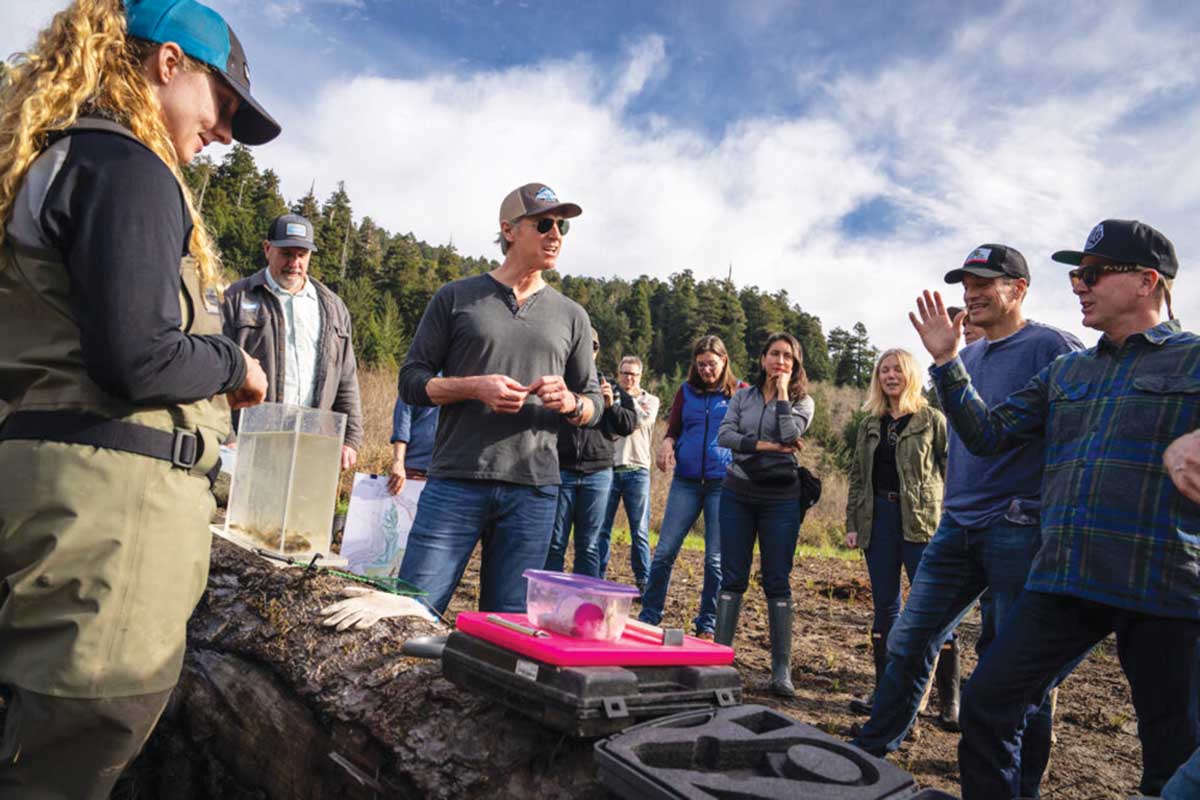
On Earth Day, several dozen people gathered on the sidewalk outside San Francisco City Hall to demand that the city’s water provider revise its system for capturing flows from the Tuolumne River, a San Joaquin River tributary and a major source of peninsula water supplies.
“Their terrible water policies don’t just harm the environment, but they harm people and communities,” said Peter Drekmeier, policy director with the Tuolumne River Trust, an environmental advocate.
Drekmeier’s beef with the San Francisco Public Utilities Commission goes back years and rests on the premise that the agency stores far more water than it needs in Hetch Hetchy Reservoir, on the upper Tuolumne, at the expense of the river downstream. The commission’s water management plan is based on the unlikely possibility of an 8.5-year drought—a theoretical disaster dubbed the “design drought” that critics consider overkill.
He cited an analysis that concluded such a drought might occur once in 25,000 years. The commission, which ordered the report, said those results were flawed and cannot be trusted for management decisions.
Environmentalists insist the agency could take a more fish-friendly approach, releasing more water through O’Shaughnessy Dam into the Tuolumne River while still providing adequate supplies for its 2.7 million customers. Just cutting the design drought short by 18 months—to seven years—would make all the difference to the fish, Drekmeier said. He and other environmentalists insist that higher average flows through the Tuolumne and into the San Joaquin would boost salmon numbers.
San Francisco resident and retired botanist Mary Butterwick held a sign on the City Hall steps that read “Honor Tribal Rights.” She said she feels the city of San Francisco has captured a water resource that belongs to others.
“The salmon have the senior water rights,” Butterwick said.
But today, San Francisco and two farming districts in the northern San Joaquin Valley control most of the river’s water. Together, the partners deprive the lower Tuolumne of so much flow that in most years, during key life stages for salmon, it trickles like a creek. This aggressive use of the river comes against the recommendation of California water officials, who in 2018 recommended substantially higher flows in the San Joaquin river system to revive the ecosystem.
The utilities commission and irrigation districts answered by suing the state three years ago. In March, a judge with the Sacramento Superior Court tossed out the lawsuits.
Nancy Crowley, press secretary with the San Francisco Public Utilities Commission, said the city’s water agency is reviewing the decision to determine its next steps.
At an April 23 commission meeting immediately following the sidewalk rally, a procession of speakers representing fishers, tribes, NGOs and disadvantaged communities publicly urged the commissioners to accept the court decision and boost the Tuolumne’s flows.
Farm groups and their lobbyists—and the San Francisco Public Utilities Commission—tend to downplay the ecological impacts of taking water from rivers.
Cintia Cortez, policy analyst with the group Restore the Delta, said the commission’s water management plan is formulated after racist statewide policies that “displaced tribes from their ancestral homelands.” She said communities downstream from the Tuolumne must contend today with the results of reduced flows, including toxic algal blooms.
Michael Frost, a board member with the same organization, called the city’s water policies “rapacious,” blaming the commission for the breakdown of a biodiversity hotspot and the largest estuary ecosystem in the West.
“We are at extinction levels of salmon,” he said.
Decline
Before European Americans swarmed California, adult Chinook salmon returned to spawn in the Sacramento and San Joaquin rivers in legendary numbers, with estimates suggesting runs of 1 to 2 million fish each year. The Tuolumne River’s annual contribution to this salmon population amounted to tens of thousands—maybe more.
In the past decade, the Central Valley’s Chinook runs have averaged around 150,000, mostly fall-run Sacramento fish. Just 186 adult Chinook returned to the Tuolumne in 2021, with a promising jump to more than 1,100 in 2023.
The Chinook decline, which has culminated in closure of the state’s salmon fishing season the last two years, has fueled decades of feuding between stakeholders. Fishery proponents contend that state policies unevenly distribute California’s water resources. Farms, they say, get unfair priority, ultimately taking from Central Valley rivers more water than aquatic ecosystems can handle.
“The water policies of California are decimating the fish,” said Scott Artis, the executive director of the Golden State Salmon Association.
Farmers and their allies in the legislature hotly contest this allegation, frequently arguing that farms don’t receive nearly enough water. Two weeks ago, Rep. David Valadao, of San Joaquin Valley, spoke on the House floor, urging the U.S. Bureau of Reclamation to increase water deliveries to the region’s farms.
“Food security is national security, and our ability to grow food for the nation will not survive without reliable water supply for south-of-Delta agriculture,” Valadao said.
But surface water shortages are often mitigated by groundwater pumping. In fact, state crop reports show record hauls of valuable nut and grape crops year after year for decades, with drought periods having little to no impact on harvest. Recent dips in price have resulted largely from oversupply.
Last year, Gov. Gavin Newsom outraged environmental watchdogs by dismantling basic protections on minimum environmental flows through the Sacramento-San Joaquin Delta to allow water managers to store more of the resource in upstream reservoirs. Critics said the action would mostly benefit growers. Similar waivers were issued in prior years, and every critically dry year in the last decade.
Another pattern that has agitated salmon proponents is the repeated failure of state and federal officials to maintain a flow of cold water—vital for spawning salmon—downstream of Shasta Dam and Lake Shasta, the state’s largest reservoir. This happens, critics say, when the Bureau of Reclamation releases too much water during the spring and summer irrigation season. Lake levels drop, and water temperatures climb. This process has killed almost all the fertilized salmon eggs and juveniles in the Sacramento River in recent years.
Fishery advocates saw the subsequent collapse coming.
“There is nothing surprising here,” said Barry Nelson, a water policy consultant to the Golden State Salmon Association. “When you kill almost all the babies, you get dismal returns three years later.”
Strategy
STRATEGY Gov. Gavin Newsom’s Salmon Strategy specifies the six priorities and 71 actions to build healthier, thriving salmon populations in California. Photo courtesy of the Office of the Governor
In January, Newsom cited this problem in his “California Salmon Strategy,” a 37-page brochure of proposed recovery actions. It says state agencies and partners will … “[b]y 2025, where appropriate, revise and modernize approaches for Shasta Reservoir management to protect water quality and temperature management for salmon.” The document offers caveats, notably that actions must be considered “in light of other competing beneficial uses of water.”
The number-one competitor for Shasta’s water is agriculture.
Farm groups and their lobbyists—and the San Francisco Public Utilities Commission—tend to downplay the ecological impacts of taking water from rivers. More frequently, water supply advocates blame invasive species, pollution, dams, habitat loss, climate change, poor ocean productivity and overfishing for the breakdown of the Central Valley’s salmon populations.
All of these are plausible factors with known impacts to salmon. In fact, commercial harvest in 2022 probably significantly dented that fall’s spawning returns. That summer, the commercial fleet caught far more salmon than fishery managers anticipated. It was also more than they could sell. Sources said that heaps of Chinook salmon rotted on boats.
Still, most scientists lean on river flows, not fishing pressure, as a key driver of salmon numbers. Historical records of annual precipitation and salmon returns reflect this relationship.
“Every year, nature does an experiment for us … and there’s a very strong pattern where every time flows are high, we get a higher percentage of eggs turning into juveniles, and we get more fish returning three years later,” said Jon Rosenfield, science director at the group San Francisco Baykeeper.
This pattern is not just a correlation, he added, as “there are mechanisms [related to flow volume] that we know drive fish abundance.”
To help the Tuolumne’s salmon, the San Francisco Public Utilities Commission and its partner irrigation districts have proposed habitat improvement measures through a plan dubbed the Tuolumne River Voluntary Agreement. With the landscape restoration group River Partners, the agencies plan to rebuild 77 acres of floodplain beside the river by 2030. This work will be complemented by the addition of 100,000 tons of gravel, the substrate in which salmon lay and fertilize their eggs.
But these measures may have their weaknesses. For one, there is a question about the need for enhanced spawning habitat. In 2008, state and federal fishery biologists found that productive nursery habitat for juvenile salmon in the Tuolumne was, at the time, a greater limiting factor on the river’s salmon production than spawning success.
“[P]roducing more fry by restoring spawning habitat is unlikely to increase adult recruitment,” the scientists wrote in a report.
And restored floodplains do little good unless they are routinely submerged for extended periods—what some say the city’s flow plan for the Tuolumne will fail to do.
“Is it really habitat if there’s no water?” Artis asked.
The city’s voluntary agreement includes actions that specifically address this concern. For instance, it proposes lowering the level of floodplains to facilitate inundation by the river and fish access.
It also calls for added water—but not enough, critics say. State wildlife officials suggested in 2013 that the San Joaquin system be maintained at an average of 60% of all the water in the watershed at a given time—a measure called unimpaired flow. This, they said, would serve as a foundation for restoring salmon runs. In 2018, the State Water Resources Control Board proposed a compromised target of 40% unimpaired flow.
But that number remains a distant goal post. Most years, the Tuolumne’s unimpaired flow ranges between 10% and 20%, while years’ worth of stored water lie idled in Hetch Hetchy. The voluntary agreement will result in an average unimpaired flow of 16%, according to a 2023 analysis by Greg Reis, a staff hydrologist with The Bay Institute.
Such meager flows result in sluggish, warm water downstream of the river’s dams, and it often leaves valuable floodplain habitat high and dry.
Rosenfield, with Baykeeper, noted that even 40% unimpaired flow still tends to be inadequate in California salmon rivers.
“At numbers over 50%, you really start to see more frequent benefits of flow,” he said.
In a Japanese mountain community not far from Tokyo, a quiet, unassuming handyperson named Takumi (played by Omika Hitoshi) lives with his eight-year-old daughter, Hana (Nishikawa Ryô). While Hana attends the village school, her father engages in a number of back-country odd jobs, including gathering fresh water and wild wasabi for a local udon restaurant—the clear mountain stream water gives the udon a unique flavor.
Filmmaker Hamaguchi Ryûsuke’s ominously titled drama, Evil Does Not Exist, takes care to show that Takumi and Hana’s simple, idyllic family life depends on observing and interacting with the natural environment. But their lifestyle is fragile, almost too good to be true.
A Tokyo developer wants to build a “glamping” tourist attraction in the nearby forest where Takumi and Hana live, and has sent a pair of salespersons to convince the villagers it’s a bright, money-making idea. None of them are buying that argument, and the meeting dissolves into a tense standoff.
In some eco-dramas, such a disagreement might lead to vigorous protests or even open violence, but that’s not how director Hamaguchi (Drive My Car) operates. Instead, the poison represented by a thoughtlessly planned commercial development seeps into the village slowly, silently, in a careful procession of disturbing signs and symbols.
Shotgun and rifle blasts from deer hunters echo through the forest. Residents begin to worry about fire prevention and the water supply. The developer—which uses the juvenile corporate brand name Playmode—doesn’t seem to comprehend what Takumi means when he warns that the proposed luxury camping project is located on a deer trail. The main thing Playmode is concerned about is taking advantage of government pandemic subsidies to finance the development.
A member of the Playmode sales team, Ms. Mayuzumi (Shibutani Ayaka), starts to have personal doubts about tromping in the wilderness after listening to Takumi and his friends’ passionate objections. Her associate, Takahashi (Kosaka Ryûji), comes to more or less the same realization, even though it means they could both lose their jobs. However, there’s also a sinister underlying force at work in the mountains.
The director, his screenwriting collaborator Ishibashi Eiko—she’s also the composer of the haunting musical score—and cinematographer Kitagawa Yoshio install the subtlest whisper of impending dread to the story, as in the long, long Terrence Malick-style tilted-up tracking shot of trees that introduces the action. And the recurring glimpse of a decaying deer carcass. The signs are obvious to Takumi the woodsman and Hana the headstrong schoolgirl.
Hamaguchi is not afraid to quote classic Japanese films to make his point about the spiritual dangers of daring to despoil the landscape. The slyly humorous wood-chopping showdown between Takumi and Takahashi is plucked from Kurosawa Akira’s Seven Samurai.
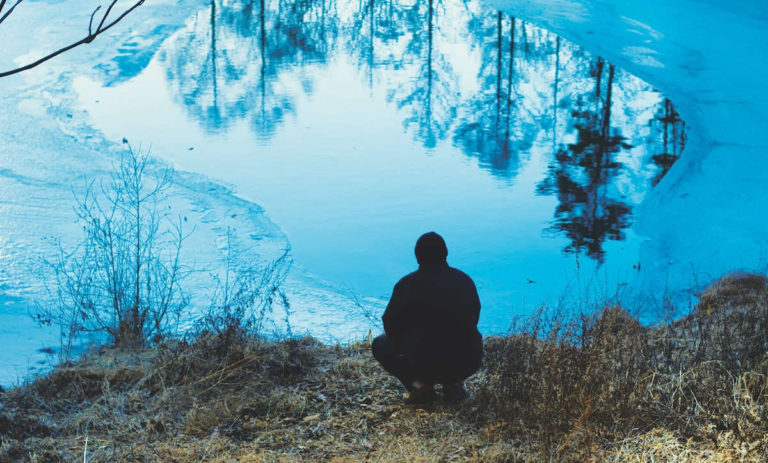
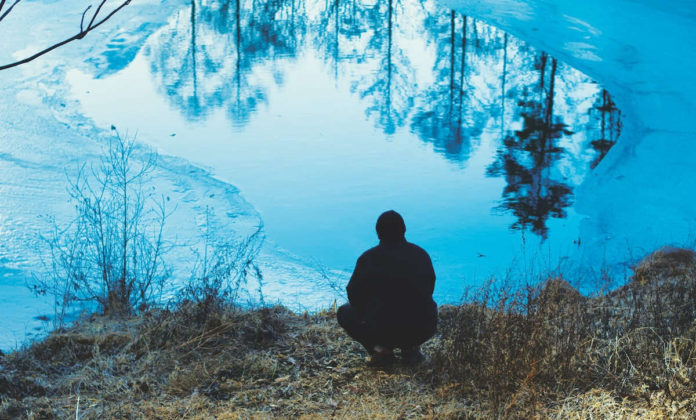
And when Takumi takes a moment to ponder the frozen water of a pond in the midst of searching for his daughter, Hana, who has suddenly gone missing, we’re reminded of the sad fate of Anju, another lost girl, in Mizoguchi Kenji’s Sansho the Bailiff. The point seems to be that certain spirits are alive in the woods, and that they’ve always been there.
Evil Does Not Exist also shares the mood of ecological peril that filmmaker Kurosawa Kiyoshi displayed in his 1999 films, Charisma and Barren Illusions. The “Other Kurosawa” seems to prefer thoroughly supernatural origins for the bizarre occurrences that upset the environment.
For Hamaguchi, the veil of doom descends on the otherwise sweet little community as the direct result of the all-too-human profit motive. It’s a natural reaction to the thousands of tiny transgressions human beings have visited on this splendid setting.
Evil Does Not Exist, an outdoorsy chamber piece, uses its understatement wisely. For every insult toward the earth, the natural world exacts a price. Not even Takumi, the humble holy man, can stop it. If Drive My Car was the tragedy of a modern man, Evil Does Not Exist is modern man’s comeuppance, served magnificently chilled.
ARIES (March 21-April 19): Polish-born author Joseph Conrad (1857–1924) didn’t begin to speak English until he was 21 years old. At 25, his writing in that language was still stiff and stilted. Yet during the next 40+ years, he employed his adopted tongue to write 19 novels, numerous short stories and several other books. Today he is regarded as one of the greatest writers in the English language. You may not embark on an equally spectacular growth period in the coming months, Aries. But you do have extra power to begin mastering a skill or subject that could ultimately be crucial to your life story. Be inspired by Conrad’s magnificent accomplishments.
TAURUS (April 20-May 20): Hypothetically, you could learn to give a stirring rendering of Beethoven’s Symphony No. 5 on a slide whistle. Or you could perform the “To be or not to be” soliloquy from Shakespeare’s Hamlet for an audience of pigeons that aren’t even paying attention. Theoretically, you could pour out your adoration to an unattainable celebrity or give a big tip to a waiter who provided mediocre service or do your finest singing at a karaoke bar with two people in the audience. But I hope you will offer your skills and gifts with more discernment and panache, Taurus—especially these days. Don’t offer yourself carelessly. Give your blessings only to people who deeply appreciate them.
GEMINI (May 21-June 20): When I lived in San Francisco in 1995, thieves stole my Chevy Malibu. It was during the celebratory mayhem that swept the city following the local football team’s Super Bowl victory. Cops miraculously recovered my car, but it had been irrevocably damaged in one specific way: It could no longer drive in reverse. Since I couldn’t afford a new vehicle, I kept it for the next two years, carefully avoiding situations when I would need to go backward. It was a perfect metaphor for my life in those days. Now I’m suggesting you consider adopting it for yours. From what I can discern, there will be no turning around anytime soon. Don’t look back. Onward to the future!
CANCER (June 21-July 22): Cancerian basketball coach Tara VanDerveer is in the Women’s Basketball Hall of Fame. She won more games than anyone else in the sport. Here’s one aspect of her approach to coaching. She says that the greatest players “have a screw loose”—and she regards that as a very good thing. I take her to mean that the superstars are eccentric, zealous, unruly and daring. They don’t conform to normal theories about how to succeed. They have a wild originality and fanatical drive for excellence. If you might ever be interested in exploring the possible advantages of having a screw loose for the sake of your ambitions, the coming months will be one of the best times ever.
LEO (July 23-Aug. 22): Am I one of your father figures, uncle figures or brother figures? I hope so! I have worked hard to purge the toxic aspects of masculinity that I inherited from my culture. And I have diligently and gleefully cultivated the most beautiful aspects of masculinity. Plus, my feminist principles have been ripening and growing stronger for many years. With that as our background, I encourage you to spend the coming weeks upgrading your own relationship to the masculine archetype, no matter which of the 77 genders you might be. I see this as an excellent time for you to take practical measures to get the very best male influences in your life.
VIRGO (Aug. 23-Sept. 22): Now that your mind, your heart and your world have opened wider than you imagined possible, try to anticipate how they might close down if you’re not always as bold and brave as you have been in recent months. Then sign a contract with yourself, promising that you will not permit your mind, your heart and your world to shrink or narrow. If you proactively heal your fears before they break out, maybe they won’t break out. (P.S.: I will acknowledge that there may eventually be a bit of contraction you should allow to fully integrate the changes—but only a bit.)
LIBRA (Sept. 23-Oct. 22): I would love you to cultivate connections with characters who can give you shimmery secrets and scintillating stories you need to hear. In my astrological opinion, you are in a phase when you require more fascination, amazement and intrigue than usual. If love and sex are included in the exchange, so much the better—but they are not mandatory elements in your assignment. The main thing is this: For the sake of your mental, physical and spiritual health, you must get your limitations dissolved, your understanding of reality enriched and your vision of the future expanded.
SCORPIO (Oct. 23-Nov. 21): Scorpio writer Andrew Solomon made a very Scorpionic comment when he wrote, “We all have our darkness, and the trick is making something exalted of it.” Of all the signs of the zodiac, you have the greatest potential to accomplish this heroic transmutation—and to do it with panache, artistry and even tenderness. I trust you are ready for another few rounds of your mysterious specialty. The people in your life would benefit from it almost as much as you.
SAGITTARIUS (Nov. 22-Dec. 21): Have you been nursing the hope that someday you will retrain your loved ones? That you will change them in ways that make them act more sensibly? That you will convince them to shed qualities you don’t like and keep just the good parts? If so, the coming weeks will be an excellent time to drop this fantasy. In its place, I advise you to go through whatever mental gymnastics are necessary as you come to accept and love them exactly as they are. If you can manage that, there will be a bonus development: You will be more inclined to accept and love yourself exactly as you are.
CAPRICORN (Dec. 22-Jan. 19): I brazenly predict that in the next 11 months, you will get closer than ever before to doing your dream job. Because of your clear intentions, your diligent pragmatism and the Fates’ grace, life will present you with good opportunities to earn money by doing what you love and providing an excellent service to your fellow creatures. But I’m not necessarily saying everything will unfold with perfection. And I am a bit afraid that you will fail to capitalize on your chances by being too insistent on perfection. Please assuage my doubts, Capricorn! Welcome imperfect but interesting progress.
AQUARIUS (Jan. 20-Feb. 18): In his book, Ambivalent Zen, Lawrence Shainberg mourns that even while meditating, his mind is always fleeing from the present moment—forever “lurching towards the future or clinging to the past.” I don’t agree that this is a terrible thing. In fact, it’s a consummately human characteristic. Why demonize and deride it? But I can also see the value of spending quality time in the here and now—enjoying each new unpredictable moment without compulsively referencing it to other times and places. I bring this up, Aquarius, because I believe that in the coming weeks, you can enjoy far more free time in the rich and resonant present than is normally possible for you. Make “BE HERE NOW” your gentle, relaxing battle cry.
PISCES (Feb. 19-March 20): Two-thirds of us claim to have had a paranormal encounter. One-fourth say they can telepathically sense other people’s emotions. One-fifth have had conversations with the spirits of the dead. As you might guess, the percentage of Pisceans in each category is higher than all the rest of the zodiac signs. And I suspect that number will be even more elevated than usual in the coming weeks. I hope you love spooky fun and uncanny mysteries and semi-miraculous epiphanies! Here they come.
Homework: I dare you to utterly renounce and dispose of a resentment you’ve held onto for a while. Newsletter.FreeWillAstrology.com.
Larkspur’s The Lark Theater continues its revue, Side by Side by Sondheim, featuring a collection of Stephen Sondheim’s most beloved songs through May 25.
The show includes classics like “Send in the Clowns” (A Little Night Music), “Side by Side” and “Company” (Company), “I’m Still Here” and “Broadway Baby” (Follies), and more. The songs, performed by a talented cast of five (Ashley Rae Little, Ken Brill, Maureen McVerry, Simon Barrad, and Emma Roos), are interspersed with intriguing stories about Sondheim’s career and the shows from which the songs originate.
Showtimes are Saturdays at 7:30 pm and Sundays at 2 pm through May 25. Tickets are $50 and available and tickets are here.
For some feel-good local news, look no further than the Petaluma-based inspirational and philanthropic organization Humans Being Media. Through three decades of documentary filmmaking, Humans Being Media has consistently worked to change the world for the better, one movie at a time.
The transformative power of media is undeniable, and those who choose to use this power for good are the unsung heroes whose hard work holds up humanity’s most precious resources: community, charity, and, of course, hope.
Humans Being Media’s list of community collaborators includes Vivalon, which works to provide Marin’s elders with support in aging; Lifehouse, which assists citizens with physical and mental disabilities; and The Sonder Project, which empowers impoverished communities through high-impact, sustainable development.
“There are just too many wonderful clients to name here,” said Humans Being Media co-founder Vince Beeton in a recent statement. “Folks who are committed to improving the world through DEI, climate, housing, education, you name it. We work with organizations who are making an impact in impressive and broad-sweeping ways, but also in smaller ways that ripple outward. It’s awe-inspiring, and keeps us hopeful about humanity and our shared future here on this beautiful planet.”
Among these clients and collaborators is Homeward Bound, a local philanthropic group dedicated to helping eradicate homelessness in Marin. Homeward Bound began 50 years ago in 1974 and has since provided 905 people with shelter and housing. The current goal of Homeward Bound is to celebrate the organization’s half-a-century of philanthropy by building 50 new homes to match their 50 years of service.
Homeward Bound also just so happens to be Humans Being Media’s longest-standing Marin County client. And, according to the Humans Being Media press release, Homeward Bound is, “an extraordinary social enterprise who supports the homeless community with housing and so much more—job training, career ladders and opportunities to get a foothold and stay housed and employed. Since 2013 they have created commercials, capital campaign films, and mini documentaries about folks who have benefited from Homeward Bound’s excellent work.”
“I love working with Humans Being Media because of…their commitment to changing the world by telling very human stories of transformation,” said Homeward Bound co-CEO Paul Fordham.
For about a decade now, Humans Being Media and Homeward Bound have collaborated to share the touching stories of those affected by homelessness in Marin County. By interviewing individuals and allowing them to tell their truths about the path leading to and through homelessness, these organizations hope to help humanize the unhoused neighbors of our community.
“We [Humans Being Media and Homeward Bound of Marin] met accidentally,” explained Fordham. “We were creating family housing, and we wanted to document the demolition of this run-down old hotel and tell the story of its transformation…into a place to build housing for 14 families who had nowhere to go. We wanted to document the destruction and rebuilding of the site as an allegory for rebirth. So, Vince [Beeton], from Humans Being, made a short documentary for us, and folks really responded well to the video.”
“So, we came up with this mini-documentary style together and found a winning formula and have had such an amazing response,” Fordham continued. “Being able to document and share all these stories of change and transformation over this period we’ve worked together, it’s been really powerful and impactful on our work in a ton of ways.”
Fordham began his work in helping combat homelessness in England, where he was born and raised. Working in a local shelter/church basement, Fordham’s expectations and preconceptions of homelessness were shattered by his first day. When he later moved to America, Fordham brought his passion, expertise and sense of empathy to the States.
“The trends that I’ve seen in California in particular, and in the Bay Area, have really changed since the great recession in 2007,” explained Fordham. “The homebuilding industry collapsed and disappeared from California, and it never came back. There’s a small number of homes being built, but never at the rate it was before. In the past five years in California, we’ve seen a huge increase in senior citizens—people in their 80s and even in their 90s, in homeless shelters because what they saved for retirement isn’t enough for the current rental market.”
“So, we have a huge housing shortage, and we don’t have enough housing units,” continued Fordham. “When there’s not enough supply, the demand goes up. So, then there are more people renting, the price goes up and so on…then those folks at the bottom get squeezed out…”
Fordham noted that his hometown of Bath in England had about 30 unhoused individuals to care for across the entire city. When he began volunteering in California, that number skyrocketed into the thousands. He described this culture shock as the underbelly of the U.S. that one doesn’t see in Hollywood movies.
This Marianas Trench of disparity between the idealized Hollywood movie version of America and the real deal highlights just how far media, its impact and its ripple effect can reach. This is why the collaborative work of Homeward Bound, Humans Being Media and the unhoused human beings of the North Bay banding together to make movies to educate and inspire is so very important.
“These mini four-minute documentaries give a lot of information in a short time,” said Fordham. “It’s really wonderful to be able to help humanize homeless people through film. And watching these videos can help demystify homelessness and educate to make change possible.”
“If you watch these videos, you’ll see they’re just people,” concluded Fordham. “The solution is producing more housing on all ranges. Housing for sale, for rental, and subsidized and general affordable housing for everybody. We just need more of everything. And if you say no to affordable housing, you’re saying yes to homelessness.”
In a world where much of the news we see is at best rather dreary and often disheartening, media that highlights goodness and inspires it in others is increasingly invaluable. And the seemingly simple act of showcasing positive changes, like the local scale endeavors of Homeward Bound and Humans Being Media—well, it invites in us all a certain permission to dream about how we too could change the world and maybe leave it a little better before we go.
To learn more about Homeward Bound of Marin, visit the website at hbofm.org or call 415.382.3363. Those interested in more Humans Being Media content and collaborations, visit humansbeingmedia.com for more info.
WATCH Humans Being Media’s videos can be accessed using a smartphone and this QR code:
The 2023 Lahaina, Maui wildfires wrought havoc, claiming over 100 lives, decimating thousands of homes and ravaging vast swathes of land, resulting in a staggering $6 billion in damages.
More than 14,000 individuals evacuated the island, grappling with homelessness or temporary displacement, shuttling between hotels in a repetitive cycle. In contrast to fire-resilient regions like Marin County, Hawaii lacks the fire-adaptive landscape of the American West.
Yet, the relentless onslaught of uncontrollable wildfires in states like Oregon and California challenges this perception. Given the difficult task of relocating those displaced by natural disasters, Marin County must prioritize local preparedness beyond wildfires.
While Marin County has been fortunate to evade major disasters (unlike its northern neighbor, Sonoma County), memories of growing up there are punctuated by fears sparked by distant wildfires. Initially dismissed by parents, concerns escalated as smoke blanketed the skies, schools closed and the region awoke to apocalyptic scenes.
With climate conditions worsening, the specter of a wildfire breaching Marin’s complacency looms large. California’s recent history bears witness to the escalation of wildfires, with three of the state’s eight largest blazes occurring in counties bordering or adjacent to Marin.
Despite this, local discourse rarely centers on preparedness for the county’s most imminent threat. Personal experiences fuel apprehensions about the community’s readiness in the face of disaster.
Regardless of existing policies and organizations, doubts persist about families’ ability to cope effectively. The irony is stark: In a county marked by wealth and privilege, many may find themselves unprepared and vulnerable in the event of a natural calamity.
The aftermath of the Maui wildfires serves as a cautionary tale. Temporary accommodations in hotels and condos offered little solace, mirroring the challenges Californians would face in finding alternative shelter.
The housing crunch in the Bay Area exacerbates these concerns, with affordable options scant for those displaced by disaster. Marin’s affluence belies a stark reality: A significant portion of its population struggles with poverty, rendering them particularly vulnerable in times of crisis.
A lack of swift, coordinated action could spell disaster for marginalized communities. It is imperative that Marin County, with its ample resources, formulate comprehensive contingency plans to confront the looming threat of catastrophe.
Adrien Gonthier is a Marin resident currently studying history and global politics at the University of Cal Poly San Luis Obispo.
Now in its third year, Marin County’s largest-drawing outdoor music festival returns with a lineup sure to please even the most avid music aficionado.
Curated by the fine folks who hold down the annual Noise Pop festival, Mill Valley Music Fest’s musical docket this year is quite impressive, with performances by Fleet Foxes, Greensky Bluegrass, Thee Sacred Souls, Margo Price, St. Paul & The Broken Bones, Fruit Bats, Rebirth Brass Band, Danielle Ponder, Eric Lindell and Elliott Peck.
Said Michelle Swing, CEO of Noise Pop Industries, “Mill Valley Music Fest is coming back bigger and better than ever in ’24. Major kudos to the team for curating such an impressive and eclectic lineup, one that really stands out from the crowd and attracts music lovers of all kinds to Mill Valley.”
First-time concert-goers can expect myriad food options, craft beer from the immediate and outer-lying areas, a dedicated gaming area, a roller skating rink, art installations and a whole lot more in a setting like no other. Nestled in a redwood tree-surrounded plot, MVMF excels at providing fans with the consummate show experience.
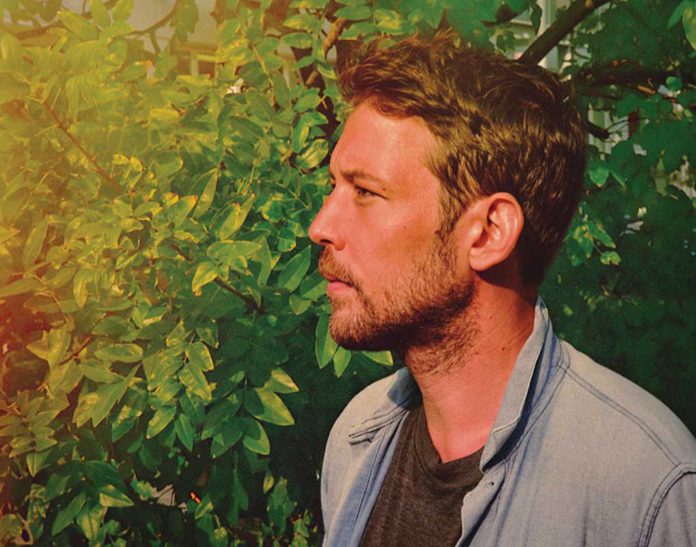
Founding member Robin Pecknold has been steering the ship for indie rock greats Fleet Foxes since 2006. And although nowhere as prolific as his adoring fans would hope for—he and his collective have only released four full-length albums, three extended plays and one live record—their latest record released in late 2020, the simply and aptly dubbed Shore, has been their most enduring.
Recorded before and during the pandemic, it finally saw the light of day when the music world needed it most. In many ways, it signaled Pecknold’s need to control his surroundings when, in fact, everything around him was falling apart.
Standout tracks from their ambitious 15-track record include (but are not limited to) “Can I Believe In You?,” “Sunblind,” the short-but-sweet album opener “Wading in Waist-High Water” and “Maestranza” are filled with sweeping highs and lows. Shore treats its listener to large-scale sweeping melodies with a lovely array of instrumentation giving way to a newer, more emboldened Fleet Foxes experience.
Shore has also received numerous accolades both in the press and on countless independent radio stations all over the U.S. After ending up on myriad 2020 year-end lists, the record was featured in such disparate publications as Mojo, The New Yorker, Uncut, USA Today, Pitchfork, Rolling Stone, SPIN, Stereogum and VICE, as well as on NPR. More importantly, the music found new fans at multiple radio formats.
For those fans expecting a repeat of their earlier output, it may be a head-scratcher. Marking their most complete collection of songs to date, it’s a heady and oftentimes depressing affair that always seems to find its own light at the end of the tunnel. Whether or not that is Pecknold’s intent, Shore is an all-inclusive affair that beckons to be enjoyed in its entirety rather than piece-by-piece, and especially so in a live setting.
And for the band’s many fans who saw them with My Morning Jacket at the Greek Theatre in Berkeley back in August 2023, their return is greatly anticipated.
Fleet Foxes play the Mill Valley Music Festival at Friends Field, 180 Camino Alto, Mill Valley, May 11. Tickets start at $145 per day. 2-day passes are $239, and VIP options are available at millvalleymusicfest.com. All ages are welcome.
A recent survey by the Leadership Now Project, a bi-partisan pro-democracy group of 400 corporations, reveals that 85% of business leaders believe a well-functioning democracy is essential to a healthy business climate, and 78% are concerned about the condition of American democracy today. Hey, no kidding.
Another way of looking at it is that 15% don’t care about democracy, and...
Zapped
The PG&E-owned Public Utilities Commission approved a PG&E rate hike last Thursday that will add about $5 a month to the average bill, and it could begin as soon as next month.
Why are Californians continuing to pay for inept “leadership” at PG&E? Why is the governor packing the CPUC with compliant members at the expense of a coherent energy...
Larkspur
Sondheim for a Lark
Larkspur’s The Lark Theater continues its revue, Side by Side by Sondheim, featuring a collection of Stephen Sondheim’s most beloved songs, through May 25. The show includes classics like “Send in the Clowns” (A Little Night Music), “Side by Side” and “Company” (Company), “I’m Still Here” and “Broadway Baby” (Follies) and more. The songs, performed by...
As California’s native Chinook salmon populations dwindle, prompting a shutdown of the fishing industry, environmentalists are pleading with water supply managers for a change of course that they say could save the keystone fish.
On Earth Day, several dozen people gathered on the sidewalk outside San Francisco City Hall to demand that the city’s water provider revise its system for...
In a Japanese mountain community not far from Tokyo, a quiet, unassuming handyperson named Takumi (played by Omika Hitoshi) lives with his eight-year-old daughter, Hana (Nishikawa Ryô). While Hana attends the village school, her father engages in a number of back-country odd jobs, including gathering fresh water and wild wasabi for a local udon restaurant—the clear mountain stream water...
ARIES (March 21-April 19): Polish-born author Joseph Conrad (1857–1924) didn’t begin to speak English until he was 21 years old. At 25, his writing in that language was still stiff and stilted. Yet during the next 40+ years, he employed his adopted tongue to write 19 novels, numerous short stories and several other books. Today he is regarded as...
Larkspur's The Lark Theater continues its revue, Side by Side by Sondheim, featuring a collection of Stephen Sondheim's most beloved songs through May 25.
The show includes classics like “Send in the Clowns” (A Little Night Music), “Side by Side” and “Company” (Company), “I’m Still Here” and “Broadway Baby” (Follies), and more. The songs, performed by a talented cast of...
For some feel-good local news, look no further than the Petaluma-based inspirational and philanthropic organization Humans Being Media. Through three decades of documentary filmmaking, Humans Being Media has consistently worked to change the world for the better, one movie at a time.
The transformative power of media is undeniable, and those who choose to use this power for good are...
The 2023 Lahaina, Maui wildfires wrought havoc, claiming over 100 lives, decimating thousands of homes and ravaging vast swathes of land, resulting in a staggering $6 billion in damages.
More than 14,000 individuals evacuated the island, grappling with homelessness or temporary displacement, shuttling between hotels in a repetitive cycle. In contrast to fire-resilient regions like Marin County, Hawaii lacks the...
Now in its third year, Marin County’s largest-drawing outdoor music festival returns with a lineup sure to please even the most avid music aficionado.
Curated by the fine folks who hold down the annual Noise Pop festival, Mill Valley Music Fest’s musical docket this year is quite impressive, with performances by Fleet Foxes, Greensky Bluegrass, Thee Sacred Souls, Margo Price,...