While the Thursday and Sunday San Rafael Civic Center farmers markets have been in operation since 1983 and 1987, respectively, it wasn’t until 2010 when the Agricultural Institute of Marin (AIM) was officially formed that a farm audit program was put in place to ensure the integrity of the markets.
Today, AIM not only verifies where and how food is grown by the participating farmers and producers; the 501(c)3 nonprofit operates nine certified farmers markets across the Bay Area, offers a mobile market and serves two million annual market shoppers. More than 400 small and midsize producers participate from 40 plus California counties.
For many of us, a trip to one of these venerable markets is a weekly excursion. The Thursday market, aka “the chef’s market,” is well known to be favored by food professionals who typically arrive early (both markets are open from 8am-1pm) and utilize the designated chef parking spots, allowing them easy in-and-out access so they can get back to their kitchens. For the rest of us, a more leisurely stroll through the aisles to assess who has the best-looking satsumas, rainbow Swiss chard or radishes is de rigueur.
As if this wasn’t enjoyable enough, it’s about to get even better.
Marin residents likely recall when Measure B passed by an 83% margin back in June 2014. It allowed for a permanent place for the local farmers market at the Marin Center on the Civic Center campus that would include a market canopy and a market building proposed by AIM of up to 30,000 square feet in size. The site is referred to as the Christmas tree lot—a triangular space that measures 3.7 acres.
While it was exceedingly apparent there was little opposition to a permanent market at the Civic Center, it still had a long road ahead. Thus—for the last 10 years, along with an executive director change at AIM and multiple iterations of what this market they once dubbed, “the world’s most visionary farmers market” would look like—it still faced hurdles, not the least of which was raising enough money to bring the revised vision to fruition.
As Peggy Smith, co-founder of Cowgirl Creamery and current chairperson of AIM’s board of directors, noted, “It took a while to iron out the lease—there were roadblocks—we needed to be sure there was continued access to the property when the market wasn’t in operation.” And as a result, one of the major pivots to the plan included changing the design from an enclosed permanent structure—think Market Hall or the Ferry Building—to include canopied shade structures that allowed for more multi-use access and were also more aligned with AIM’s sustainability mission.
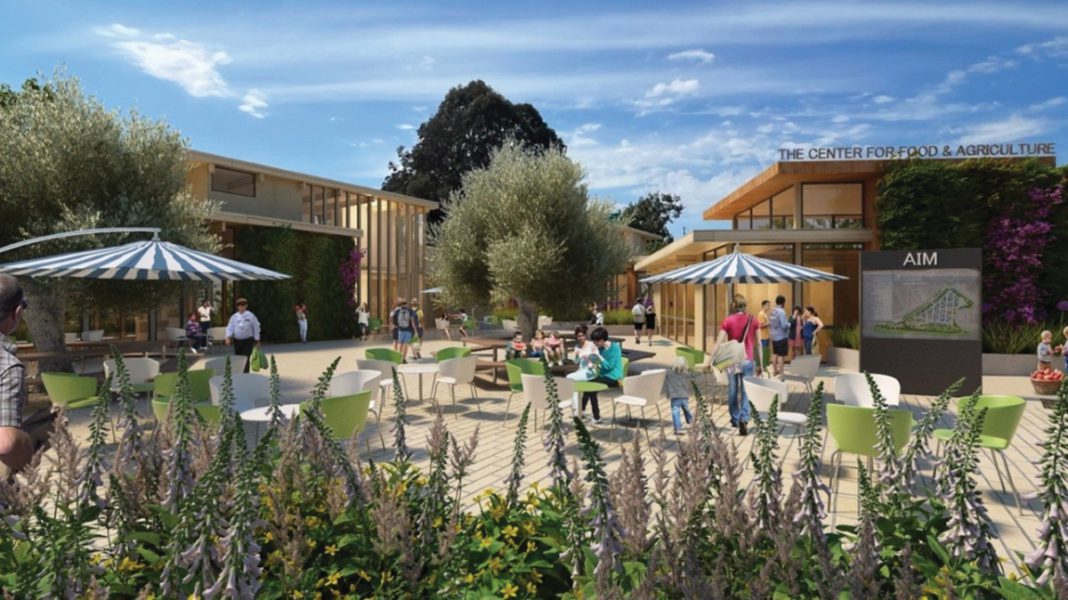
Three months ago, AIM and Marin County finalized a 40-year lease that secures a campus for the permanent and enhanced farmers market as well as a proposed Food Innovation Hub. The two entities will make up the Center for Food and Agriculture (CFA). The ambitious plan has two phases—the first includes rolling out the enhanced farmers market by mid 2027, and the Food Innovation Hub is slated for 2028.
Unsurprisingly, one of the people most excited about this recent development is AIM’s executive director, Andy Naja-Riese, who came on board in 2018 and brings his extensive background in federal public health policy and food inequity from his time spent at the USDA and CDC. Naja-Riese stresses, “The lease agreement demonstrates Marin’s belief in resilient local food systems, climate smart infrastructure and shared public benefit.”
And while he keeps the big picture in mind, he and his team, with oversight from the organization’s board of directors, have hired a local landscape architect to design the space. Also, structural and environmental engineers have been secured, along with a real estate firm that assists nonprofits with project management. Because the Frank Lloyd Wright Building Conservancy shares the Marin Civic Center location, three Usonian-style buildings were incorporated into the plan (phase 2) to fit with the famed architect’s style.
“We really want to be sure we are creating and emphasizing a state-of-the-art farmers market. We want permanent amenities like drinking water and ADA accessible bathrooms. It’s always just been an empty parking lot—we want to bring the community together in a much nicer space,” explains Naja–Riese. He is clearly committed to transforming these markets into what he hopes will become “the third place” for many.
“One of the goals of the permanent market is to create an infrastructure that is fully electric, so producers will no longer be solely reliant on generators,” explains Anna Candee, AIM’s community engagement specialist, who expertly guides shoppers through a large model of the proposed market out of AIM’s booth.
Candee points out three 11-foot-tall permanent shade structures that will provide shoppers with shade and rain protection. There are currently 215 occupied spaces for market vendors, and the new plan will allow for 220. In addition, a third market day (Tuesday) has been proposed for the revised iteration.
“As a farmer, this (new market plan) is the best opportunity to connect even more to the community,” says Nick Petkov of SunBlaze Ranch, who brings his coveted satsumas from his 18-acre farm in Winters to the Thursday market. “I want this to be not just a farmers market—I want it to be a destination,” says Petkov, viewing the expansion as providing multiple opportunities for growth for farmers and producers. He is especially enthusiastic about the second phase of the plan—the Food Innovation Hub that includes plans for a café, indoor/outdoor classrooms, and producer training and support programs.
“We sold out three weeks in advance for our yearly fundraiser, Gather,” says AIM’s director of development, Jasson Minadakis, who reports the total amount raised for the project is now at $7.2 million. AIM doesn’t divulge the projected cost for the entire program, as the bidding process is now beginning. But with its ambitious scope, it’s safe to say there is much more fundraising ahead.
If all goes to plan, the site preparation and infrastructure for the 3.7-acre lot will be completed early next year. Construction is slated to begin in mid 2026, and by the middle of 2027 a grand opening of the market is projected.
Back in 2015, the Pacific Sun ran a story about this planned emporium that was titled “Keeping the Dream Alive.” Ten years later, it is safe to say the dream not only appears to be alive but will likely become a reality in the next couple of years.
To learn more and to donate to this impactful enterprise, visit agriculturalinstitute.org.