Alyssa Huang seriously loves science and math. And she’s on a mission to make every kid feel the same way.
That’s why she founded AspireED, an organization that makes learning science and math exciting and accessible—especially for low-income youth. In just two years, AspireED has served more than 1,100 students through after-school classes, mentorship and other programs.
Even more remarkable, Huang, 17, is a student herself. A junior at Branson School in Ross, she runs AspireED with the assistance of 30 high school and college students and several faculty advisors. Huang is all in.
“Outside of school and basketball, I spend most of my time on AspireED,” Huang said. “I brainstorm ideas, think about ways to execute them, ask for help from friends and teachers, and try those activities out.”
Huang and her small army of student volunteers are dedicated to helping young people become interested in STEM—science, technology, engineering and math. With boundless enthusiasm, they share their knowledge with elementary and middle school children.
The catalysts for AspireED were Huang’s two eye-opening experiences. In middle school, she joined the math team, but as one of the few girls participating, the mathlete often found it challenging and lonely.
During her freshman and sophomore years of high school, Huang tutored middle school students in math. That’s when she noticed a fundamental problem: Many of the students had little access to STEM resources in the classroom, after school or during the summer. The gears started turning for Huang.
Based on the two issues she uncovered, Huang decided to do some research, ultimately writing a paper on gender, socioeconomic status and STEM. The findings were troubling.
“I learned that women make up only 28% of the STEM workforce, and that students from lower income backgrounds earn STEM degrees at only one-third the rate of higher income peers,” Huang said. “This is important because STEM careers tend to be among the highest paying jobs and are important for economic mobility. And because STEM is important for national innovation.”
Huang’s research also revealed methods to close the STEM gaps. Offering accessible programs and mentorship, as well as addressing stereotypes, gives girls and low-income students the opportunity to catch up.
AspireED, with Huang at the helm, developed an educational model based on tried-and-true practices. She decided to use a peer teaching approach because her investigation showed that it improves learning and helps students gain confidence.
Initially, Huang did everything as AspireED’s sole volunteer. Soon enough, she recruited fellow students, those who also have a zeal for science and math, to join the STEM teaching effort.
“I started by tutoring and teaching weekend math classes to first generation middle school students, then later teaching after-school science classes,” she said. “We’ve since expanded to include student volunteers, community STEM events, STEM kit giveaways, STEM scholarships, a mentorship program and free online STEM resources.”
Huang and her cohorts teach free classes to low-income Latinx elementary school kids in San Rafael’s Canal neighborhood. The curriculum includes hands-on projects, keeping students engaged while they learn science and math principles.
“We cover activities like butterfly life cycle, watching caterpillars transform into pupae and then butterflies,” Huang said. “Three weeks later, [we] release the butterflies outdoors.”
The student teachers also help the younger children build a real “ant city” to observe how the insects work together in a colony. Another class favorite is launching mini rockets, with the kids learning about early acid-base reactions and gases.
AspireED’s mentorship program matches college students with high school students, taking into account their common interests. Mentors assist their protégés in navigating the complexities of college prep and STEM career paths.
“Our focus is on students who have limited access to college counseling,” Huang said. “My hope is that former mentees will become future mentors.”
Opportunities to ignite science and math curiosity in youth aren’t limited to the classroom and mentorship. Huang’s volunteer team goes out into the community to spread the wonders of science, showing up at fairs and other events. Young visitors to AspireED’s exhibit take part in science experiments and go home with a kit of STEM activities.
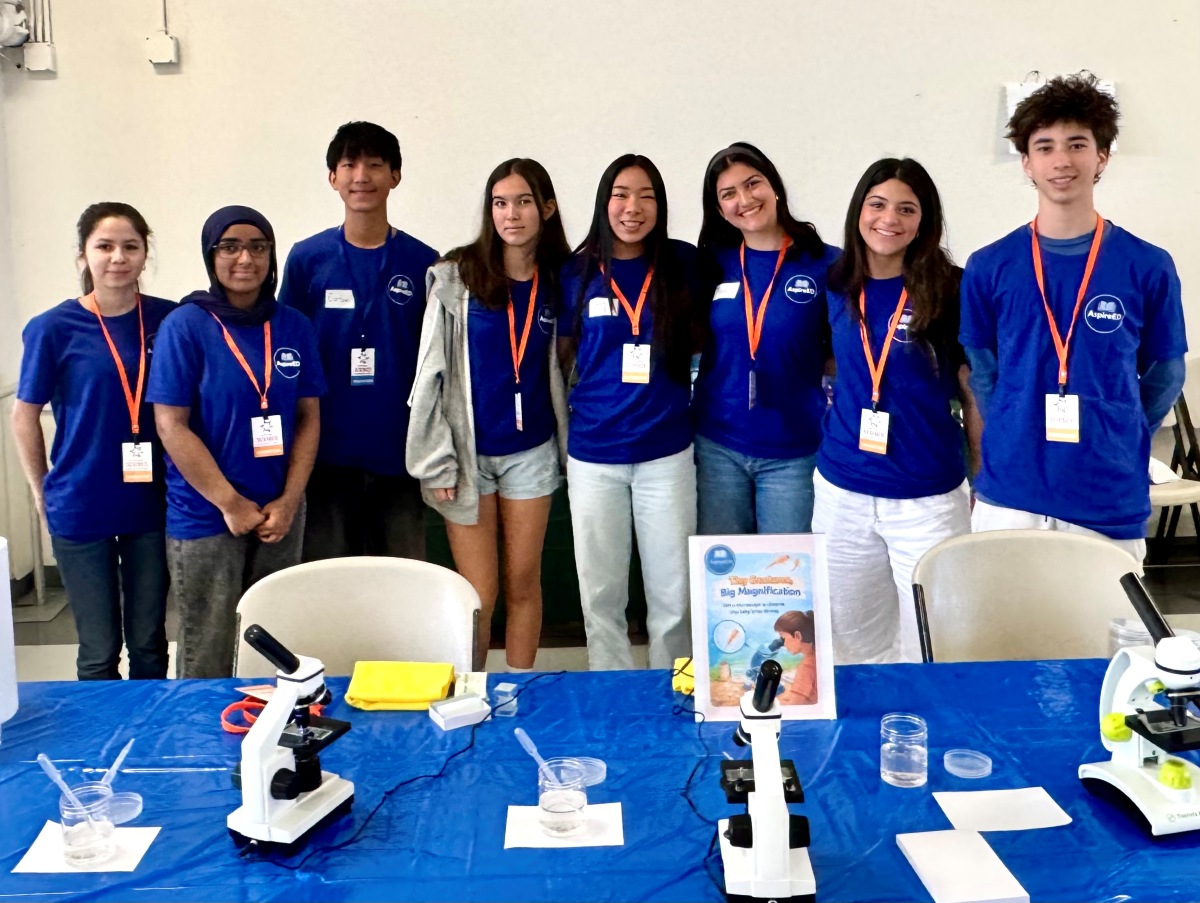
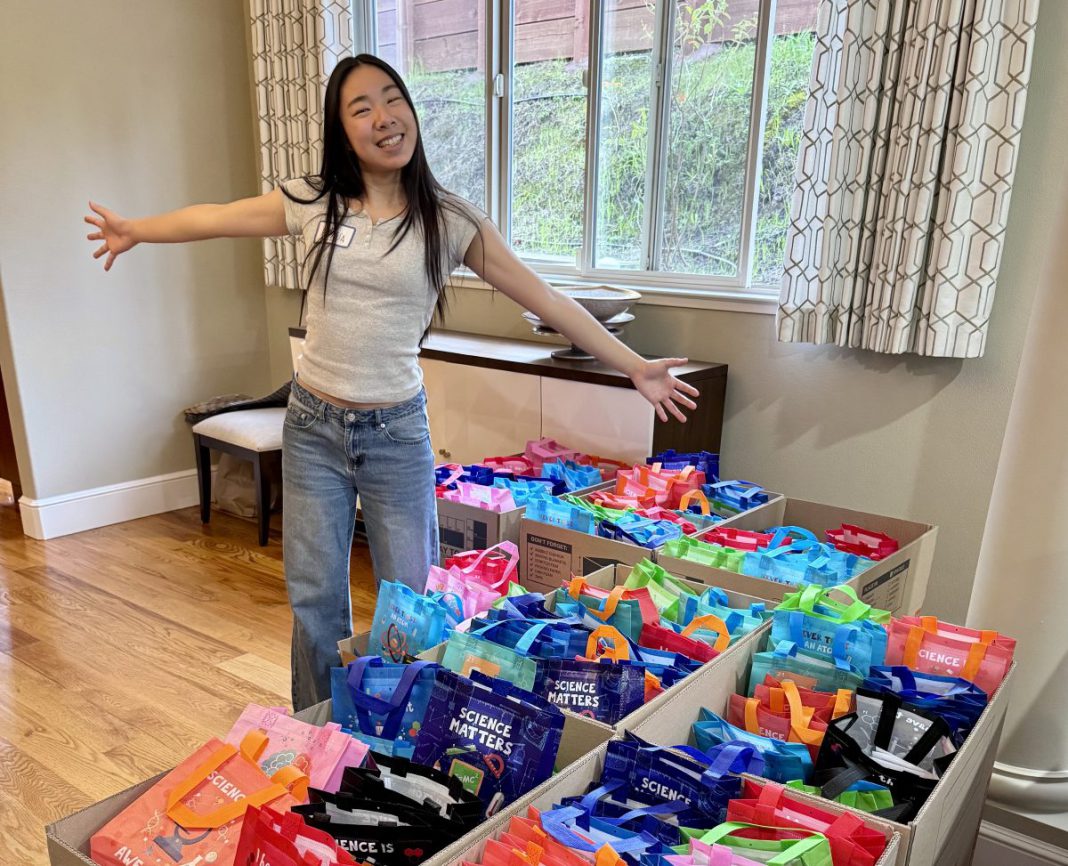
Earlier this month, AspireED’s student volunteers manned a busy booth at the North Bay Science Discovery Day. Kids lined up to learn about the science behind invisible ink and observe newly hatched brine shrimp under a microscope. The crew also distributed 500 free STEM kits, each containing six science projects, including creating a tornado in a bottle, making an egg bounce and a do-it-yourself lava lamp.
With accessibility always top of mind, Huang asked a Spanish teacher at her school to help translate the science activity instructions. All the STEM kits given away had directions in both English and Spanish.
AspireED also provides scholarships to Branson School’s summer enrichment program, which offers a variety of STEM classes. Recipients choose from an interesting line-up of courses, such as designing and building video games, food science and AI for social good.
The costs to award scholarships and give away school supplies and STEM kits are substantial. Huang has cooked up several successful strategies to finance the organization’s projects. To date, the organization has raised $12,000.
“We’re funded by grants and scholarships, donations, and from some money I’ve saved from a baking business I started during Covid,” Huang said.
In the first few months of 2026, AspireED has made great strides by raising the annual budget, growing its volunteer roster, expanding the mentorship program and increasing the number of STEM kit giveaways. Huang expects the upward trend to continue as more people learn about the organization’s significant programs for under-resourced communities.
Now approaching the end of her junior year, it won’t be long before Huang starts applying to colleges and universities. While she plans to major in chemistry, she’s also considering getting a second degree in teaching, wanting to combine her two interests.
I’m looking forward to hearing more about Huang and the young people she’s inspired. Certainly, their hard work will help bridge the vast STEM divide.
To learn more about AspireED, visit aspireed.org.