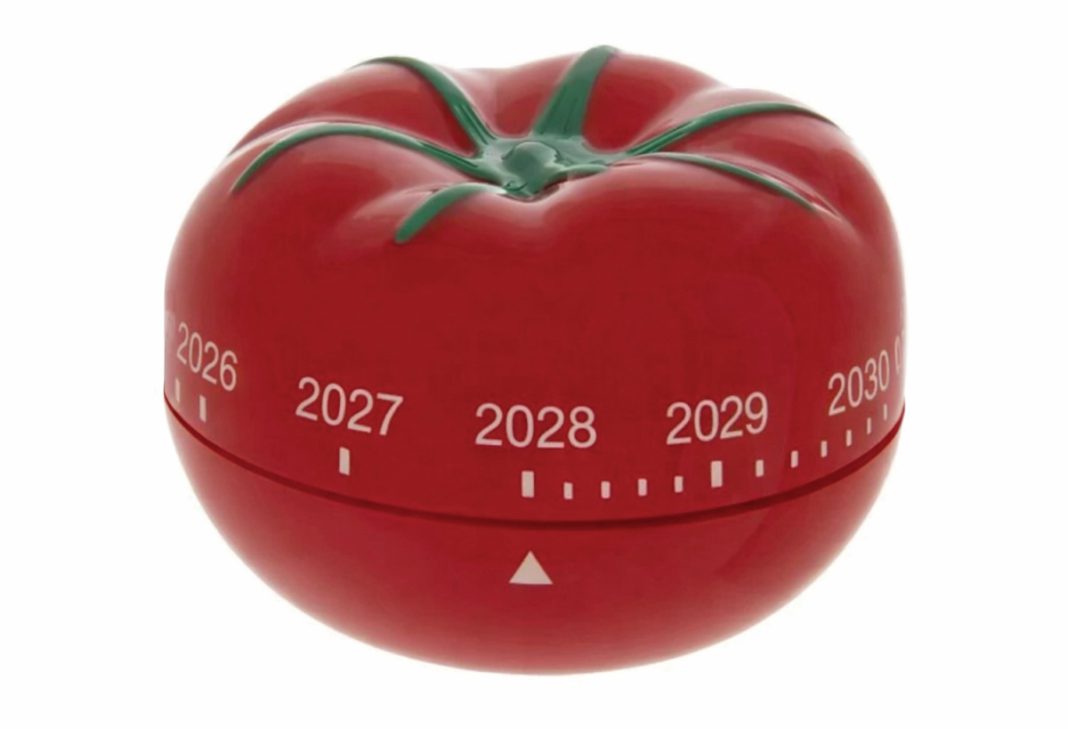
In a bookstore yesterday, I clocked a stack of calendars going for 90% off. Albeit, it’s February, and calendars have about as much shelf life as the bananas one buys in a fit of virtuousness in the produce aisle, only to watch them blacken on the countertop. But still, the rest of the year is on clearance.
Time used to be money. Now no one knows what either are other than we have neither. Which is why getting a whole year as a calendar for 10% the usual rate seems a little undervalued. When it comes to the denominations of time, a year—though less than a decade, century or millennium—is still worth more than the chump change we feed parking meters, right? Save the coins for minutes and hours. I don’t have time to change my time-to-change ratio.
Time is the one currency we’re allotted by fate—we can’t acquire any more of it, and we often spend it unwisely (think hangovers, Jerry Bruckheimer films, the DMV). We get what we get, and we never know how much that is until it’s too late. Random sh– happens all the time. In the U.S., 13,000 people are hit by buses annually.
I was once a cub reporter and have lived the entirety of my professional life on deadline, only to realize I’m now a grizzled old bear pawing at the passing fishwrap with an acute sense that time is running out. Our perception of time speeds up as we age because our brains think we’ve seen it all. Youth feels endless because it brims with novelty—firsts upon firsts, each day richly encoded, each memory distinct.
Adulthood, by contrast, is a greatest-hits album: Routine flattens experience; we’re stuck in a groove; time is a flat circle; and then the Great Record Scratch.
Fun fact, on the cyclical nature of time—the 2026 calendar is the same as calendars from 2015, 2009, 1998, all the way back to 1931. Time doesn’t repeat, but it rhymes—like a lewd limerick.
All the more reason to always do the things, say the things and live the way we wish right now—one’s time might be discounted 90%, and we’d never know it.
And therein lies the irony. In my experience, there is one reliable way to sidestep the clock, and that’s making something. Anyone who’s ever written, composed or built anything from nothing knows this trick. Sit down; do the thing; look up. Hours have vanished. This is that elusive flow state where time both passes and stands still. Neuroscience has ways of explaining this, but we don’t have time for that—we have to get to work.
The irony is that while creating pulls one out of time, the work one makes gestures toward permanence. However naïve, we work under the assumption that what we produce might outlive us—that it will enjoy a brief afterlife, a half-life, a glow after we’re gone. In its way, every work of art is a memento mori. Unless, of course, one designs calendars.
Read more Daedalus Howell at dhowell.com.