After years building apps for global brands and artists, Corte Madera-based digital product executive Sharon Hibbert Seitz is now focused on a different challenge: getting young people to engage with civic life.
Seitz grew up in Pennsylvania and spent much of her education and early career in Boston, earning a masters in clinical mental health counseling from Lesley University, as well as a master of education degree specializing in technology, innovation and education from Harvard University.
She moved to the West Coast after landing work producing educational games with PBS Kids, kicking off a wide-ranging career in product development. Her work included producing the singer Björk’s Biophilia app—which became the first app to join MoMA’s collection—as well as the Star Wars official app at Lucasfilm, among others.
At the start of 2024, while recovering from knee replacement surgery, she found herself looking for something to occupy her time. “I thought, ‘I’ll take an eight-week course with MIT and learn how to do Python coding for AI,’” she recalled, “and honestly, you should be on painkillers if you’re gonna do that.” As part of the course, students were assigned to propose use cases for different types of artificial intelligence. Drawing on her background in product management, Seitz began to think more broadly about ways this emerging technology could be used.
“Right about then I was thinking, ‘What is going on with society?’ Things are becoming so partisan, and people are becoming so polarized,” Seitz said. “You couldn’t even have a conversation with somebody if you didn’t share their full ideology.”
There were many political issues that she knew she couldn’t solve. “I can’t fix government corruption. I cannot make ranked voting happen. I can’t fix voting. I don’t know how to make fake news go away,” she noted. Ultimately, she landed on a grassroots solution: civic engagement. “When I realized how many people under 40 have completely checked out, I thought to myself, ‘Oh, there’s a ripe audience.’”
According to the Kaiser Family Foundation, just 48% of individuals ages 18 to 24 voted in the 2024 election. “Our whole government is based on participatory democracy,” Seitz said. “If half of us don’t participate, then our government is not representing the majority of the people. It’s only representing the loudest people.”
Once she identified the problem she wanted to address, Seitz began with market research. She found that many existing apps reflected rather than mitigated the factors contributing to low political engagement among young people. Many relied on long quizzes to assess political opinions, quickly putting off users who were looking for a simple entry point.
“A lot of these apps expect you to know so much about politics and about how government works. They’re overwhelming and intimidating,” Seitz said. “I mean, I’m pretty smart, and I’ve opened some of these apps and felt like a complete fool, and I don’t think that’s a good way to get people engaged.”
She also found that many platforms sorted users into rigid categories that failed to reflect the nuanced views of today’s young voters. “I don’t like being put in boxes,” she noted, “and I don’t know that other people do.” These tools often prioritized helping users find their political “tribe” rather than connecting them with real-world opportunities for engagement, reinforcing existing divides.
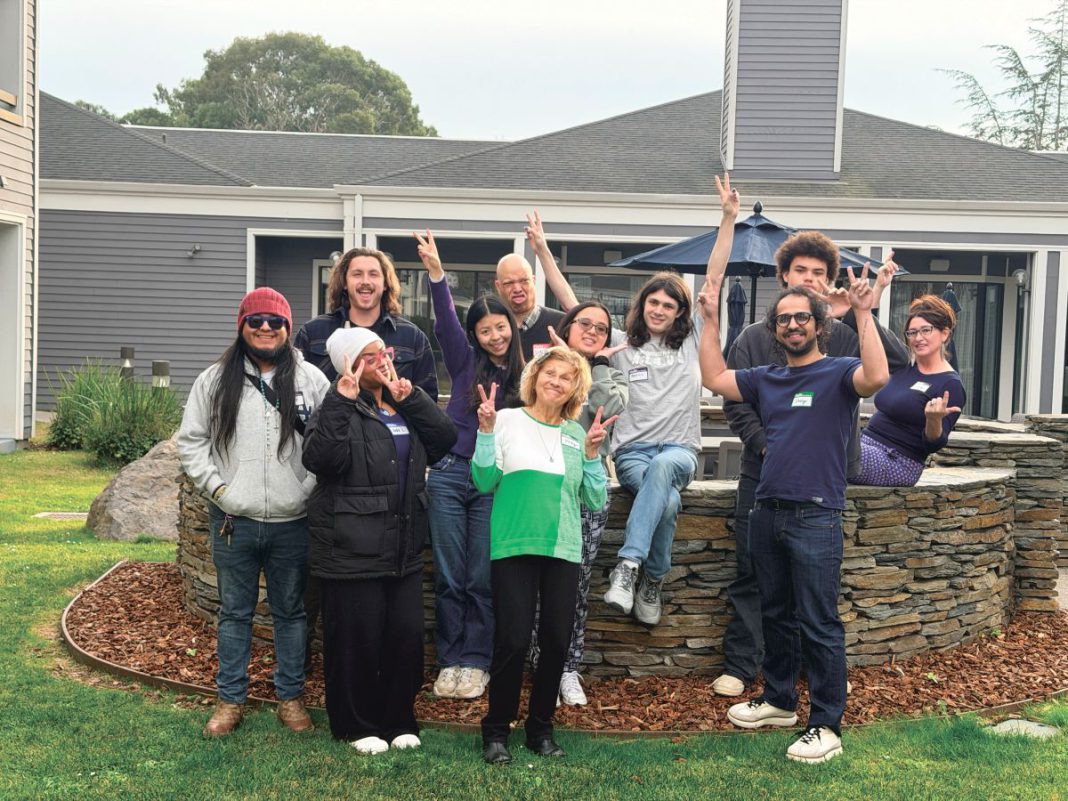
After eight months of discovery research, Seitz founded the nonprofit VoterPrime with the goal of creating an app that would move users from online interaction to in-person civic participation. In January, she recruited seven 17- to 26-year-old students studying design for a session that was part focus group, part product design workshop. The students, who were paid $200 each for their participation, spent five hours discussing civic engagement, politics, and their thoughts and suggestions for how VoterPrime should look.
Seitz found that participants consistently emphasized the imperative of in-person participation. Having spent their formative years during Covid, many expressed a strong interest in face-to-face connection. “They’re busy, they’re overwhelmed, and they don’t trust half of what they read,” she said. “If you can make it easy to say, ‘Here’s one thing you could do this week to participate,’ that’s highly desirable.”
As a result of her market research and focus group, Seitz decided on a format in which users can describe their top policy concerns in their own words, using natural language processing to translate those inputs into relevant policy areas and engagement opportunities. Users will then be able to review and either refine or approve these matches before exploring related actions.
For example, if a user writes that they are concerned with censorship on social media, the application might return a category like “Free Speech and Expression.” If approved, the user would then be shown candidates, ballot measures, petitions, legislation, interest groups and civic education content aligned with that issue, along with opportunities to take action. These suggestions would not be contingent on an association with a particular party, just a focus on the individual issue that a user is interested in.
Seitz chose this approach with Gen Z users in mind—those in their mid-teens to mid-20s in 2026. She notes that this group is accustomed to highly personalized digital experiences, where content adapts to their interests. Rather than being told what their political identity is, these users expect to shape their own experience.
She doesn’t want these opportunities to fall only along party lines or to give partisan recommendations supporting one party or political candidate. “If you care about the ocean, we could say, ‘Here are some people working on legislation related to that. Here’s some candidates that care about that. Here’s a couple of ballot measures related to that,’” she said. “If you live coastally, we could say, ‘Hey, there’s a beach cleanup next weekend. Go connect with other people that feel that way.’”
Building the infrastructure to support this vision presents significant challenges. Seitz plans to develop an AI-driven system to aggregate and organize civic data, despite the lack of centralized sources for local engagement opportunities. She is currently fundraising to continue development and pursue these larger technical goals, hoping to reach 3,000 users by the November midterms.
Through the challenges of development, she has remained focused on the core mission behind the project. “There’s a takeaway I keep coming back to every time I talk to anyone about this project,” she pointed out. “And it’s that most people don’t care about holding hard stances. They care about solving problems.”
To contribute to the VoterPrime effort, visit givebutter.com/W7s4uB.