Roll With It. Got Papers? We do.

0

When it comes to the consumption of cannabis in Marin County, there is enough local historical and cultural material to fill at least a few books. Between the beatnik and hippie movements of the past and the easy-breeze Nice Guys delivery of the present, it’s safe to say that Marin County’s morale is … well, high. Very high.

Factor in the origin story of 4/20 being a local bit of lore along with San Rafael being the literal epicenter of the Waldos storyline, and it’s hard to deny that the North Bay is a bit of a cannabis cultural epicenter.

So, in celebration of the stoners who paved the way for modern lovers of the devil’s lettuce to “puff puff passing” things along today, it is high time to unite newspapers and cannabis into one—one joint, that is.

While technically one should never roll a joint out of a newspaper since the ink is not fit for human consumption, let’s briefly ignore that fact for the sake of some laughs. So, with that warning in mind, it’s time to delve into the process of rolling a joint from a Pacific Sun newspaper:

Step one is, of course, to consume an edible at least two hours prior to trying to roll the joint. Step two is to pick up and try to read a Pacific Sun newspaper.

Once step two successfully fails, either cut up the newspaper into individual rolling papers or commit to the bit and roll one giant joint instead—preferably with the front page facing outward so people know it’s a Pacific Sun joint and not a Marin IJoint.

Step three involves packing that newspaper high with whatever weed one can find and then licking the edges of the newspaper profusely and passionately prior to rolling it all up to the best of one’s own individual ability. And last but not least, step four is to smoke that righteous Pacific Sun joint like the Waldos are watching.

Dimensions of joints may vary upon preference of desired density and girth for ensuring optimal satisfaction. Note that the steps above are best when undertaken on a windy day on some Marin County beach or another. 

Isabella Cook writes avidly about food and local food-related adventures. She is a regular features writer for the Pacific Sun. This selection is reprinted from our 2024 Best of Marin edition.

Culture Crush, April 9

San Rafael

Phasers on Stun

It’s time to set course for comedy as Phasers on Stun: Verdant Horizons beams into the Belrose Theater for a night of improvised interstellar antics. This fully improvised Star Trek parody takes the best of the original series—quirky aliens, low-budget charm and wide-eyed wonder—and spins it into something entirely new, unscripted and designed to be hilarious. One can anticipate cosmic confusion, unexpected plot twists and the kind of nerdy joy that only a lovingly crafted spoof can deliver. Described by fans as “absolutely tremendous” and “too good to be true—I must be on the holodeck!,” this show is perfect for Trekkies, improv fans and anyone who enjoys their sci-fi with a side of satire. 7-8:30pm, Saturday, April 19, at the Belrose Theater, 1415 Fifth Ave., San Rafael. Tickets $20; available at bit.ly/phasers-on-stun.

Cloverdale

Wings of Change

The Cloverdale History Museum Speaker Series takes off with Wings of Change, a special evening spotlighting Dusty Roads—the trailblazing flight attendant who helped start the women’s movement. Historian and author Elaine Rock shares the remarkable true story behind her best-selling book, Dusty Roads: The Hidden Figure Who Really Ignited the Women’s Movement, joined in conversation by Amy Nykamp, president of Sonoma County NOW. The talk includes a slideshow, followed by a book signing and reception just steps away at the museum. 7pm, Tuesday, April 22, at Cloverdale Performing Arts Center, 209 N. Cloverdale Blvd. Tickets $20 at cloverdalehistoricalsociety.org.

Mill Valley

Dynamic Duo

Jazz musician Larry Vuckovich makes a rare Marin appearance on Sunday, April 27, for an intimate concert at the Community Church of Mill Valley, joined by rising star guitarist Kai Lyons. Together, they’ve built one of the tightest and most versatile duos on the scene today, blending swinging bebop, Afro-Cuban rhythms, Brazilian beats, Middle Eastern melodies, tango jazz, funky boogaloo blues—and everything in between. Their years of collaboration have developed into a seamless musical chemistry that’s as globe-trotting as it is groove-driven. Lyons, a Bay Area phenom, regularly tours through Cuba, Brazil, Europe and Morocco, bringing a worldly sensibility to every performance. Vuckovich, a jazz veteran and local treasure, calls this dynamic pairing “one of the most wide-ranging musical programs you can experience today anywhere in the world.” 4-6 pm, Sunday, April 27, at the Community Church of Mill Valley, 8 Olive St. (corner of Throckmorton). Suggested donation: $25. More info and tickets at bit.ly/larry-v-jazz.

Santa Rosa

Heard Eye at Shady Oak

Santa Rosa’s own The Heard Eye returns to the stage at Shady Oak Barrelhouse on Friday, April 11, for a high-energy night of funk and rock in celebration of their rising success. The band’s latest single, “All Love,” is making serious waves—spinning on nearly 90 college radio stations nationwide and climbing the charts, all without a label. One can expect a set that’s as self-assured as it is self-produced, channeling the kind of DIY spirit that’s kept this North Bay crew moving (not to mention craft beer on tap and a venue that keeps the vibes loose and loud). 7-10 pm, Friday, April 11, at Shady Oak Brewing Company, 420 1st St., Santa Rosa. No cover. More at shadyoakbarrelhouse.com, or follow @theheardeye for updates.

Free Will Astrology, April 9-14

0

ARIES (March 21-April 19): Life is asking you to be a source of generosity and strength for the people and animals in your sphere. I hope you will exude maximum amounts of your natural charisma as you bestow maximum blessings. Soak up the admiration and affection you deserve, too, as you convey admiration and affection to others. Here’s a secret: The more you share your resources, help and intelligence, the more of that good stuff will flow back your way.

TAURUS (April 20-May 20): Ceramicist Jun Hamada says that trying to force harmony into her art leads to sterile work. “The most beautiful pieces come from the moments I stop trying to make them beautiful,” she notes. “They emerge from embracing the clay’s natural tendencies, even when they seem to fight against my intentions.” I recommend her approach to you in the coming weeks. Your best results may emerge as you allow supposed flaws and glitches to play an unexpected part in the process. Alliances might benefit, even deepen, through honest friction rather than imposed peace. What will happen when you loosen your attachment to enforced harmony and let life’s natural tensions gyrate?

GEMINI (May 21-June 20): Gemini-born Frank Lloyd Wright (1867-1959) was a prolific architect who orchestrated many daring designs. Among his most audacious experiments was a project to build a house over a waterfall in Pennsylvania. “It can’t be done,” experts said. But he did it. Before he was ready to accomplish the impossible, though, he had to spend months studying the site’s natural patterns. I bring this to your attention, Gemini, because I believe you are ready to consider your own equivalent of constructing a house over a waterfall. Prepare well. Do your homework.

CANCER (June 21-July 22): In the early phase of his illustrious career as a photographer, Edward Weston (1886-1958) cultivated a soft-focus, romantic style. But he ultimately converted to stark, uncompromising realism. “The camera,” he said, “should be used for recording life, for rendering the very substance and quintessence of the thing itself.” If there is anything about you that prefers warm, fuzzy illusions over objective, detailed truth, I suggest you switch emphasis for a while. If you like, you can return to the soft-focus approach in June. But for now, a gritty, unsentimental attitude will be essential to your well-being.

LEO (July 23-Aug. 22): Here’s my mini-manifesto about change, just in time for a phase when change is most necessary and possible for you. 1. Real change is often a slow and subtle process. There may be rare dramatic shifts, but mostly the process is gradual and incremental. 2. Instead of pushing hard for a short time, you’re more likely to change things by persistently pushing with modest strength for a sustained time. 3. Rather than trying to confront and wrestle with a big problem exactly as it is, it’s often more effective to break the seemingly insurmountable challenge into small, manageable pieces that can be solved one at a time through simple efforts.

VIRGO (Aug. 23-Sept. 22): Textile artist Mei Zhang wondered if the synthetic dyes she used on her fabrics were limited. Might there be a wider variety of colors she could use in her creations? She discovered that her grandmother, using age-old techniques, had produced hues that modern dyes couldn’t replicate. “The most sustainable path forward,” Zhang concluded, “often involves rediscovering what we’ve forgotten rather than inventing something entirely new.” I recommend that counsel to you, Virgo. The solution to a current challenge might come from looking back instead of pushing forward. Consider what old approaches or traditional wisdom you might call on to generate novelty. Weave together fresh applications with timeless principles.

LIBRA (Sept. 23-Oct. 22): The moon rises about 50 minutes later every day, and always at a slightly different place on the horizon. The amount of light it shows us is also constantly in flux. And yet where and how it will appear tomorrow or 10 years from today is completely predictable. Its ever-changing nature follows a rhythmic pattern. I believe the same is true about our emotions and feelings, which in astrology are ruled by the moon. They are forever shifting. And yet if we survey the big picture of how they arise, we will see their overall flow has distinct patterns. Now would be a good time for you to get to know your flow better. See if you can detect recurring motifs. Try to develop more objectivity about how your precious emotions and feelings really work. If you do this correctly, you will deepen and enhance the guiding power of your precious emotions and feelings.

SCORPIO (Oct. 23-Nov. 21): Research reveals that interludes of productive uncertainty may strengthen our brain’s neural pathways—even more so than if we consistently leap to immediate comprehension. The key modifier to this fortifying uncertainty is “productive.” We must be willing to dwell with poise in our puzzlement, even welcome and enjoy the fertile mystery it invokes in us. Neurobiologist Aiden Chen says, “Confusion, when properly supported, isn’t an obstacle to learning but a catalyst for understanding.” These ideas will be good medicine in the coming weeks, dear Scorpio. 

SAGITTARIUS (Nov. 22-Dec. 21): Persian American author Haleh Liza Gafori translates the poetry of 13th-century Sufi mystic Rumi. One of their joint books is titled Gold. She writes, “Rumi’s gold is not the precious metal, but a feeling-state arrived at through the alchemical process of burning through layers of self, greed, pettiness, calculation, doctrine—all of it. The prayer of Sufism is ‘teach me to love more deeply.’ Gold is the deepest love.” That’s the gold I hope you aspire to embody in the coming weeks, Sagittarius. You are in a resplendently golden phase when you have more power than usual to create, find and commune with Rumi’s type of gold.

CAPRICORN (Dec. 22-Jan. 19): The coming weeks will be an excellent time to reframe the meaning of “emptiness” in your life. To launch your quest, I will remind you that quiet interludes and gaps in your schedule can be rejuvenating. Sitting still and doing nothing in particular may be a good way to recharge your spiritual batteries. Relieving yourself of the pressure to be endlessly active could be just what you need to open up space for fresh possibilities.

AQUARIUS (Jan. 20-Feb. 18): There was a time, many years ago, when I consulted a divinatory oracle every day of my life. Sometimes it was the Tarot or the I Ching. I threw the Norse runes, did automatic writing, used a pendulum or tried bibliomancy. Astrology was always in the mix, too, of course. Looking back on those days, I am amused at my obsession with scrying the future and uncovering subconscious currents. But employing these aids had a wonderful result: It helped me develop and fine-tune my intuition and psychic powers—which, after all, are the ultimate divination strategy. I bring this to your attention, Aquarius, because I believe you now have an enhanced power to cultivate and strengthen your intuition and psychic powers.

PISCES (Feb. 19-March 20): The fovea is the part of the eye that enables sharp vision. Humans have just one kind of fovea, which gives them the ability to see clearly straight ahead. Eagles have both a central and peripheral fovea. The latter gives them an amazing visual acuity for things at a distance. This extra asset also attunes them to accurately detect very slow movements. I suspect you will have a metaphorical semblance of the eagle’s perceptual capacity in the coming weeks, Pisces. You will be able to see things you wouldn’t normally see and things that other people can’t see. Take full advantage of this superpower. Find what you didn’t even know you were looking for.

Fiddler on the Move, Alasdair Fraser and Friends Celebrate Tradition

After four decades at the heart of the Bay Area’s musical community, renowned fiddler Alasdair Fraser is preparing for his final bow as the director of the San Francisco Scottish Fiddlers. 

This spring, Fraser and his musical community of more than 65 musicians will bring their exhilarating show “Stravaig”—a Scots word meaning “to wander, digress and stray beyond limits”—to the North Bay.

Performances take place at the Angelico Concert Hall at Dominican College in San Rafael on Saturday, April 26, and at Sonoma Country Day School’s Jackson Theater in Santa Rosa on Sunday, April 27. As Fraser puts it, audiences will witness not just a concert, but “an unruly mob of rabble-rousing, musical adventurers.”

It’s hard to imagine a more fitting description for the ensemble that Fraser founded in 1986. From humble beginnings as a casual monthly gathering of fiddlers in Fraser’s own home, the group has grown into an inclusive community of 200 musicians who meet regularly to learn and play Scottish tunes and other Celtic traditions. Over the years, their repertoire has expanded to embrace the music of Brittany, Galicia, Scandinavia and North America.

Now, approaching 40 years at the helm, Fraser reflects warmly on this milestone: “You do something you love, and you don’t really notice the time as it goes by,” he says. “It’s become a way of life, really. I feel very fortunate to have been able to include music and community and my own family in that way, in the pursuit of using music to bring people together and learn a lot in the process.”

Indeed, Fraser’s efforts have resonated deeply, as evidenced by the nearly 100,000 monthly listeners who currently stream his music on platforms like Spotify. Yet, despite his worldwide acclaim, he still marvels at music’s ability to unite. 

“I live in awe at the power of music, and I think I probably wouldn’t have said that 40 years ago,” he says thoughtfully. “In the beginning, I played the fiddle—what a wonderful thing; let’s play some tunes. It’s amazing how quickly you can go from ‘Hey, let’s play some tunes’ to ‘Oh my gosh, we’re digging deeply into a tradition here.’ We’re meeting the ancestors. We’re using a force that can gather people, which is a mighty thing.”

For Fraser, music has become something essential, an integral part of life itself. “Music is not trivial,” he says firmly. “Certainly for me, it wasn’t an add-on. It wasn’t like music is something you do when you finish your job or when you go home. It’s more like it’s part of our DNA.”

This profound respect for music’s emotional and communal power forms the heart of Fraser’s leadership with the San Francisco Scottish Fiddlers. Each year, after months of preparation, their annual concert series showcases both seasoned virtuosos and enthusiastic amateurs side by side. Fraser explains that the diverse range of experience actually strengthens the ensemble’s performance.

“That was something else that I have gained insight on through the years,” Fraser says. “I feel like when we gather the village—the musical village—the village does better when it has different levels present because you can set up what I call nurturing loops within the village. You have great players—I’m talking some of the best in the country, representatives of their tradition, ambassadors of the tradition—and they’re mixing it in with people who are new to it, younger kids. 

“And you get this nurturing loop where the learners love to be with the people that are their heroes. The heroes, the veteran players, love to see the lights turn on, get these bright-eyed responses from people who want to do what they’re doing,” he continues.

This year, the ensemble includes standouts such as acclaimed cellist and educator Renata Bratt, a versatile musician who has toured with alternative rockers and classical ensembles alike, and Caroline McCaskey, a multi-instrumentalist and 2019 U.S. National Scottish Fiddle Champion. 

Vocalist and fiddler Rob Godfrey, whose soulful Gaelic singing has become a beloved highlight, joins Janette Duncan and Pate Thomson—two founding members who have shaped the ensemble from the start. Duncan, a cherished fiddler and educator in Sonoma County, has played an integral role in the ensemble for decades. 

Fraser views traditional Scottish music as part of a continuum, something handed down and ever evolving. “That is part of the deal with traditional music,” he says. “It does have this depth, and you can go back and choose a point of music. You can say, ‘I’m going to play this the way they might have played in 1846 or 1760.’ 

“But what’s also beautiful is kids today get smitten by it, and they go, ‘Man, I need this in my life right now.’ I’m going to take these tunes from 1700 and push them around a bit, reshape them, reinvigorate them with what’s on my mind now. And the music comes alive,” he adds.

As Fraser prepares to pass the baton, he emphasizes that the annual spring concerts are not simply performances—they are invitations. 

“What we do in these concerts is not so much to say, ‘Hey, this is a class you get to come to and watch us enjoying ourselves.’ Instead, we get to say, ‘Hey, look at what we’re doing here as a community. You could be part of this. You could pick up your fiddle that your grandfather left lying around, or your old flute in the garage, or the cello that no one’s been using, and you can dust it off and come join us,’” he notes.

In a fitting tribute to his legacy, Fraser and the San Francisco Scottish Fiddlers invite the community to experience the transformative power of traditional music and to be inspired to make their own melodies. The spring concert series promises, as Fraser puts it, a “grand ceilidh, where you can tap your toes, dance in your seat and share in the joy.” It’s a farewell concert series to remember, and an open-hearted invitation to keep the musical journey alive.

Stravaig Spring Concert Series commences locally at 7pm, Saturday, April 26, at Angelico Concert Hall, Dominican College, 20 Olive Ave., San Rafael, and at 3pm, Sunday, April 27, at Jackson Theater, Sonoma Country Day School, 4400 Day School Pl., Santa Rosa. Tickets $32-$35; kids under 12 free with an adult. Visit sfscottishfiddlers.org for details.

The Right Moves: Marin Kids Learn the Joys of Chess

When Stanley Wong’s family moved from Shanghai to Tiburon more than a decade ago, the five year old didn’t speak English. He remembers feeling isolated. 

Then he learned the international language of chess.

“I had a very, very hard time learning English, number one, and then making friends,” Wong said. “I struggled because I was a big introvert. Chess was a way for me to interact and engage with other people.” 

Wong, now 19, fell in love with the game, crediting it with teaching him important life skills. He learned to play under the tutelage of Lanette and Jeffrey Gordon, a couple who ran an after-school chess program and hosted tournaments for years in Marin. 

“One of the first crucial lessons that the Gordons instilled is simply never give up, no matter what position you’re in,” Wong said. “You don’t just resign, right? There are always opportunities to find a way out. That is very true in chess and in my real life.”

For Wong, the game acts as a great equalizer. On the chess board, it doesn’t matter who you are or who you’re not, he said. 

When the Gordons stepped back, it left an “educational chess gap” for the county’s youth. In October 2023, Wong partnered with a friend, Henry Lien, to start MarinChess, a year-round program that brings chess to kids in kindergarten through fifth grade.

MarinChess quickly took off, with hundreds of children now participating in the after-school classes and Friday Night Chess Camp. While the program focuses on teaching the game’s fundamentals, the coaches also ensure that beginners and more experienced players learn in a fun, social environment.

The program’s growth has kept Wong busy. In fact, he left college to devote more time to managing MarinChess. Yet he always makes room in his schedule to teach several chess classes each week. He’s passionate about the game’s benefits for young people.

“Chess helps improve critical thinking, strategic planning and problem-solving abilities,” Wong said. “It’s also linked to higher academic performance in math and reading.”

Last week, I attended Wong’s class at Saint Hilary School in Tiburon. Eight kids, ages 7-10, sat with rapt attention as he took them through a game that he had previously played with an international master. 

“Why did I do this?” Wong asked his students.

The expressions on their faces revealed some deep thinking—I could see the gears turning. Then the students eagerly raised their hands. If one didn’t get the answer quite right, Wong doled out hints.

Move by move, the classmates figured out their coach’s strategy. The kids with the most experience were able to analyze the game by thinking five moves ahead, and the newest student could visualize two moves. All were impressed that Wong ultimately brought down a chess champion, especially when he had spent the first half behind. 

After the lesson, the children played “blitz” chess, with each player allotted five minutes to complete the game. Although the games were friendly, it became apparent that each of them was playing to win. Cries of “oh” filled the room as one player or another captured an opponent’s piece.

Jack Hooker, a first grader, battled his brother James, who is two grades ahead. The boys have different styles. James, 9, chatted. But Jack, 7, is a young man of few words, his favorite being “check,” which he called out as he repeatedly placed his brother’s king under attack. The lead went back and forth, with James finally emerging as the winner.

The class has another pair of brothers, Maddox and Spencer Sullivan, 7 and 10, respectively. Their father taught them chess, and the three of them play every night at home. 

“It’s just a fun game,” Maddox said. “I use my brain more when I’m playing chess.”

Spencer agreed, saying he learns a new strategy every game. But the boys have different opinions about the time clock. Maddox said it stresses him out, while his brother prefers playing under some pressure. At home, they don’t use it.

A fourth-grader, AJ Ordona, began playing chess at age five. With six years under his belt, he’s pretty darn good. 

“My parents taught me, and then I went to chess camp,” AJ said. “I play with friends because I like strategies.”

Colette Roessler, 9, started playing chess a few months ago, developing an interest after her younger brother took up the game. Despite her recent foray into the world of chess, she has a knack for it. Wong called her a “brilliant” player.  

“I got him in checkmate,” she said as I watched her first game of the afternoon. “He can’t move.”

With a mere five seconds left on her clock, Colette pulled out the win in the nick of time. Her opponent still had 40 seconds. Even as she claimed not to be competitive, she triumphantly lifted her arms in the air. 

Colette is the lone girl in the class. Some of MarinChess’ classes have only male students. Girls remain underrepresented in chess, stemming from lack of exposure and encouragement, according to Wong. 

“Boys are often introduced to chess earlier and pushed to compete, while girls can feel out of place in these male-dominated environments,” Wong said. “Something interesting we’ve found is that when chess is introduced early on, such as in kindergarten or first grade, girls engage just as much, if not more, than boys.”

A winning attitude helps Colette hold her own against her male counterparts. She said that she would like to see more girls take chess classes because it’s enjoyable and helps with thinking skills.

“Being the only girl sometimes can be annoying,” Colette said. “But it’s fun when you beat one of the boys.”

In addition to the gender gap, chess also can be out of reach for kids from low-income families. Wong wants to help change that too. 

“Our goal within the next 1-2 years is to turn MarinChess into a foundation so we can expand access to chess even further, especially for students from underrepresented or underserved backgrounds,” Wong said. “We believe every child deserves the chance to benefit from the lifelong skills chess teaches, and we’re working to build a model for accessible, community-rooted chess education right here.”

Friday Night Chess Camp begins on April 11 at Redwood High School in Larkspur. K-5 students at all levels are welcome. Financial aid available. For more information, visit marinchesscamp.com.


Your Letters, April 9

MAGA-Lago

Here is the MAGA hypocrisy of the day: Commerce Secretary Howard Lutnik recently complained about fraud in Social Security, saying, “Fraudsters always make the loudest noise.” To him I say, you are describing your boss, who is always screaming, “Witch hunt.” 

Here is a thought for the day: Why would Chief Justice John Roberts take the time to shelter the president from prosecution for crimes committed during his administration if the president wasn’t planning to commit some and the chief justice wasn’t expecting him to commit some? 

There would be no need for immunity if both these characters were expecting #47 to run an honest and legal operation, right? Roberts knew what was coming, and he wanted to enable it. Now we are seeing presidential immunity being extended to cabinet members and White House staff, like those responsible for the “bomb Yemen” group chat war plans leak. This was the plan all along. 

The chief executive and his chief justice bootlicker, John Roberts, want to provide legal cover for any and all misfeasance, malfeasance, nonfeasance and violent, anti-American behavior committed by anybody who takes on the sacred name of Donald Trump as savior of the world.

Kimball Shinkoskey
Marin County

Open Mic: Odorous Ode for Today’s American

One cursed day it came to pass 

In what was the land of the free and the brave 

That an old orange fellow who was both cruel and crass 

Rode to power on the crest of a deeply conned wave 

Of voters hungry for the things that they needed

That they overlooked the reality of the monarchy they had seeded

Perhaps they believed it could not happen here 

But here it is, in the flesh, just 11 weeks in

Where the destruction he’s doing is tragically clear 

And, of course, he denies having ever, ever committed a sin. 

Or even done wrong or made a mistake. 

Continuing to get away with everything 

Now that he’s again in. 

More tax cuts for the oligarchs 

More taxes for the rest 

Votes brought in this villain 

And cast out our best 

A king simply declares 

And those declarations are law 

Hold loved ones tight 

Figure out how to fight. 

Oh, my country and my countrymen 

What have we done 

To invite and elect this rampant darkness 

And blot out our nation’s sun? 

It’s too late to switch:

Our near future’s a bitch. 

And today: He’ll decide what reporters can attend his “news” sessions 

So all will be absent who might challenge 

Either his actions or his indiscretions. 

Each day brings some new blight 

On a country that once saw the light.

David Reinstein lives in San Anselmo.

Cream Tok: Straus milk & other social media trends in local food culture

Holy cow—a collaboration between social media and a local dairy has gone viral.

Marin-based Straus Family Creamery’s organic milk has unearthed an interesting online trend in local and global food culture. Readers at home may be wondering, “How now brown cow?” So, let’s just take the bull by the horns and dive in. 

Last year, popular social media app TikTok made Straus Family Creamery internet famous after a Bay Area foodie influencer named Peggy Xu opened Pandora’s Bottle, so to speak. 

Xu shared her Straus experience, cream top and all, with the world, and the world ate it up (literally). The app’s audience was nothing short of awe-struck by the milk’s glass bottle and cream top. This trend meant that both interest in and sales of Straus products experienced an unprecedented spike last fall as a result.

Predicting what internet trends will sweep the world wide web now or next is difficult, if not nigh on impossible. And when Marin’s own Straus Family Creamery was side-swept with internet fame, it revealed a more global yearning for something locals of the North Bay already have—a collective desire for real food in a world of mediocre convenience.

Considering most modern milk comes from a supermarket shelf, sold en masse in plastic or paper cartons, social media’s rampant excitement of seeing real milk makes a certain amount of sense. What makes less sense is the udderly hilarious and out-of-touch mistranslation that happened due to modern society’s disconnect from … well, real food. 

During the heyday of TikTok’s Straus Family Creamery craze, every food influencer and their grandmother was ordering a bottle to stay relevant, get views and see what all the hubbub was about, presumably. But the influencers, unlike their grandparents, had never seen a cream top on milk before, and their interpretations of its nature were fantastically farcical. 

Rather than recognizing (or researching) the layer of cream that naturally occurs in non-homogenized milk, some influencers just decided that Straus milk came with a surprisingly tasty mold on top—the story of Straus’ tasty moldy milk spread far and wide in a strangely dairy-specific example of how easily social media can make misinformation mainstream. 

Despite the monumental disconnect between people and the food they consume that this trend so clearly demonstrated, the silver lining is this: Humanity craves natural food so much that they will still go gaga over Straus and its cream top. And if they have to eat presumed mold to get to the good stuff, then so be it.

So, what exactly is it about Straus milk that made the masses on social media so milk-hungry? Well, to understand that and to dive deeper into the local and global implications, one first has to know a little bit about Straus itself. 

Let’s take a metaphorical trip in a time machine and rewind this story, starting in reverse from today’s modern world of TikTok in 2025 and going backward to its origin in the idyllic landscape of West Marin of the 1940s. When Straus began, the world was a very, very different place with no iPhones or internet to speak of. And that just may be what makes the milk and auxiliary dairy products so gosh darned delicious.

Straus is a legacy family creamery with a history almost as rich as its signature cream top. The farm itself was officially founded by Albert Straus, though his parents, Bill and Ellen Straus, were the OG couple to put down some dairy farm roots in Marshall in the 1940s.

In the beginning, the Straus family farm was home to 23 Jersey cows. Now, Straus has grown their modest herd of dairy cattle into a 270-strong force of organic bovines. The Straus cows are hormone-free, antibiotic-free and free range over 500 acres of pasture that sprawl across West Marin. During the day, they munch on grass and frolic together through the fields, as many of us wish we could do instead of work. And then, at night, the herd of dairy cows is led indoors to lay their large, weary heads to rest on soft hay in a barn.

The Straus Family Creamery has always put its best hoof forward, especially when it comes to the environment. One of the company’s most distinctive and beloved features is its reusable glass bottle. Back in the day, glass bottles delivered by milkmen were common. But as time went on and the world poured value into quantity over quality, milk containers turned into plastic, and cream tops were almost forgotten remnants of a bygone era.

But Straus’ recent surge of popularity on social media begs the question: Is that bygone era making a comeback? All signs point to a possible, resounding “yes.”

Now, one could talk about Straus and TikTok until the cows come home. But to avoid milking the topic entirely, let’s pivot a bit to look at Marin and its food culture as a whole (instead of just 2% of it).

Marin is already deeply familiar with the exciting “new” trends sweeping the culinary world. In fact, California’s Bay Area is often considered to spearhead many cultural trends, from cannabis to wellness to cuisine. However, the healthy, eat-green mentality that’s intrinsic to Marin County is more than a localized cultural concept—it’s also an indicator of how the global mindset toward food could change in the near future. After all, California’s central coast is known for being an epicenter of shifts in art, lifestyle and culture.

So, what new trend does TikTok’s Straus obsession indicate for the future of our relationship with food? Well, these breaking trends are, ironically, revealing a desire for a return to the true source of food, as it was before processed convenience became the popular norm. Even though many of the influencers thought the cream top was made of mold, they still enjoyed the Straus experience because of the quality. And people can taste quality, made-up mold or not. 

Happy, pasture-fed cows, raised organically without antibiotics or artificial hormones, naturally make better milk. The same can be said for any and all products we eat, as many of Marin’s residents already know very well.

A supermarket tomato bought in November tastes nothing like a vine-ripe heirloom tomato in late summer. A mass-produced lion’s mane mushroom doesn’t hold a candle to a fresh-foraged one. And a plastic carton of milk just isn’t comparable to the real deal, as the Straus trend so clearly shows. So, let’s celebrate the fatted calf that is Marin’s food culture—mo(ooo)ve aside, processed convenience food; it’s time to return to the source with real food and real flavors.

Sip in a Bottle, Sausalito Liquor’s Scott Jampol

As senior vice president of marketing at OpenTable for more than a decade, Marin local Scott Jampol knows a thing or two about the hospitality business. 

He tapped that insight to launch Sausalito Liquor Co. in 2023, as a way to capture our namesake locale in the bottle. One may find him on Monday nights tending bar at his own neighborhood haunt and otherwise playing bocce in the local city league or hiking with his Bernese mountain dogs in the Marin Headlands.

Amber Turpin: What’s your job?

Scott Jampol: Founder and CEO of Sausalito Liquor Co..

How did you get into that work?

It all started with the big idea that people want spirits made with quality local ingredients that let them enjoy the beauty of the moment, the people they’re with and the place that surrounds them. … “Local” was taking hold as it had in beer and wine, and I wanted to be a part of that for the amazing area we live in. 

I attended Moonshine University’s intensive distilling program in Louisville, Kentucky, took on a job as a bartender at a local bar and partnered with a master distiller to help refine my recipes. 

Did you ever have an “aha” moment with a certain beverage? If so, tell us about it.

When we were formulating the recipe (for our Marin Coastal Gin), we were amazed that you could actually drink the gin straight … without any mixers or dilution. … We hear so often that gin reminds people of the smell of their grandma or that horrible night they had in college. Once they taste the new era of gins, ours included, it’s a game changer. 

AT: What is your favorite thing to drink at home?

I am a classic three ingredient cocktail lover. My favorite is a Rye Manhattan. Light vermouth, heavy on the bitters and stirred with a little of the cherry juice on the spoon.

Where do you like to go out for a drink?

The Sausalito Cruising Club, where I bartend, is also my favorite destination for a drink. Good people, great views and simple, delicious cocktails. … I am also excited that we partnered with Canela in SF to put together a spirits and food pairing menu for SF Restaurant Week in mid-April. It’s a combination of food and drink that you’ll never get any other time. 

If you were stuck on a desert island, what would you want to be drinking (besides fresh water)?

Well, I would need to get all my food groups to stay alive on a desert island, so probably a spicy Red Snapper—a Bloody Mary with Marin Coastal Gin. It would have two strips of bacon, grilled shrimp and an assortment of pickled veggies … a meal in a glass. Sausalito Liquor Co., 415.602.8765. sausalitoliquor.com.

Small Ball, Guy de Maupassant in San Rafael

Guy de Maupassant is one of the most adapted writers of all time. His first story, Boule de Suif, about a young prostitute on a stagecoach with a gaggle of hypocrites, is the most adapted. It’s known for its biting social criticism, which makes it a logical choice for film/political writer J.D. Murphy to rework into a satiric “comic fable” for his first theatrical script.  

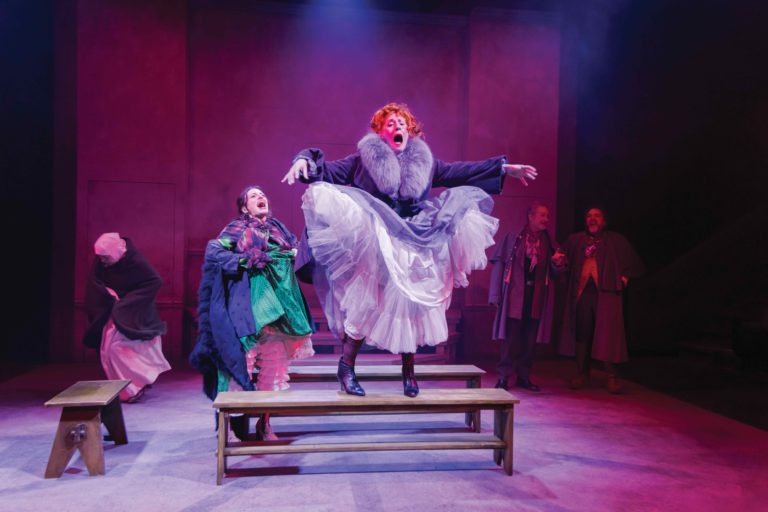
Murphy’s Buttercup, produced by Intercontinental Drift, directed by Nancy Carlin and playing at Marin Shakespeare’s Downtown Theater through April 13, keeps the same base as the original. Buttercup (Gianna Digregorio Rivera) has her baby stolen by Sister Walter (Lizzie Calogero). In a bid to raise money to find her baby, Buttercup turns to prostitution during the briefly disastrous Franco-Prussian War. 

Discovered by her long-lost lover, Albert (Titus Vanhook), she finds herself on an ill-fated coach journey to the coast. Halfway through their journey, they are detained by a Prussian officer (Brennan Pickman-Thoon) at an inn run by an enigmatic innkeeper (Norman Gee).

The cast is stacked with actors from some of the Bay Area’s most noted theatrical institutions. They are well-cast. The choreography by Bridgette Loriaux and the staging by Carlin are technically perfect, as the entire cast moves like a single organism. Maggie Whitaker’s costumes are fun and practical, and Randy Wong-Westbrooke’s set is a textbook example of minimalism. Lights by Christian V. Mejia transcend mere lights and instead create scenes themselves. 

Rivera is a witty and charismatic actor who brings a believable feisty strength to the character of Buttercup. Highly talented physical actors backup Rivera. There are beautiful little touches of silliness, like the Prussian salute, and the physical mastery displayed by all is excellent. 

With all that good work, this play should work but it doesn’t. It’s just not funny. The script doesn’t help. There are unnecessary scenes, and some plot points simply don’t make sense. By the end of the play, almost every scene begins with the actors sighing in boredom, which is a very odd choice given that the audience has been in their seats for more than an hour. 

One of the first things actors are taught about comedy is “never ask for the laugh.” This play is a prime example of why. Being so wrapped up in the comedy and not the truth of the characters will always backfire.

Intercontinental Drift presents ‘Buttercup’ through April 13 at Marin Shakespeare Company’s Center for Performing Arts, Education, and Social Justice at 514 4th Street, San Rafael. Thurs-Sat, 7:30pm; Sat & Sun, 2pm. $20-$35. 415.388.5208. marinshakespeare.org.

Roll With It. Got Papers? We do.

At a certain point, a town stops being a place and becomes a recommendation of some algorithm or other.
When it comes to the consumption of cannabis in Marin County, there is enough local historical and cultural material to fill at least a few books. Between the beatnik and hippie movements of the past and the easy-breeze Nice Guys delivery of the present, it’s safe to say that Marin County’s morale is … well, high. Very high. Factor in...

Culture Crush, April 9

San Rafael Phasers on Stun It’s time to set course for comedy as Phasers on Stun: Verdant Horizons beams into the Belrose Theater for a night of improvised interstellar antics. This fully improvised Star Trek parody takes the best of the original series—quirky aliens, low-budget charm and wide-eyed wonder—and spins it into something entirely new, unscripted and designed to be hilarious....

Free Will Astrology, April 9-14

ARIES (March 21-April 19): Life is asking you to be a source of generosity and strength for the people and animals in your sphere. I hope you will exude maximum amounts of your natural charisma as you bestow maximum blessings. Soak up the admiration and affection you deserve, too, as you convey admiration and affection to others. Here’s a...

Fiddler on the Move, Alasdair Fraser and Friends Celebrate Tradition

After four decades at the heart of the Bay Area’s musical community, renowned fiddler Alasdair Fraser is preparing for his final bow as the director of the San Francisco Scottish Fiddlers.  This spring, Fraser and his musical community of more than 65 musicians will bring their exhilarating show “Stravaig”—a Scots word meaning “to wander, digress and stray beyond limits”—to the...

The Right Moves: Marin Kids Learn the Joys of Chess

When Stanley Wong’s family moved from Shanghai to Tiburon more than a decade ago, the five year old didn’t speak English. He remembers feeling isolated.  Then he learned the international language of chess. “I had a very, very hard time learning English, number one, and then making friends,” Wong said. “I struggled because I was a big introvert. Chess was a...

Your Letters, April 9

MAGA-Lago Here is the MAGA hypocrisy of the day: Commerce Secretary Howard Lutnik recently complained about fraud in Social Security, saying, “Fraudsters always make the loudest noise.” To him I say, you are describing your boss, who is always screaming, “Witch hunt.”  Here is a thought for the day: Why would Chief Justice John Roberts take the time to shelter the...

Open Mic: Odorous Ode for Today’s American

One cursed day it came to pass  In what was the land of the free and the brave  That an old orange fellow who was both cruel and crass  Rode to power on the crest of a deeply conned wave  Of voters hungry for the things that they needed That they overlooked the reality of the monarchy they had seeded Perhaps they believed it could...

Cream Tok: Straus milk & other social media trends in local food culture

Holy cow—a collaboration between social media and a local dairy has gone viral. Marin-based Straus Family Creamery’s organic milk has unearthed an interesting online trend in local and global food culture. Readers at home may be wondering, “How now brown cow?” So, let’s just take the bull by the horns and dive in.  Last year, popular social media app TikTok made...

Sip in a Bottle, Sausalito Liquor’s Scott Jampol

As senior vice president of marketing at OpenTable for more than a decade, Marin local Scott Jampol knows a thing or two about the hospitality business.  He tapped that insight to launch Sausalito Liquor Co. in 2023, as a way to capture our namesake locale in the bottle. One may find him on Monday nights tending bar at his own...

Small Ball, Guy de Maupassant in San Rafael

Guy de Maupassant is one of the most adapted writers of all time. His first story, Boule de Suif, about a young prostitute on a stagecoach with a gaggle of hypocrites, is the most adapted. It’s known for its biting social criticism, which makes it a logical choice for film/political writer J.D. Murphy to rework into a satiric “comic...
3,002FansLike
3,850FollowersFollow