What do coders, yoga instructors and Japanophiles all have in common? A taste for a potent, fine premium green powdered tea high in antioxidants that carries health claims of lowering cholesterol, fighting cancer and slowing the aging process. And if Eric Gower has his way, many more of us will become devotees of this “liquid meditation” also known as matcha.
Gower, a cookbook author, writer and entrepreneur who lives with his wife and young daughter in San Anselmo, has recently moved his tea operation, Breakaway Matcha, into a new space at 1218 San Anselmo Avenue (at Yolanda Station), where he offers tastings of his carefully blended matcha green teas. While he admits to being on a mission to make this vibrant green elixir more accessible to the masses, and dispel the myth that it can only be enjoyed formally in Japanese tea ceremonies, there is still a fair amount of ritual and preparation required.
Gower took me through the process of preparing a cup of hot matcha by placing a small amount of the green tea powder (about a half teaspoon) into a special ceramic creamer (his design). He then added a few ounces of hot (not boiling) water to the mixture and whisked it with a handheld milk frother. Next, he transferred it to another ceramic cup for drinking, but explained that it can be enjoyed straight from the same cup if desired. I was also treated to an iced version that simply required adding powdered matcha, ice and water and shaking vigorously—much like a martini.
“There are many similarities between the way we consume wine and matcha,” says Gower, who describes the importance of the unique terroir near Kyoto where he sources his premium matchas from small artisanal farmers. Gower sells (mostly online) six matcha blends, and breaks the teas into three distinct categories including hyper premium, cold brew and culinary. Heady aromas, smooth, non-tannic and full-bodied are common terms used to convey this coveted beverage’s profile that for some is more akin to an espresso or a hearty cabernet sauvignon.
For the uninitiated, whether enjoyed hot or cold, matcha is indeed a unique tea experience. Its frothiness and umami (savory) characteristics make it more like a food than a beverage. And whether its many health claims can be substantiated or not, matcha certainly offers an opportunity to disrupt our same old caffeine-imbibing rituals. Perhaps some of us will even join the ever-growing and diverse tribe of converts and true believers. To find out more, visit breakawaymatcha.com.
Every Sunday through June 21, Peter and Wendy are making regularly scheduled flights from the top of Mt. Tamalpais to a far-off destination called Neverland. Back in Marin, the weather (at least, as of this writing) is stuck in its familiar late spring/early summer morning-fog-followed-by-afternoon-sun rut. Yellow school buses on extra-hours duty are discharging excited passengers carrying edibles and drinkables at the entrance to Cushing Memorial Amphitheatre.
In case you haven’t caught on, it’s Mountain Play time, and this year’s attraction is the essence of family entertainment: Peter Pan.
For the past 103 years, there has been a rite of spring celebration on Mt. Tam. When the Mountain Play series began in 1913, it was a gathering of Mill Valley residents in a grassy natural bowl near the summit. They picnicked, chatted with neighbors and entertained each other with impromptu performances of music, poetry and drama. After Franklin D. Roosevelt’s Civilian Conservation Corps converted the site into a classic Greek-style amphitheatre in the 1930s, the entertainment portion became more organized—often featuring rehearsed original scripts based on real or imagined local native legends—but the feeling of community continued. Today, its unique setting and entertaining productions of popular Broadway musicals have turned what was once a very modest local event into a genuine regional attraction. That sense of drawing the tribes together for “a day on the mountain” is almost as important as the performance itself.
Turning to the business at hand, let me begin with a caveat. I was part of a small audience that included members of the working press at Peter Pan’s one and only preview, the Saturday before opening day. That’s tempting fate. Anything can happen, particularly for a show that is technically complex and depends on coordinating a 34-member cast with varying levels of experience, a half-dozen designers and a 17-member orchestra. Guest stage director Michael Schwartz, veteran music director Debra Chambliss and choreographer Nicole Helfer deserve full credit for pulling it together into a relatively seamless whole without the adjustments that additional previews would have made possible. To be sure, there were a few stumbles and falls—like the on-stage action during the overture that had the Darling family’s three children seemingly trying to fill the time with aimless movements—but my impression coming away was that this was a production that would mature very quickly.
On the positive side, the centerpiece of any Peter Pan production—Wendy and Peter flying—was ingeniously accomplished by using cables that were suspended from overhead girders and manipulated by some of the heavier cast members who jumped off a platform (in full view of the audience) while holding the lift ropes. Melissa WolfKlain (Peter Pan) sings and dances with an exuberant energy that seems to have an infectious effect on her fellow performers. Although Jeff Wiesen’s Captain Hook, Peter’s pirate nemesis, is more comical than menacing, the result is amusing and probably in keeping with the spirit of the musical comedy adaptation of J.M. Barrie’s children’s classic by a gaggle of Broadway regulars—Moose Charlap, Carolyn Leigh, Betty Comden, Adolph Green and Jule Styne.
In fact, I suspect that they wanted to widen its family appeal by downplaying Barrie’s concern about the Victorian model of parent-child relations and the central question he poses about whether the Faustian bargain Peter offers his “lost boys”—avoid the vexations of adulthood and achieve immortality by remaining in Neverland as a permanent child—is worth the price of not experiencing the joys and sorrows of being truly human. Those are weighty subjects that thoughtful parents might consider exploring with their offspring on the way back down the mountain.
Finally, BREAKING NEWS!!! [Drum roll, please!] Next year’s Mountain Play will be West Side Story, a masterful collaboration by Leonard Bernstein, Stephen Sondheim and Arthur Laurents. I can’t wait.
Charles Brousse can be reached at cb******@*tt.net.
NOW PLAYING: Peter Pan runs through June 21 in the Cushing Memorial Amphitheatre, Mt. Tamalpais State Park, Mill Valley. For more information, call 415/383-1100, or visit mountainplay.org.
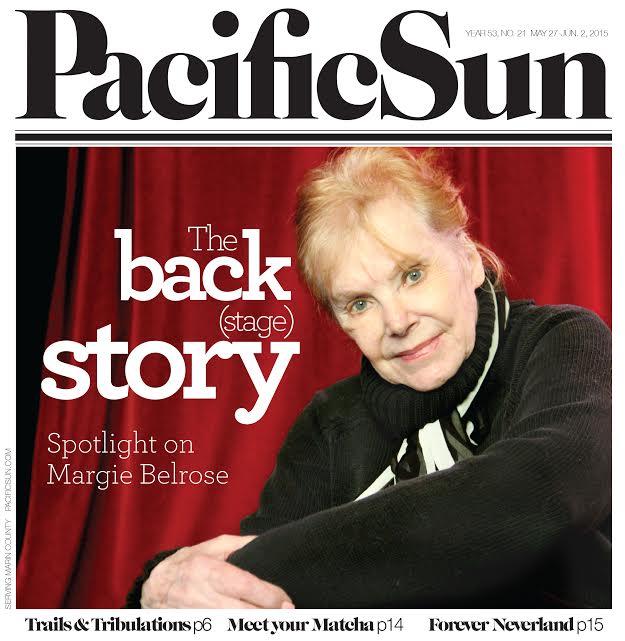
This week in the Pacific Sun, David Templeton profiles Margie Belrose, recipient of the Jerry Friedman Lifetime Achievement Award, and the force behind San Rafael’s The Belrose–a theater, school and costume shop. Joanne Williams writes about Bridge the Gap College Prep, a free college preparatory tutoring/mentoring program for Marin City kids. Charles Brousse reviews Mountain Play’s ‘Peter Pan,’ and Tanya Henry talks to the owner of Breakaway Matcha about powerful green tea. All that and more on stands and online today.
Margie Belrose, perched on a chair inside the atmospheric, slightly mysterious interior of The Belrose performing arts center, knows better than most how to kick off a really good story.
“The best show biz stories,” Belrose says, “are about the right people being in the right place at the right time, right? Well … I’ve got a story like that, a story so good some people have accused me of making it up. But it’s all true. I swear it is.”
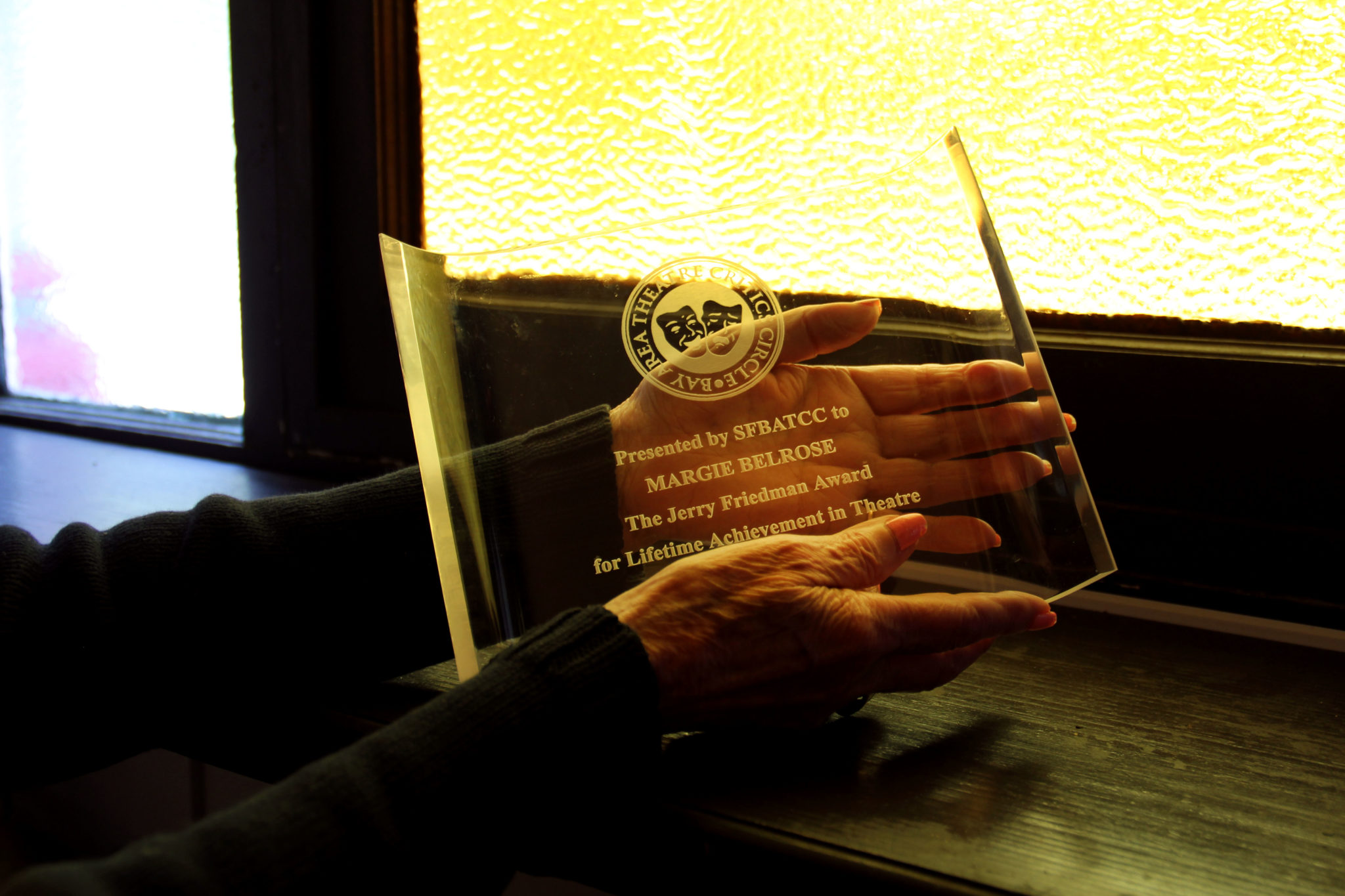
Belrose’s sweet smile and confident voice suggest that even if her story were not true, she’d be able to convince a person otherwise. It doesn’t hurt that Belrose is a certified local legend. Inducted into the Marin Women’s Hall of Fame in 1997, and named San Rafael’s Person of the Year in 2010, Belrose, 84, is also a recipient of the 2015 Jerry Friedman Lifetime Achievement Award—presented to her last March at the San Francisco Bay Area Theater Critics Circle gala ceremony. She was treated to a four-minute-long standing ovation by 300 critics, actors, directors and other practicing artists from the Bay Area theater community.
Margie Belrose holds her Jerry Friedman Lifetime Achievement Award. Photo by Molly Oleson
The ovation was in recognition of much more than just Belrose’s longevity. The theater and school that bears her name—which she founded with her late husband David in 1956 before moving to the current location—has been a small-but-mighty hub of theatrical energy for decades. Belrose estimates that more than 6,000 students of acting, dancing and other theatrical disciplines have graduated from the theater over the years. Though Belrose herself has had to take a break from teaching, dancing and directing after a serious back injury two years ago, San Rafael’s little downtown theater across from the library is still going strong. Weekly dance and exercise classes continue to take place there—everything from Tango to Tai Chi—and the theater has recently become the new home of Marin Onstage, which just had a successful run of the popular meta-musical called [Title of Show].
[That’s the title. Brackets included.]
Even this afternoon, as Belrose reminisces with a visitor, there is a constant bit of bustle in the space, as Johnny Smith, a regular producer of events at the Belrose, sets up for one of the fashionable afternoon teas he’s been putting on there for years.
“I hate the theater to be dark, I just hate it,” Belrose says. “Whether we make money or not—though that’s obviously important—I just don’t want the place to ever look like we’ve gone out of business—that this is a place where interesting things aren’t always happening.”
Which brings us back to the story. That’s the thing about Margie Belrose. Much like her life, her stories have many tangents.
“I’m an orphan,” she says. “It’s true. I was born in New Jersey, but my sister and I were raised in orphanages, at first in New Jersey, then in Saginaw and Detroit, in Michigan.”
After her mother abandoned the family when Belrose was a year old, her abusive father quickly followed suit, and the girls were turned over to a Protestant orphanage. After a series of moves, Belrose was transferred to a Catholic orphanage.
“It was good and it was bad,” she says with a shrug. “I’m not Catholic, but at one orphanage there was a nun who changed my life. Sister Theresa. I know she loved me. I know she did. Nobody ever looked at me the way she looked at me. She convinced me that I was worth loving, that my life was worth living. I thank her every morning.”
Though Belrose knew little about her parents, there is one thing that she has always known about herself.
“I’m a dancer,” she says firmly. “I remember being three years old, standing on this grassy hill, I’m not sure where—my memories of childhood have a lot of gaps in them—but I was dancing on this hill, and singing out loud, ‘I’m going to be a dancer! I’m going to be a dancer!’ I have no idea where I’d seen dancing to know about it, but I remember that so clearly, being a little girl who knew exactly what she wanted to be.”
By the time she became a freshman in high school, Belrose had explored every opportunity to dance available to a kid in “the system,” and finally began paying for formal dance lessons herself.
“A dance class was 50 cents a lesson back then,” she says. “So I scrounged and I saved and I found that 50 cents a week. Because one way or another, I was going to become a dancer. I just had to do it.” She started out loving ballet, but recalls that there wasn’t a single ballet lesson that she did not leave in tears. “In those days, the teacher gave you a whack if you did anything that wasn’t perfect. It wasn’t a happy thing. But I loved dancing ballet in spite of it.”
That said, Belrose eventually learned to tap dance, a dancing style she now claims as her favorite.
“I don’t think you can tap dance and be unhappy,” she says. “You can jazz dance and be unhappy. You can certainly do ballet and be unhappy. But the minute you start tap dancing, you just feel good!”
After being taken in by a foster family—one of the few other times she says she knew she was loved as a child—she ended up in California, where she eventually graduated, and then met David Belrose. A dancer with theatrical ambitions, the San Francisco State psychology grad shared his new wife’s dream of starting a school where they could teach others to believe in their own dreams of dancing and acting.
For a pair of young dreamers, it was an ambitious undertaking. After several years of operating out of whatever rental facility they could find, now with two children, a chance event occurred that Belrose still considers a miracle.
“It was one of those magical occurrences that some people don’t believe in, but I do,” she says. “We needed more space for our school, and we wanted to operate a real theater, too. And one night we walked past this place, which then was an old, empty church up for sale. And I said to David, ‘Look at that old church! That would be a perfect place for our school and theater.’”
Margie Belrose in her church-turned-theater. Photo by Molly Oleson
The sign out front said Trinity Lutheran Church. It was formerly Saint Matthew’s German Evangelical Church, and had just recently been put up for rent. David was initially pessimistic about it being financially feasible to acquire such a place, but the idea would not leave Margie’s mind.
She eventually located the realtor, visited the facility and decided to take matters into her own hands.
“I had a lawyer friend, whose kids I’d been teaching to dance,” she says. “His name was Sol. His wife had said that if David and I ever wanted to invest our money, Sol was the guy to talk to. Well, we didn’t have a pot to piss in let alone money to invest in anything, but now I had an idea. One night I called up Sol—it was 9 o’clock at night—and I told him he had to meet me right then, that it was a matter that concerned the very lives of the Belrose family.”
He showed up at the church, where Belrose was waiting with a flashlight.
“The side door had been left open,” she says. “I knew because I was the one who left it open when I was in earlier with the owner. We looked all around, and I started pointing things out to Sol. ‘That’s where the stage will be! This is where the box office will be!’”
The next day, Belrose, her kids in tow, met Sol for lunch.
“I looked him square in the eyes and said, ‘Sol, that building belongs to the Belrose family. You have to help us get it and make this dream happen!’ and he just looked at me for a minute, kind of adjusted his collar, and said, ‘Well, if I HAVE to help … then I guess I will.’”
That was March of 1962, and by the summer of that year, the family had moved into an upstairs apartment in the church. The renovations had already begun, and the Belrose Theater was born.
“If it wasn’t for Sol, not only would we not have ended up with this theater, I’m certain this would be a parking lot now.”
Belrose stops, practically beaming with pleasure at the memory.
“Now,” she says, leaning in with a bright smile, “isn’t that a great show biz story?”
Fortunately for several thousand theater students and would-be actors, that wasn’t the end of the story. Almost immediately, David and Margie started producing shows on the new Belrose Stage. The first was an original show called Zig Zag, written by David, who went on to write many more plays for that stage.
“I named that first one Zig Zag, because it was a crazy thing where we had four different scenes that were totally different, so there was a scene and then it ‘zigged’ over to something else and then it ‘zagged’ off in yet another direction, and on like that,” Belrose recalls. “Zig Zag. I named all of our shows. It was fun!”
Then, in 1971, David Belrose died suddenly of a heart attack. It was then up to Margie to keep the theater going or move on to something else. She decided to stick it out and learn what she needed to learn to make the theater work.
“I have learned a lot in the last 40 years, I can tell you,” she says.
One thing she learned was, when you own your own theater, you can do more than just help other people’s dreams come true. You can allow yourself a few dreams of your own.
Which is why, in the mid-1970s, at the age of 40, Margie Belrose played Peter Pan in a production that became a kind of celebration of her new life.
“I thought I was too old,” she says. “I know David would have said I was too old. But a friend said, ‘Margie, this is YOUR theater. This is where you tell kids to take chances and try scary things. This is your turn. If you don’t do well with it, who cares? You should just do it. You want to be Peter Pan? Be Peter Pan!’
“I tell you,” she says, “that was a turning point in my professional life. We ended up doing two different productions of Peter Pan over the next few years.”
Since then, she’s appeared in several shows at the Belrose, including playing Queen Eleanor in seven different productions of the classic A Lion in Winter. In 1978, her son David opened a costume shop downstairs, an ever-expanding enterprise that has often been called one of Marin County’s greatest local treasures. Sometime after that, Belrose introduced the idea of doing dinner theater, adding yet another distinct attraction to The Belrose.
Margie Belrose in her costume shop, which offers more than 3,000 costumes in adult sizes. Photo by Molly Oleson
Two years ago, she decided to write a memoir—another scary project that she refused to back down from. The result is The Me I Found: A Journey, available at local bookstores. And of course, there are a few copies on sale at The Belrose.
Today, Margie Belrose looks forward to a time in the not-too-distant-future when she can get back to work—back to acting and back to teaching.
“I hurt too much right now; I’m too unstable,” she says. “But it won’t last. I’ll do it again. I’ll do what I have to do. And theater is just that—it’s what I have to do.”
Looking around the room, hung with the various paintings and decorations that she’s collected over the years, Belrose allows herself a moment to reflect on what her life would be like if she’d never taken that chance, never joined up with David to turn an old abandoned church into an icon of blind faith and big dreams.
She can’t imagine it.
“This is all I ever wanted,” she says. “A safe place to be myself in. The thing is, we didn’t just come in and here and sit around hoping something good would happen next. We came in with a plan, and we came in with a vision, and we came in believing we were the only ones who could make it happen.
“And then we did it.”
Margie Belrose, leaning in again, lets another mischievous smile spread across her face.
“So there,” she says. “That’s my story and I’m sticking with it.”
Ask David if he tried on a costume at le*****@********un.com.
Aries (March 21 – April 19) Here come Thing 1 and Thing 2, Aries. Yep, you’re ex-significant others. Mercury went retrograde and your old girlfriends and/or boyfriends started to show up in your newsfeed. We all know that you’ve been more than a little curious to check in. Take time to say hello and explore a little rekindling action on June 1.
Taurus (April 20 – May 20) Get back on the horse, Taurus! Your self-esteem has been a little shaky lately. We’d be embarrassed, too, if our significant other ditched us to play video games. Stand up for yourself and say your piece. Your confidence is one of your best attributes, after all. And besides, who plays Pokemon anymore anyway?
Gemini (May 21 – June 20) Trouble in paradise, Gemini? Saturn went retrograde in your house of relationships—what does that mean exactly? You’re saying all the wrong things at the wrong times. If you feel like you’re tiptoeing on eggshells, it’s probably because you are, and maybe also because you haven’t taken the trash out in a few weeks.
Cancer (June 21 – July 22) A little resentful, Cancer? You’ve been hanging onto a grudge. It’s written all over your face. The only way to make things right might be to consider all the things you’ve done wrong. No one said Memory Lane wasn’t painful—a little introspection can feel like a fresh stab wound. Draft a list of people to make amends to on May 30.
Leo (July 23 – Aug. 22) Did you accidently sext your boss, Leo? Technology isn’t your thing this week. With Mercury in retrograde you’re likely to have a few technical hiccups. Do your best to keep all of your emails, texts and phone calls PG on May 31. Or you may be called into your boss’ office for an unexpected meeting.
Virgo (Aug. 23 – Sept. 22) Get real, Virgo! Hoping to tie the knot with a special someone? Here’s a spoiler alert: With Mars and Neptune butting heads, it’s very unlikely that you and yours are on the same page. So what’s the best way to realign? Take some space and wait for this celestial mess to die down—otherwise you might find yourself back on Match.com sooner than you were hoping for.
Libra (Sept. 23 – Oct. 22) Did you really just say that, Libra? What have we told you about thinking before you speak? It’s likely that you said something so painfully awkward, even the waitress at dinner slowly backed away from you. If you have something on your mind, that’s fine. But a little tact goes a long way on June 2.
Scorpio (Oct. 23 – Nov. 21) Feeling a little suspicious of a special someone, Scorpio? Your possessiveness can get the best of you, sure, but this time you might be right. Mercury in retrograde tends to bring exes back into the picture, so if your dearly beloved is hiding his or her phone, he or she might be finding a new reason to go to the laundromat at 8pm.
Sagittarius (Nov. 22 – Dec. 21) What are you looking for, Sagittarius? A new moon in your sign on June 2 has you asking yourself the big questions. Yes, bigger than, “Should I go on a juice diet this week?” We’re talking life-changing thoughts here: Career, love and health. If you’ve been uncertain about a big decision lately, here’s a clue: Go with “yes.”
Capricorn (Dec. 22 – Jan. 19) Did you just become Facebook official, Capricorn? Venus is in Cancer, your house of committed relationships, so it’s no surprise that you’ve found a special someone. Enjoy the tender long walks on the beach while they last—before the snoring starts to annoy you at least.
Aquarius (Jan. 20 – Feb. 18) Who’s that knocking at your door, Aquarius? Your ex. How did he or she find your address? It’s 2015. Pull it together—a fifth grader could find your social security number if he or she wanted to at this point. Don’t write this star-crossed lover off just yet—it might be worth it to hear what he or she has to say.
Pisces (Feb. 19 – March 20) Don’t get pregnant, Pisces! You might be eager to take things to the next level, but creating another earthling isn’t necessarily a step in the right direction. There’s some friction in your relationship right now, and babies aren’t the answer.
Fully prepared to hate AMERICAN SNIPER, I came away from the film under a spell that few war films have ever put me through. Director Clint Eastwood accepted the project far into production after Steven Spielberg left it, and it turns out that my Republican, rally-round-the-flag fears were unfounded—Eastwood’s austere style trumps his politics and finds little to romanticize in this story of America’s deadliest shooter. Still, the film has struck a chord, that once-a-decade groundswell among red-staters and non-moviegoers, like ThePassion of the Christ and Forrest Gump before it—which has less, I think, to do with Chris Kyle’s story than with the more real sense that versions of this story are being repeated thousands of times in this country. War’s horror and the unreality of homecoming are well-trodden territory, but thanks to Bradley Cooper’s mesmerizing performance, which follows Kyle’s training, romance, deployment to Iraq—four tours in a decade—and return, it’s felt here with conviction. The unlikelihood that any of Kyle’s 255 kills (160 confirmed) had anything to do with the terrorist attacks that so galvanized him doesn’t enter into the film’s calculus, and in its sealed-off atmosphere you realize that it never would. You’re on a rooftop, your friends are in someone’s gun sights and you’re the only being who can save them. When you’ve returned home to your family, you’ve abandoned those friends.
It’s never productive in Marin to deliver a major planning document and throw it on the table as a done deal.
Mill Valley learned that when the city produced a plan to rehabilitate Miller Avenue. The plan, which featured street realignment and a vision of mixed-use buildings in a style sympathetic to the town’s architecture, triggered an outcry from residents who said that the city had failed to engage them before the plan reached the drawing board.
The experience in Mill Valley could have been a model for what to do—and what not to do—when representatives of Plan Bay Area drove to Marin from the East Bay and presented the county and its cities with a document that many Marin residents said looked like a done deal.
That was in 2013, a year marked by raucous public meetings marked by aggressive contention. A blizzard of criticism emanated from Marin critics who said that Plan Bay Area threatened the character of the county and its cities. Little communication existed between those who held opposing viewpoints. Less compromise was in the air.
The reality is more complicated and touches on existential issues for Bay Area cities and counties: Should the state dictate the number of new homes a community should build in a planning cycle? Or should the state allow communities to enact incentives and innovative attractions to developers that could accomplish the same goal but possibly without adding new buildings in a community that doesn’t want them?
Critics often miss the mark when they attack ABAG for mandating the number of new homes the agency says communities will need to accommodate projected growth in population. Starting at the top, the California State Department of Housing and Community Development mandates that regional government councils assign housing requirements to local counties and cities. ABAG is the local government council in the Bay Area. It has jurisdiction over the nine Bay Area counties and the cities within those counties. ABAG assigns each an anticipated regional housing need determination.
The process mandates that counties and cities only identify areas that could accommodate growth to meet future need. It does not mandate changes in current zoning or planning or building approvals. But if counties and cities fail to identify areas and make a good faith effort to accommodate growth, they open themselves to housing-based lawsuits. Critics of the process say it’s a one-size-fits-all top-down sword held over the heads of cities.
A central vision of how AB 32 would work includes a scenario in which counties, cities and towns will, among other goals, promote efficient energy use, encourage workforce housing and push for improved public transit.
In 2008, the Legislature took AB 32 another step down the road to regional planning with SB 375. It’s part of the Sustainable Communities Strategy. It seeks to coordinate land-use and transportation planning, a first in regional planning in the state. It pushes for integrating non-motorized transportation, public transit, walking and transit-oriented development. “Improved planning means cleaner cities, less time stuck in your car and healthier, more sustainable communities,” said California Air Resources Board Chairman Mary D. Nichols in a press release.
AB 32 and SB 375 begat Plan Bay Area, which remains a sore point for critics who say that the state and its regional agencies have no business trying to fit Marin for one-size-fits-all planning future.
But the tenure of the criticism has moderated, as evidenced by a more than civil workshop held on May 16 in Novato. Representatives from ABAG and the Transportation Authority of Marin (TAM) came to Novato to gather input and disseminate information about the next iteration of Plan Bay Area, which receives an update every four years. The next one is set to begin in 2017. (TAM will hold its own public workshop about transportation issues in the county on June 20 from 11am to 3pm at San Rafael High School.)
Plan Bay Area staff already had scheduled an open house in Marin from 5pm to 7pm on May 28. But that workshop leaves no room for an active pubic debate. The agencies will set up tables in a room at the Civic Center, where planners and public information officers from the two agencies will interact with participants, but only in a one-to-one format. The agencies plan no general discussion.
That lack of interaction bothered Marin representatives to ABAG, says Pat Eklund, Novato mayor pro tem. “The Marin delegates felt very strongly that just having an open house was not going to really give us the open dialogue that we wanted.” The Marin delegates wanted a workshop atmosphere in which ideas could bounce around and participants could learn as well as contribute ideas, says Eklund, who in addition to representing Novato at ABAG is the liaison to ABAG for Marin cities. That lack of interaction played a role in the anger Plan Bay area critics exhibited in 2013.
But ABAG and MTC rejected the notion of having an open house before an open workshop format, Eklund says, “So we decided to go forward with the public workshop. We felt it was critical to have an open dialogue with the community.”
The Marin representatives have been engaging ABAG in an attempt to convince the agency that Marin is different than the rest of the Bay Area and the differences should count in setting policies and growth projections. The message got through, although it remains until the four-year update lands on the desk to see the extent to which ABAG has received the message. Promising signs do exist that ABAG is at least listening. Eklund says, “ABAG told Marin delegates that, yes, [ABAG is] specifically looking at Marin and perhaps the approach they have been taking for estimating population, jobs and housing needs has not been necessarily appropriate because of the county’s demographics.”
The import of that transition from the 2013 stance of throwing the plan on the table to accepting calls for another look at Marin merit an exclamation, according to Eklund, who says, “That’s huge.” The need for a renewed look that would inform the next iteration of Plan Bay Area rests on the age of the Marin population, which is the oldest in the Bay Area. Because more older adults on a percentage basis live in Marin than other counties, the projections of population growth and job growth may be inflated in the calculations that produced the first iteration of the plan.
That’s not to say that all is sweetness and light in the Marin relationship revolving around Plan Bay Area. Eklund provides a monthly update on the website for Marin County Council Mayors and Councilmembers. In a list of issues that went right and issues still outstanding, Eklund states that, acknowledging critics of the plan, the next iteration of growth projections and targets should take into account the available water supply, sea level rise and air quality, among other benchmarks.
The stakes are serious. The concept of tying together jobs, housing and transportation is based on allocations of transportation funding. According to an MTC document the agency compiled in 2012 for the first Plan Bay Area cycle, “One Bay Area Grant is a new funding approach that better integrates the region’s federal transportation program with California’s climate law and the Sustainable Communities Strategy. Funding distribution to the counties will encourage land-use and housing policies that support the production of housing with supportive transportation investments.”
Marin residents can contribute comments to the next iteration of the plan via the ABAG Virtual Open House website. Contributors have until May 31 to add their comments. MTC has an informative Vital Signs page to disseminate information about transportation and potential growth.
Although the spotlight often focuses on greenhouse gas emissions because of the state laws, proponents of the Sustainable Communities Strategy say that attention also should focus on the quality of life that can come with transit oriented development—especially for an older population that can, perhaps, no longer jump in a car. Making incremental improvements can be important, they say. Even if not all residents of a transit-oriented development give up their cars entirely, a substantive quality of life for many individuals and for a community can accrue.
Along with the philosophical and the more esoteric effects of the Sustainable Communities Strategy, come some practical implications for transportation funding.
MTC, for example, receives gas tax disbursement from the feds and takes 50 percent of it for regional projects. The other 50 percent goes to the nine Bay Area counties, which must spend their set percentages in priority development areas.
The problem for Marin, because critics of the plan rejected priority development areas, is that only two priority development areas of consequence remain in Marin: Downtown San Rafael and Marin City. Other cities having no priority development areas will see only half of the federal gas tax money—and they must share it with the rest of the non-priority development areas in the county.
Q: I’ve been dating this guy long distance for six months. He’ll often fail to return texts for an entire day or even a few days. I keep breaking up with him, but he keeps apologizing, acknowledging that he can be “distracted” and then offering convincing excuses or making me feel I’m overreacting. This is getting old.—Annoyed
A: Is there some crater somewhere where all his promises go to die?
There is sometimes a good reason that your boyfriend can’t return your text for days, like that it’s 790 B.C. and there’s a snowstorm and he’s sending his eunuch with the bum knee over the Alps with a set of stone tablets. When there is no good reason, his acknowledging an error, like by admitting to being “distracted,” is a first step in mending his ways. That is, except when he shows you—repeatedly—that it’s his only step (perhaps because it’s tricky to text you back when his other, more local girlfriend is sitting right next to him).
Getting somebody to respect your boundaries starts with appearing to have them. Sure, there are sometimes allowances to be made, like for an all-nighter at work or illness. As a friend of mine once wrote: “Sorry I didn’t respond to your email; I was in a coma.” But a man who cares about you generally acts in ways reflecting that—like by dashing off a text to tell you “sleepy—w/write u in a.m.” or “kidnapped—w/be in touch w/ransom demand.” Instead, this guy gives you yet another apology—which basically translates to, “Sorry that it’ll be a few days before I can do this to you again.”
To have a caring, attentive man, you’ll need to make room for him in your life. You do this the same way you make room for a new TV—by putting the old broken one out on the curb. It’s tempting to keep believing the excuses, which allows you to believe that you’re loved. Unfortunately, believing that you’re loved never plays out like actually being loved. The problem is, in the moment, our emotions are our first responder, and reason—that slacker—burrows under the covers, hoping it won’t get called in to work.
Overriding wishful thinking-driven gullibility takes planning—having a pre-packed set of standards for how you want to be treated and then pulling them out at excuse o’clock and holding them up to how you’re actually being treated. This is how you end up with a boyfriend who keeps his word. Keeps it and puts it on his phone and texts it to you—as opposed to keeping it in a drawer with slightly used chopsticks, old answering machine tapes and a Ziploc baggie of his sister’s hamster’s ashes.
Q: I’m a 31-year-old straight guy. I dress pretty boringly—except for my socks. I go for crazy colors and patterns. My buddy says that these make me look “weird” and “less manly.” Come on. Do women really want you to be a carbon copy of every black-sock-wearing dude out there?—Mr. Fun
A: In the sock department, as in other areas, it’s the nuances that count. So, go ahead and make a statement—but maybe one that stops short of, “I’m really a Japanese schoolgirl!”
Novelty sock-wearing for men has actually been a thing in North America for a few years. The really wacky ones may work as what anthropologists and animal behaviorists call a “costly signal.” This is an extravagant or risky trait or behavior that comes with a substantial price—handicapping a person’s or critter’s survival or chances of mating—thus suggesting that it’s a reliable sign of their quality. An example is a peacock with a particularly lush (and heavy) tail. His managing to escape predators while dragging around big, feathered hindquarters like a train on a royal wedding dress tells peahens (girl peacocks) that he must be a real Chuck Norris among big, feathery birds.
Still, there are costly signals—”I’m man enough”—and too-costly signals: “It’s raining men! Hallelujah!” To figure out where the line lies for you, average all the variables: Degree of manliness, girliness of sock choice, occupation (like if you’re a British graphic designer or a guy who goes to work in oversized red shoes) and the eccentricity level of the women you like. But keep in mind that certain socks are risky for any man, such as—and yes, these actually exist—Superman insignia socks, complete with tiny red capes attached. Sure, let your socks tell a woman that you want to take her home with you—but maybe not so you can tear off all your clothes and make her watch as you play with your action figures in your Superman Underoos.
While I’m no lover of punning, it’s hard to resist the temptation to “come clean” about my reaction to The Clean House, Sarah Ruhl’s comic drama (or dramatic comedy—whichever you prefer) that just began its run at the Ross Valley Players’ Barn Theatre.
In previous reviews, I’ve voiced concern about the increasing tendency among contemporary playwrights to replace the traditional “unities” of time, place and character development that have shaped Western theater from classical Greece to the present with a kind of anarchic/anything goes approach that stresses form over content, sensory impact over psychological depth, innovation over consistency.
Sadly, the experience turned out to be a textbook example of what I’ve just described. This is not to denigrate the quality of RVP’s cast, which is solid throughout.
The Clean House is barely seconds old when Ruhl tips her hand. Wall projections of huge abstract paintings and a sparse, all-white décor conform with what the program describes as an upscale suburban Connecticut home inhabited by a childless married pair of affluent medical doctors. Their maid, Matilde (a vibrant Livia Demarchi), interrupts her desultory dusting, moves to the front of the stage to address the audience with a lengthy song in Portuguese, expressing her dislike of housework and the sexual favors (suggested by repeated pelvic thrusts) requested by previous employers.
Matilde’s song—together with her confession that she’d rather continue her fun-loving father’s search for the “perfect joke” than clean houses—and the stern rebuke that this elicits from Lane, her employer’s wife. Enter Virginia (the perfectly cast Tamar Cohn), Lane’s older sister, whose obsession with cleaning is an escape from an empty life. Without Lane’s knowledge, she becomes Matilde’s everyday assistant and the mood shifts. It’s still wacky, but now it’s about housewives’ depression.
And then—Voila! It becomes a romantic farce.
As enticing as this setup seems, Ruhl has other ideas. It’s time for tragedy. Charles’ paramour Anna (a super exuberant Sumi Narendran) has breast cancer. Although no longer funny, the wackiness continues as the survivors cheerfully embrace the ensuing confusion and bury their differences.
So, what is the playwright trying to tell us? Chaos is dangerous but good for the spirit, order is safe but bad? Frankly, I’m not really sure, but I’d certainly like to check out the dust level in her house.
Charles Brousse can be reached at cb******@*tt.net.
NOW PLAYING:The Clean House runs through June 14 at the Ross Valley Players’ Barn Theatre, Marin Art & Garden Center, 30 Sir Francis Drake Blvd., Ross. For more information, call 415/456-9555, or visit rossvalleyplayers.com.
Who is Batman’s sidekick?” asks actor-director David Yen, reading aloud from an “electronic waiter” thingamajig perched on the table at Applebee’s. That’s where we’ve landed after catching a screening of Mad Max: Fury Road, but before we can get our conversation started, Yen has been bemusedly distracted by the iPad-like device that Applebee’s now employs to keep its patrons entertained by trivia questions and games. What amuses Yen most is not the Batman question but the four bird-themed, multiple-choice answers suggested by the machine. Only one of them is Robin.
“Sparrow!” Yen exclaims. “Batman’s sidekick was definitely … Sparrow! Wow! That’s really kind of dumb.”
With that, he turns the thingamabob face-down, we briefly ponder the culinary curiosity of something on the menu called “Churro S’mores,” and finally turn our conversation to Mad Max: Fury Road, a rollicking, action-packed crowd-pleaser of a film that’s partly a sequel to the three Mel Gibson films of the 1980s, and partly a re-energized reboot of the entire franchise, with Tom Hardy now stepping into the leather boots of the iconic post-apocalyptic road warrior.
With almost non-stop excitement and some of the most entertainingly over-the-top stunts and action sequences ever put on film, Fury Road is the definition of a big summer blockbuster.
Yen, being an established company member of Marin County’s annual Mountain Play production, knows a thing or two about really big shows. Taking place annually atop Mt. Tamalpais at the massive 3,000-seat Cushing Memorial Amphitheatre, the Mountain Play is without question the biggest indoor-or-outdoor theatrical endeavor in the Bay Area. This year, the Mountain Play is staging the indelible musical adventure Peter Pan, with a visually inventive approach to the timeless story that, according to Yen—who plays Smee, the affable henchman to the villainous pirate Captain Hook—will be unlike anything a Mountain Play audience has ever seen.
Though Peter Pan has little in common with Mad Max, beyond the fact that both feature extraordinary fantasy worlds full of outrageous characters, swashbuckling action and plenty of danger and excitement, the film got Yen thinking about one unlikely connection between the world of live theater and the recent spate of theatrical reboots.
“I usually have a real hard time with reboots of film series,” he says. “I absolutely despised the new Star Trek movies. Whenever there’s a new superhero reboot or some other new version of an old story, I always think, ‘Is there not enough new material out there that we have to keep doing the same things over and over?’ I know there are good writers out there!”
“Each new rebooted series of movies,” I point out, “seems to reinvent the rules of the story, changing things up and usually trashing what made the original fun to begin with.”
“Exactly!” Yen says. “When I first started seeing previews for this new Mad Max film, I was going, ‘Oh, really? That’s MY Mad Max, and I like him the way I remember him. Don’t you dare mess with my Max!’ But then, after you asked me to see Mad Max with you, I started sort of rethinking my position.
“I do theater,” he continues, “and in a way, isn’t all theater essentially a reboot? I guess world premieres of brand new shows would be the exception, but every time a theater artist takes an existing show and stages it, aren’t they basically rebooting it? A director brings his or her vision to it. They hopefully try to bring something fresh to the show while keeping alive what made it worth doing to begin with. So maybe I can understand all of these movie reboots a little better.”
In Mad Max: Fury Road, the story is picked up by original director George Miller—and what he does is not a reinvention so much as a reinvigoration. Set in another corner of the apocalyptic wasteland established in Mad Max, The Road Warrior and Mad Max Beyond Thunderdome, this one drops Max—still a man of very few words—into the clutches of a nightmarish cult overseen by a mutant overlord named Immortan Joe (Hugh Keays-Byrne), against whom he eventually sides with the one-armed warrior Furiosa (Charlize Theron). What follows is essentially the longest chase-sequence in movie history, featuring Max and Furiosa on a jury-rigged gas tanker being pursued across a desert by hundreds of bald, deformed “war boys” in cars and trucks and motorcycles.
“It was a total blast!’ Yen says. “And the best thing is that it wasn’t trying to retell or reinvent the mythology. It was just using a new actor to tell a story that totally fits in with the stories in the other movies.”
In the Peter Pan play that opens on the mountain this weekend, there isn’t nearly the same kind of tinkering, but Yen says that the style of the production will be different than others, starting with director Michael Schwartz’s inspiration to capture the essence of how J.M. Barrie came up with the idea of Peter Pan in the first place.
“It’s pretty unique,” Yen says. “Michael said, ‘Let’s just go back to the lake where J.M. Barrie went with the boys he made up these adventures for.’ There are things you can do in a small theater—things like blackouts—that you can’t do on the mountain at two in the afternoon, so Michael has envisioned this Peter Pan as taking place at a camp in the Adirondacks, with the story popping to life in the imagination as the characters basically build Neverland out of ladders and crazy stuff all around them. It’s all about play and creativity and the limitlessness of the imagination. It’s very, very cool, and very much based in the art of making-believe.”
There are some surprises in the show so big that Yen elects to keep quiet about them.
“They are, after all, ‘surprises,” he says.
We talk for a while about other “alternative visions” brought to classic shows, and how many favorites, especially Shakespeare plays, often are set in post-apocalyptic, Road Warrior-style worlds.
“I even heard of a production of The Pirates of Penzance set in a post-apocalyptic world,” I tell Yen, who responds to this idea with mock, open-mouthed silence, before simply shaking his head.
“Well, I suppose someone could try to do a post-apocalyptic Peter Pan some day,” he says with a laugh, “but this one definitely isn’t that. It’s not a ‘reboot,’ so much as it’s a reimagining. The story’s still there. The songs are all there. And Peter definitely still flies.”
“But there are no mutant gas-pirates on motorcycles?” I ask.
“Definitely not,” Yen says with a laugh. “But … we do have pirates. Lots of pirates!”
But none, we can hope, named Jack Sparrow. Who, come to think of it, would make a great sidekick for Batman.
Anything is possible.
Ask David if he’s ever been to Neverland at ta*****@*******nk.net.
by Tanya Henry
What do coders, yoga instructors and Japanophiles all have in common? A taste for a potent, fine premium green powdered tea high in antioxidants that carries health claims of lowering cholesterol, fighting cancer and slowing the aging process. And if Eric Gower has his way, many more of us will become devotees of this “liquid meditation” also...
by Charles Brousse
Every Sunday through June 21, Peter and Wendy are making regularly scheduled flights from the top of Mt. Tamalpais to a far-off destination called Neverland. Back in Marin, the weather (at least, as of this writing) is stuck in its familiar late spring/early summer morning-fog-followed-by-afternoon-sun rut. Yellow school buses on extra-hours duty are discharging excited passengers carrying...
This week in the Pacific Sun, David Templeton profiles Margie Belrose, recipient of the Jerry Friedman Lifetime Achievement Award, and the force behind San Rafael's The Belrose--a theater, school and costume shop. Joanne Williams writes about Bridge the Gap College Prep, a free college preparatory tutoring/mentoring program for Marin City kids. Charles Brousse reviews Mountain Play's 'Peter Pan,' and...
by David Templeton
"Want to hear a great show biz story?”
Margie Belrose, perched on a chair inside the atmospheric, slightly mysterious interior of The Belrose performing arts center, knows better than most how to kick off a really good story.
“The best show biz stories,” Belrose says, “are about the right people being in the right place at the right time,...
by Leona Moon
Aries (March 21 - April 19) Here come Thing 1 and Thing 2, Aries. Yep, you’re ex-significant others. Mercury went retrograde and your old girlfriends and/or boyfriends started to show up in your newsfeed. We all know that you’ve been more than a little curious to check in. Take time to say hello and explore a little...
by Richard Gould
Fully prepared to hate AMERICAN SNIPER, I came away from the film under a spell that few war films have ever put me through. Director Clint Eastwood accepted the project far into production after Steven Spielberg left it, and it turns out that my Republican, rally-round-the-flag fears were unfounded—Eastwood’s austere style trumps his politics and finds little...
by Peter Seidman
It’s never productive in Marin to deliver a major planning document and throw it on the table as a done deal.
Mill Valley learned that when the city produced a plan to rehabilitate Miller Avenue. The plan, which featured street realignment and a vision of mixed-use buildings in a style sympathetic to the town’s architecture, triggered an outcry...
by Amy Alkon
Q: I’ve been dating this guy long distance for six months. He’ll often fail to return texts for an entire day or even a few days. I keep breaking up with him, but he keeps apologizing, acknowledging that he can be “distracted” and then offering convincing excuses or making me feel I’m overreacting. This is getting old.—Annoyed
A:...
by Charles Brousse
While I’m no lover of punning, it’s hard to resist the temptation to “come clean” about my reaction to The Clean House, Sarah Ruhl’s comic drama (or dramatic comedy—whichever you prefer) that just began its run at the Ross Valley Players’ Barn Theatre.
In previous reviews, I’ve voiced concern about the increasing tendency among contemporary playwrights to replace...
by David Templeton
Who is Batman’s sidekick?” asks actor-director David Yen, reading aloud from an “electronic waiter” thingamajig perched on the table at Applebee’s. That’s where we’ve landed after catching a screening of Mad Max: Fury Road, but before we can get our conversation started, Yen has been bemusedly distracted by the iPad-like device that Applebee’s now employs to keep...