News: Whale mystery

0

by Kathleen Willett

Walking Sonoma and Marin County beaches recently has yielded some unusual sights—and smells.

According to officials at the National Oceanic and Atmospheric Administration (NOAA), 12 dead whales have washed up on Northern California beaches in the last three months, including two along the Sonoma County coast and one in Marin County. The carcass of a young gray whale showed up on Portuguese Beach on May 23, with another gray whale washing ashore near Jenner around May 28. In Marin, a headless whale came ashore on South Beach along the Point Reyes National Seashore on May 26.

Other than the fact that they are all whales, what do the carcasses share in common?

“There is no unifying factor,” says Mary Jane Schramm, spokeswoman for the Gulf of the Farallones National Marine Sanctuary.

Marine scientists have identified four different species among the 12 dead whales: orca, humpback, sperm and gray, which are commonly seen heading north along the coast this time of year. Their ages, along with their causes of death, have varied.

According to Schramm, one of the dead whales found in Pacifica was mature and possibly died of “old age,” given the condition and apparent wear on various body parts. Several others were young, possibly calves from the winter birthing season in Mexico, and may have been victims of predation by orcas.

One humpback was a victim of shipping traffic, while other whale carcasses have shown signs of possible “fishery interactions” such as net entanglements, which can mortally wound the immense animals.

In a typical year, one or two gray whale carcasses wash ashore. So what is different this year?

Since the 2013–14 winter, climatologists have noticed the formation of a “blob” of water in the northeastern Pacific Ocean that runs 3 to 4 degrees Fahrenheit warmer than usual. Nick Bond, a scientist with the Office of the Washington State Climatologist, says it currently extends from Baja to the Gulf of Alaska, and is up to 1,000 miles wide in places.

Both Bond and California state climatologist Michael Anderson agree that the warm-water mass is not directly related to climate change or the whale deaths since the phenomenon has been noted before. But Anderson believes that “climate change may be impacting the magnitude of the anomalies.”

Though climatologists believe the warmer water is a short-term condition that will likely last only a few years, it is nonetheless an unusual event which, according to Bond, we could consider “a dress rehearsal for climate change.”

Scientists agree that linkages between climate and organisms of all types are difficult to make. In order to conduct sound, meaningful research, commercial activities that could disrupt the ecosystem, such as the oil spill near Santa Barbara, need to be tightly managed or eliminated.

As it happens, the NOAA recently announced the expansion of marine sanctuaries along the Marin, Sonoma and Mendocino coasts. The Gulf of the Farallones and the Cordell Bank national marine sanctuaries are both increasing to more than twice the area they previously encompassed.

The expanded areas contain significant resources and habitats, including an “upwelling zone” originating off Point Arena. Upwelling is a process by which deep, nutrient-rich water rises to the surface. The upwelling zone along the Sonoma and Marin coasts is one of the most productive systems in North America, and contributes to the rich marine life in local waters.

Designating these areas as a sanctuary protects them from oil and gas exploration, and makes it possible to regulate activities that could be detrimental to the ecosystem, such as commercial shipping speeds and fishing.

Dr. Frances Gulland, Senior Scientist with the Marine Mammal Center in Sausalito believes that while the number of dead whales seen on North Coast beaches this spring may not be alarming, relative to the 1999-2000 catastrophe when 40 gray whales washed up on North Coast beaches, it is cause for concern.

“We just don’t know what is altering the distribution of these whale carcasses,” she said.

The NOAA is hosting a celebration of the sanctuary expansion on June 28 from 11am to 3pm at the Gualala Arts Center.


Music: For the greater good

0

by Tom Gogola

“It was a pretty outrageous idea,” says Bruce Burtch, of what began, seven months ago, as a dream to bring together art by—and of—rock legends of the ‘60s, and at-risk kids. “But the outpouring of support has been phenomenal.”

Burtch, known as the “Father of Cause Marketing” for his work over the last 40 years in building “win-win” partnerships—focused on creating a greater good—between for-profit, nonprofit, education and government sectors, is the author of the highly-acclaimed book Win-Win for the Greater Good.

Burtch, who says that he’s technically retired, has been working around the clock on a project close to his heart: Forty-five works of art by some of the most well-known musical icons will be part of a month-long fandango to celebrate rock icons and benefit DrawBridge, a Bay Area art program for homeless and other underserved children that was founded in San Rafael more than 25 years ago.

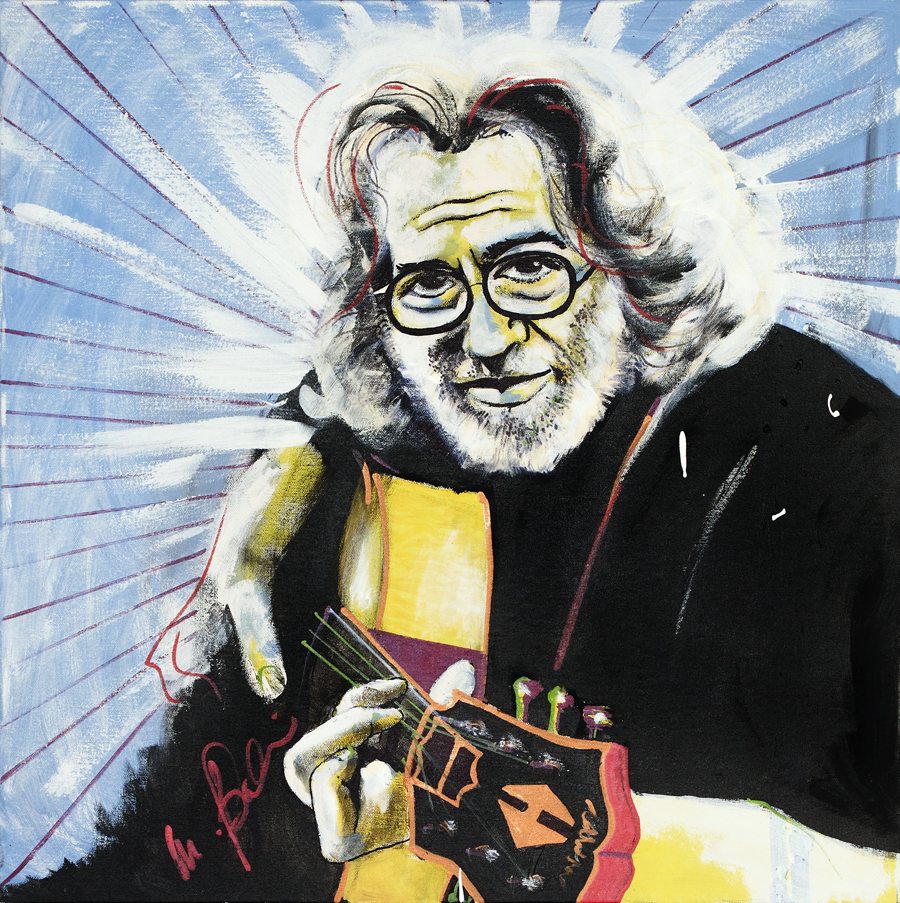
The event is called, naturally, San Rafael Rocks, and San Rafael will commence to rock in June. It will rock through July, thanks to Burtch, who has produced and curated a multi-platform celebration of the art of rock that includes the biggest-ever showing of original art by the late Garcia (thanks to the good graces of the Jerry Garcia Foundation, which is overseen by the musician’s family). This is the first-ever project of the foundation in the United States, Burtch says.

With the Fare Thee Well hoopla as backdrop, Burtch’s first move was to approach well-known musicians who are also noted visual artists, and get them to donate paintings to benefit DrawBridge.

Now there’s an art show, a film festival, a street fair, a planned musical tribute to Garcia and a local webcast of the final Fare Thee Well Grateful Dead show.

This piece of Janis Joplin will be included in The Art of Rock Legends exhibit on June 12.

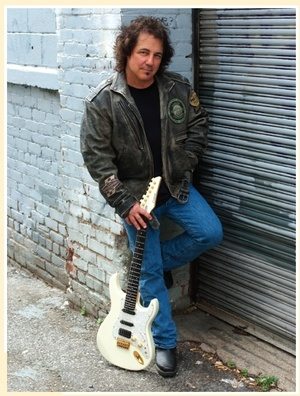
The Art of Rock Legends kicks off on Friday, June 12 from 5 to 8pm at Art Works Downtown (1337 Fourth St., San Rafael), and runs through July 24. Burtch has, along with snagging 21 original Jerry Garcia artworks for the exhibition (seven of which will be for sale) used his powers of persuasion to coax works into the San Rafael gallery from the likes of the Jefferson Airplane’s Marty Balin, Carlos Santana and Rolling Stone photographer Baron Wolman.

The Rock and Roll Film Festival unspools July 6-8 at the Rafael Theater (1118 Fourth St., San Rafael) and will emphasize films about the Grateful Dead and the Jer-Man. As a high-impact warmup show, on July 5, the Smith Rafael Film Center will webcast the last of the Fare Thee Well Dead shows from Soldier Field in Chicago.

A rock and roll Block Party in downtown San Rafael on July 11 will include all kinds of cool, vintage and contemporary poster art from the folks at the Rock Poster Society.

And finally, the Fenix (919 Fourth St., San Rafael) is tentatively putting July 17 on the calendar for a musical event hosted by Merl Saunders Jr., and called “In the Spirit of Garcia.” Merl Jr. works at the theater and Merl Sr. was a musical collaborator with Garcia. Burtch says to expect “a very special guest” at this show, the details of which are still being hashed out.

Burtch is too excited to retire any time soon. “People are saying, ‘Let’s have some fun, let’s make some noise about the need to help homeless kids,’” he says. “‘And let’s celebrate the great art, music and film we have here in the Bay Area.’”

For more information, visit sanrafaelrocks.com and drawbridge.org.

Theater: One for the books

0

by Charles Brousse

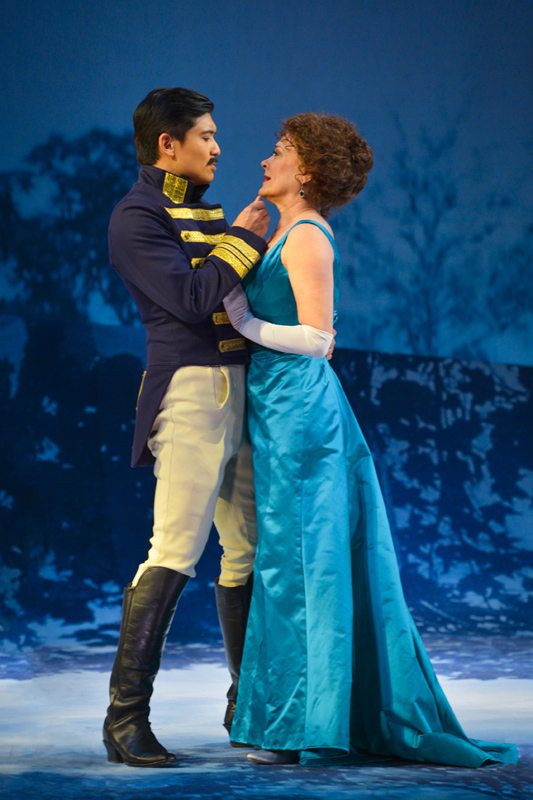
If you’re hungering to see one of the best late-20th century American musicals (arguably the best) presented with that unmistakeable Broadway panache—but without the effort and expense of a trip to Manhattan—here is your golden opportunity. In an extended run that closes on June 21, San Francisco’s American Conservatory Theater (A.C.T.) hosts a superb production of Stephen Sondheim’s A Little Night Music that should satisfy your craving—and then some.

Truth be told, this show’s position in the pantheon of American musical theater is something of an enigma. Although the 1973 Broadway debut received six Tonys (including Best Musical), along with numerous other critics’ awards, and seemed to please audiences once they were in the theater, it ran for only 601 performances—fairly brief by New York standards, and its revivals have been similarly limited.

So, what explains the disconnect? My guess is that it’s mostly a public perception that even though the creative team is 100 percent native born, the show is not American enough. Certainly, its formative influences are foreign. Hugh Wheeler’s book and Sondheim’s lyrics closely mirror the content of Swedish director Ingmar Bergman’s acclaimed 1955 film, Smiles of a Summer Night, a sophisticated romantic comedy in which lust, love and despair intertwine among a group of affluent Swedes gathered on a country estate for the annual Midsummer celebration. The musical’s title is a direct English translation of “Eine Kleine Nachtmusik,” the popular name given to Mozart’s “Serenade in G Major.” Sondheim’s score, with its unusual reliance on minor key three-quarter time waltz tempos has antecedents in Ravel, Weill and other European composers.

A second damaging perception has been that Night Music is lugubrious to the point of boredom. From what I’ve read, director Harold Prince’s original Broadway version was exceptionally slow-paced, and others have followed his example. This extended to the show’s hit song, “Send in the Clowns,” which potential ticket-buyers took as a signal that they would be in for a long evening.

Sophisticated? Foreign? Slow-moving? That’s not what Americans look for in a genre they think they own!

The American Conservatory Theater has done a number of things to restore the sparkle that was lost when Bergman’s comedy moved to the stage. First and foremost, director Mark Lamos keeps the action moving at a nice clip—brisk, but not to the point that the underlying poignancy is compromised. Music director Wayne Barker adds a vital dimension by keeping his orchestral tempos a bit livelier than usual. Together, the two blend to make the show look and sound more like the dynamic Sondheim of Company than a slow-moving Chekhovian knockoff.

All of the production elements are of the highest quality. They include an impressive (and flexible) scenic design by Riccardo Hernandez that utilizes every inch of the company’s capacious stage, an elegant lighting plot by Robert Wierzel, an assortment of attractive costumes from designer Candice Donnelly and a live (though hidden) group of seven instrumentalists whose rich sound belies their small number.

Of the large cast of actors/singers, given my space limitations, I can say very little, except that they are thorough professionals—even 14-year-old Brigid O’Brien, who cut her performance teeth in Marin’s Mountain Play—and several have extensive experience on top New York stages. Karen Ziemba’s quietly introspective delivery of “Clowns” is just what the song requires, and Marissa McGowan brings down the house with her defiant assertion of independence in “The Miller’s Son.” In the end, though, everyone involved has a part in making this production of A Little Night Music one for the history books.

Charles Brousse can be reached at cb******@*tt.net.

Upfront: Path of peace

2

by Peter Seidman

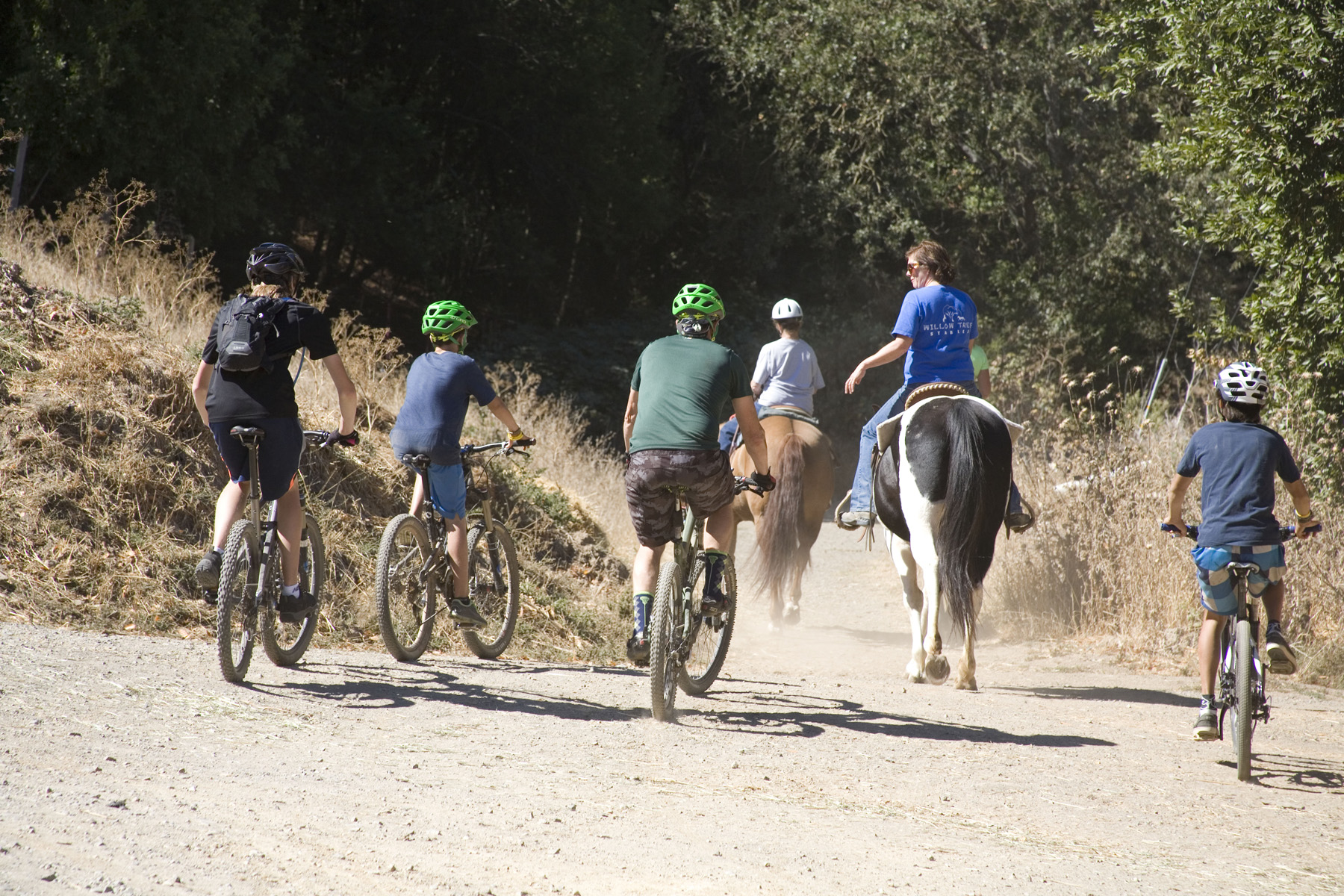
The Marin Museum of Bicycling and the Mountain Bike Hall of Fame opened in Fairfax on June 6, the same day that Trail Partners held an inaugural event in that organization’s effort to bring peace to trails in Marin open spaces.

The two events highlighted the history of biking, especially mountain biking, in Marin, as well as the problems that come with popularity. Marin has been wrestling with the increasing popularity of mountain biking ever since the 1960s, when a small group of enthusiasts pointed their fat-tire bikes down the slopes of Mount Tam. They created a new sport and an industry that has spread across the globe. And while most mountain bikers play nice with other trail-users, a rogue element in Marin has always stirred controversy on the county’s trails.

In writing a draft version of the county’s open space management plan, consultants came out of the gate with this: “Conflicts among visitors, safety concerns, high speed and extreme riding, unauthorized off-trail use, highly destructive trail building in fragile areas, sedimentation into creeks, fire risk and fuel management needs, the proliferation of invasive non-native plans, and subsequent diminution of ecological integrity brought preserve management to a critical point in 2010.”

Conflict among visitors is a reference to a seemingly intransigent problem: A minority of mountain bikers speed on trails and create hazards for hikers and equestrians.

The conflict between bikers and other users came to a head when two equestrians on a single-track, no-bikes trail in the Indian Tree Preserve in Novato said that two boys on bikes came flying around a blind curve and spooked their horses. One of the riders was thrown and suffered spinal fractures. The horse she was riding bolted and wasn’t recovered until 24 hours later. Although the boys reportedly were only 10 or 12 years old, an age when reckless behavior is not unheard of, the incident renewed calls for mountain bike management on county trails.

After that incident, Curt Kruger of the Marin Horse Council, Kim Baenisch, former executive director of the Marin County Bicycle Coalition (MCBC) and Tom Boss, off-road and events director at the coalition, started talking in an attempt to begin a peace process among user groups on the trails. “We recognized that what was really needed was a comprehensive effort at culture change,” Kruger says.

Last year, the two organizations, along with the Marin Conservation League, created Trail Partners. The idea was that through an outreach effort on and off the trails, each user group could better understand why rules and etiquette are necessary when riding and walking on trails. Trail Partners was—and is—an attempt to reroute a conversation that in the past often veered toward the invective, to a new path of cooperation.

Each user group started actually listening to the others, rather than merely hurling accusations. The event on June 6, dubbed “Slow & Say Hello!” saw Trail Partners at locations across the county spreading the share-the-trail message.

It’s been done before. The MCBC has stationed members at trailheads to disseminate safe-trail etiquette, for instance. But the event on June 6 was a coordinated event that could signal a new and invigorated effort to educate and cajole trail-users. That’s tough—changing trail culture is no easy task.

Speaking for Trail Partners, Kruger says, “For the past few years, we worked on an investigation into the root causes of the conflict issues on the trails and the environmental damage. Not just what is happening, but why, what goes on inside [users’] heads. We also have Tails and Tires.” That’s an education program that was a precursor to Trail Partners. The investigation and early work led to Trail Partners. Volunteers for the June 6 event distributed brochures that feature information aimed at each of the three user groups. The information explains why, for example, a mountain biker should proceed with caution when meeting a horse.

It’s the explanation of the rules that could bring a new understanding. It’s also part of Trail Partners’ mission to impart a sense of personal responsibility and cooperation to the users in each group—not just mountain bikers. Kruger says that when some bikers met some equestrians on a trail recently, the bikers slowed and interacted with the equestrians. The horseback contingent said that there was an area to the side of the trail where they could bring their horses and let the bikers pass safely.

And underscoring Trail Partners’ effort to seek across-the-board cooperation, the brochure mentions that horses can be intimidating for hikers, and equestrians should bear that in mind.

Although the inaugural event for Trail Partners signals a positive turn of events, a wave of sweetness and light has yet to shine without exception among the three user groups. Even setting aside the recalcitrant cohort of mountain bikers who will never obey speed limits or courtesy concerns, conflict on county trails seems endemic in Marin. Traffic laws get ignored. Trail etiquette is rejected.

That’s the culture that Trail Partners and those who seek to calm bike road traffic seek to moderate. But with human nature being what it is, it may be a virtually impossible task to convince the recalcitrants to calm their behavior. Take a look at the reckless vehicle driving on Marin roads. “I often say that the same [minority of] riders who blast down a trail in the open space probably load their bikes on a car and cut people off at an exit on the freeway,” Boss says.

The tension among user groups is nowhere more apparent than in a recently formed, informal association of hiking and equestrian enthusiasts. Calling themselves the Footpeople, they say that land managers in the county’s open space and the Marin Municipal Water District watershed need to tighten enforcement of the rules and regulations.

According to a report that the Footpeople compiled, rangers in the county’s open space issued “less than one biker citation per ranger/deputy every two months.” That’s insufficient to control recalcitrant bikers, say the Footpeople, whose report states, “The data provided strongly suggests that enforcement of the Marin County Open Space District code provisions relating to bicycles is not given sufficient priority.”

Hunter Sykes is a spokesman for Access4Bikes, perhaps the most militant organization pushing for increased trail access for mountain bikers. He says that the Footpeople cherry-picked statistics to prove a problem that doesn’t exist. Even with an increased number of enforcement officers (the Open Space District now has 11 rangers and a deputy sheriff), the number of citations has not increased dramatically. Sykes says that’s proof that a problem doesn’t exist.

Nona Dennis, a member of the Conservation League and part of the Footpeople contingent, says that the increased number of officers means little if they fail to issue citations when they should. That’s not such an easy task. An officer must see an infraction to issue a citation. The nature of open space trails makes that difficult, even though many infractions occur at the same spots on county trails.

“Although enforcement of open space rules is an essential foundation for appropriate behavior,” Dennis says, “Rules alone cannot resolve [all] the conflicts. You have to have strong ground rules as well as active enforcement. There’s a fringe that simply won’t respond to anything else. They’re the ones who ruin the experience for everyone.”

Those uncooperative users—whether they’re hikers, bikers or equestrians—will look at the “Slow & Say Hello!” paradigm and “just say, ‘F you,’” Dennis says. It’s the rest of the users, the majority, who will respond to the Trail Partners’ message, and that’s a worthy contingent to reach. The ultimate goal, perhaps a blue-sky goal, rests on the hope that peer pressure among users can reduce tension and confrontation on the trail.

“We need something positive for people to latch onto, and the majority will respond,” Dennis says. “There are a lot of people who will do the right thing. It would be really nice to have them self-enforcing more than they do.”

Dennis says that Trail Partners’ effort is meeting “a strong sense of cooperation” from the MCBC. But, Dennis adds, “I don’t know what we’re going to get from Access4Bikes.”

Sykes says that his organization supports Trail Partners’ premise, but because Access4Bikes is solely aimed at increasing access to trails, it isn’t an active participant. “The brochure is great,” he says. “But what bothers us a little bit is that two of the three partners are organizations whose members are always speaking against increased bike access. That’s troublesome to us. They don’t seem to be forthcoming about wanting to share trails.”

Contact the writer at pe***@******an.com.

Trivia: Who was the first U.S. president with an official White House automobile, in 1909?

For more trivia questions (and answers!) see Howard Rachelson’s Trivia Café every week in the Pacific Sun.


Answer: William Howard Taft

Letter: ‘Please do not tell me to go online’

Devoted reader

I have been a devoted reader of the Pacific Sun for most of my life. I eagerly look forward to the new issue each week. Unfortunately the new format has almost entirely killed my interest in reading the paper. I do not want to read about Clubs and Venues. What I need is the music calendar, by day, so I can quickly see what event might be appropriate when I have time to go out.

I am a huge music fan and love all types of live music. I used to leave the paper open on the table all week so I was sure not to miss something epic. Now I have to read each and every venue to see what’s happening. It just isn’t the same. Can you please make this simple format change, restoring the way it worked before? Your Sonoma readers might like it, too. AND please do not tell me to go online. That’s why I have the paper. Thanks for listening.

Donell

Letter: ‘We are enjoying the new look … ‘

Good fortune to you

Hello to new publisher, Rosemary Olson! We are enjoying the new look of our favorite newspaper and are pleased to see that the input from Nikki Silverstein and Peter Seidman continues to be regularly featured. Any contributions from Skip Corsini will continue to be welcomed!

Additionally, we like the inclusion of activities held in Petaluma and Sonoma and attend a number of them, as there is nothing of corresponding interest here in Central Marin.

What would be a welcome addition to your listings would be listings of clubs, classes, volunteer activities, etc. The “Field Trips” column is much appreciated.

We wish you good fortune in your new undertaking.

Mike and Martine Curran

Letter: ‘To be civil about it … ‘

‘Naughty or nice’

I appreciate in theory Tony Good’s suggestion [“Keep the changes coming,” Letters, June 3] that I be allotted more column inches on the Sun’s Letters pages, but not if they come at the expense of Nikki Silverstein and/or Amy Alkon. I, for one, enjoy Amy’s witty and occasionally snarky advice, and I always read Nikki’s Heroes and Zeroes to see who’s been naughty or nice.

By the way, I don’t understand why Nikki seems to be such a lightning rod for readers with felonious manners and spotty grammar. I don’t always agree with her, but were I to make my disagreement public, I would consider it my responsibility to be civil about it.

Stanton Klose, San Rafael

Letter: A clueless question

No guilt-tripping, please

Your water conservation article [“A call for shared sacrifice,” June 3] ends with a clueless question as to whether “MMWD residents … would, as a matter of social service, be willing to contribute to the wider community’s water supply well-being.” Well, actually, in 2004 MMWD customers annually used 149 gallons a day per capita; for the years 2005-2007, that number dropped to 139 gallons a day. Fast forward to June of 2014—when our residents used only 113.4 gallons daily—and from there to April of this year when that number dropped further to an amazing 78.1 gallons a day (a decrease of 31.13 percent over this nine-month period alone). Clearly, way before this drought emergency declaration, our residents unselfishly put their hearts and souls into water conservation, and will undoubtedly continue to do so.

MMWD’s residential customers tend to reject unsustainable mega-engineering boondoggles like desalination and trans-bridge pipelines—understanding full well the large financial costs of building them, the high cost of the water they would deliver, the significant energy use required to build and operate them (think global warming), and the stimulus they would inevitably provide for over-development. Instead, we’re already contributing to environmental and social well-being by reducing our demand rather than constantly increasing supply, and living within our own watershed’s natural carrying capacity for potable water so that the water supply (and everything dependent on it) can be sustainable for future generations.

Alexander Binik, Fairfax

Food & Drink: (Flu) Free Bird

by Nate Voge

Since the start of the current U.S. avian flu outbreak in December, more than 46 million chickens, turkeys and ducks—about one-third of the processed egg supply—have been culled to fight the virus.

“Because of the outbreak in the Midwest, people are on their toes and there’s a heightened sense of urgency because these are very virulent viruses,” says Sonoma Country Agricultural Commissioner Tony Linegar.

But so far the North Bay has avoided the problem.

Wild birds spread the virus to domestic flocks through contact or contamination in shared waterways. The Centers for Disease Control says the risk for human infection is low, and no human cases have been reported.

“We have two fairly good-sized egg-laying operations in Petaluma,” says Linegar. “We’re increasing our biosecurity measures now just as a precaution.” Precautions include egg inspections, footbaths for those who enter facilities, and washing vehicles.

Prices of larger egg brands have already increased as the supply of hens has dropped. To help baking industries, the USDA allowed pasteurized egg imports from the Netherlands, the only country other than Canada from which the United States imports eggs.

Though most avian flu cases are in the Midwest, one reached a Foster Farms turkey ranch in Stanislaus County in January. “California is much more experienced at dealing with these sorts of outbreaks,” says Linegar. “It’s good that we don’t have clusters of large poultry operations all together.”

At Sunrise Farms in Petaluma, which more than 1 million hens call home, managing partner Arnie Riebli says they’re taking extra precautions in washing down the facility.

“If a chicken gets it, she’s going to die,” he says. “It has nothing to do with eggs.”

Riebli says chickens and other poultry are less susceptible to the virus than turkeys. The largest concentration of turkeys are in the Upper Midwest—Michigan, Minnesota and Wisconsin.

Decentralized poultry operations limit the threat of flock-to-flock spread, but wild birds still pose a threat. “It just takes one bird to get in the pens,” says David Marson, a sales clerk at Western Farm Center in Santa Rosa, where they incubate eggs and inspect backyard chickens brought in by the public.

The store also put up a net to protect its birds from interacting with wild species. Marson speculates that climate could play a role in the severity of the outbreak in the Midwest, where winter temperatures are much lower and favor the virus. The USDA predicts the hot, dry summer months will help kill off the rapidly mutating virus.

At Salmon Creek Ranch in Bodega Bay, the threat of wild birds passing along the virus has raised concern. Jocelyn Brabyn, daughter of owners John and Lesley Brabyn, says that since the recent outbreak they’ve built a prototype flight pen to keep their ducks safe from contact with wild birds. The ducks aren’t crammed into pens and have room to roam the pasture and supplement their feed with bugs.

“Our ducks are eating worms out there in the grass,” Brabyn says. “Places that are raising birds naturally have better immunity.”

News: Whale mystery

by Kathleen Willett Walking Sonoma and Marin County beaches recently has yielded some unusual sights—and smells. According to officials at the National Oceanic and Atmospheric Administration (NOAA), 12 dead whales have washed up on Northern California beaches in the last three months, including two along the Sonoma County coast and one in Marin County. The carcass of a young gray whale...

Music: For the greater good

by Tom Gogola "It was a pretty outrageous idea,” says Bruce Burtch, of what began, seven months ago, as a dream to bring together art by—and of—rock legends of the ‘60s, and at-risk kids. “But the outpouring of support has been phenomenal.” Burtch, known as the “Father of Cause Marketing” for his work over the last 40 years in building “win-win”...

Theater: One for the books

by Charles Brousse If you’re hungering to see one of the best late-20th century American musicals (arguably the best) presented with that unmistakeable Broadway panache—but without the effort and expense of a trip to Manhattan—here is your golden opportunity. In an extended run that closes on June 21, San Francisco’s American Conservatory Theater (A.C.T.) hosts a superb production of Stephen...

Upfront: Path of peace

by Peter Seidman The Marin Museum of Bicycling and the Mountain Bike Hall of Fame opened in Fairfax on June 6, the same day that Trail Partners held an inaugural event in that organization’s effort to bring peace to trails in Marin open spaces. The two events highlighted the history of biking, especially mountain biking, in Marin, as well as the...

Trivia: Who was the first U.S. president with an official White House automobile, in 1909?

For more trivia questions (and answers!) see Howard Rachelson’s Trivia Café every week in the Pacific Sun.   Answer: William Howard Taft

Letter: ‘Please do not tell me to go online’

Devoted reader I have been a devoted reader of the Pacific Sun for most of my life. I eagerly look forward to the new issue each week. Unfortunately the new format has almost entirely killed my interest in reading the paper. I do not want to read about Clubs and Venues. What I need is the music calendar, by day,...

Letter: ‘We are enjoying the new look … ‘

Good fortune to you Hello to new publisher, Rosemary Olson! We are enjoying the new look of our favorite newspaper and are pleased to see that the input from Nikki Silverstein and Peter Seidman continues to be regularly featured. Any contributions from Skip Corsini will continue to be welcomed! Additionally, we like the inclusion of activities held in Petaluma and Sonoma...

Letter: ‘To be civil about it … ‘

'Naughty or nice' I appreciate in theory Tony Good’s suggestion that I be allotted more column inches on the Sun’s Letters pages, but not if they come at the expense of Nikki Silverstein and/or Amy Alkon. I, for one, enjoy Amy’s witty and occasionally snarky advice, and I always read Nikki’s Heroes and Zeroes to see who’s been naughty...

Letter: A clueless question

No guilt-tripping, please Your water conservation article ends with a clueless question as to whether “MMWD residents ... would, as a matter of social service, be willing to contribute to the wider community’s water supply well-being.” Well, actually, in 2004 MMWD customers annually used 149 gallons a day per capita; for the years 2005-2007, that number dropped to 139...

Food & Drink: (Flu) Free Bird

by Nate Voge Since the start of the current U.S. avian flu outbreak in December, more than 46 million chickens, turkeys and ducks—about one-third of the processed egg supply—have been culled to fight the virus. “Because of the outbreak in the Midwest, people are on their toes and there’s a heightened sense of urgency because these are very virulent viruses,” says...
3,002FansLike
3,850FollowersFollow