Flashback

0

50 Years Ago

I was over at Don Stanley’s house in Lagunitas the other night and he showed me a sad little souvenir. It was a photo of a stunning blonde he had pinned up on the wall at his last job.

Now the job is dead and so is the blonde. She was Sharon Tate, murdered with four others at the home of her husband, Roman Polanski. The job was with On View, the magazine which went to all BankAmericard holders and which died after two issues.

The third issue was ready to go when the On View people ran out of money. Its cover story was on Roman and Sharon Polanski, written by Don Stanley. Don had made two trips to the Polanskis’ home and kept the photo of Sharon on his office wall to evoke the remarkable girl he was writing about. …On his second visit, Don remembers that the huge beams in the house were being painted white by a young man he thinks was William Garretson, the guy who lived in the guest cottage. “Polanski was very fond of those beams,” said Don, “he thought they were the nicest part of the house.”

Those were the beams which supported the ropes in the ritual hangings of the victims.

—Pete Shattuck, 8/20/69

Novato will try again next Tuesday to get past that classic small town hangup: the switch from angled to parallel parking. The city is trying to speed up the traffic flow on west Grant Ave., and some of the merchants are all a-flutter, just as their confreres were in San Rafael two years ago. The hoary arguments are that some parking spaces will be lost and that women can’t park parallel. Oddly, the merchants most outspoken against the change are from east Grant, which won’t be affected. —Newsgram

40 Years Ago

…And now it’s Chrysler’s turn to take advantage of hard times. The auto industry’s opposition to emission controls is long-standing and Chrysler is playing their woes to the hilt in order to ease those controls. They argue that since their sale volume is so much lower than that of GM and Ford, the cost-per-car of the anti-pollution devices is much more expensive for Chrysler.

…This argument, of course, ignores the fact that Chrysler brought these regulations on themselves with their disdain for environmental standards through the years. Whether or not Congress buys their argument and sets a disturbing anti-environmental precedent remains to be seen. —Hut Landon, 8/17/79

30 Years Ago

Furry demonstrators from Earth First! wearing animal costumes protested at the Mill Valley offices of the Pacific Lumber Co. Since the old-line firm was gobbled up by Maxxam Inc. four years ago, the rate of cutting has jumped dramatically to pay for the buyout. —Steve McNamara, 8/18/89

20 Years Ago

The desperate verbal wriggling of the gun people gets ever more preposterous with each road rage shooting, gang murder, and school and workplace massacre. An English friend, observing that the U.S. buries more bullet-riddled corpses every week than do other nations in a year, remarked in a recent email message, “In Britain we have as many violence-prone misfits, race haters, and street gangs as you do, only ours are obligated to settle things with their fists.”

What they don’t have is a rich, powerful lobby dedicated to making pocket weapons as freely available as yo-yos. —Dana Moses, Tiburon (letter) 8/18/99

Compiled by Alex T. Randolph

Treasure Trove

A piratical new travelling show from an iconic political theater company sails into the North Bay this season for a pair of provocative performances in public parks, spotlighting the “free” in freebooter while putting the “buck” back in buccaneer.

“It’s definitely a pirate show, with sword fights and sea shanties and everything,” explains Daniel Savio, the lyricist for “Treasure Island,” the currently touring musical by the legendary, Tony-Award-winning San Francisco Mime Troupe. Now celebrating its 60th year of politically- minded free theater, the troupe— – never actually a mime company, but more of a satirical, musical comic ensemble— – takes the title of its new show from the actual Treasure Island in San Francisco Bay. The play, written by Michael Gene Sullivan and directed by Wilma Bonet, will be presented on Sunday, Aug. 25, at the Plaza in Cotati, and Thursday, Sept. 5, at the Mill Valley Community Center.

“In addition to having pirates in it,” allows Savio allows, “the show is actually about modern- day developers and corporate greed, and how cities consistently force the poor and people of color into the worst, most dangerous places to live.”

The story follows Jill Hawkins, a city planner with big dreams, as she falls in with a band of sea-dog developers who’ve set their sights on turning Treasure Island into condos for rich people. And yes, there’s a mysterious, one-legged developer with a secret agenda. Oh, and they all sing, which is where Savio— – the son of the famed free- speech activist Mario Savio— – comes in.

“The songs,” he says, “with music by Michael Bello, do recognizably call to mind established ideas of what pirate music might sound like, but they also create a newer, more modern take on what pirate songs are. Or should I say, Arrrrr?”

As the scion of politically astute activists, Savio, 39, definitely grew up with some awareness of the San Francisco Mime Troupe.

“My parents absolutely took me to Mime Troupe shows,” he recalls, though he never imagined he’d become a creative partner of the troupe until about 12 years ago, when he was tapped to fill in for the keyboardist for a couple of shows during the tour of a musical called “Godfellas.” The following year, he played the entire summer tour, but did not work with the Mime Troupe again for over a decade.

“Then, in 2014, I started performing with the Mime Troupe again, and have done it every summer since,” Savio says. “But this marks my first year on the writing team, as well as touring with the troupe and performing in the band.”

According to Savio, the Mime Troupe performs two kinds of shows— – the ‘call to action’ shows, and the ‘sharing information’ shows, which attempting to explain something the audience may not know about.

“’Treasure Island,’” he says, “is more along those lines, the latter type of show. And it’s a total blast.”—David Templeton

‘Treasure Island’ is performed on Sunday, Aug. 25, at La Plaza Park, Old Redwood Hwy and West Sierra Ave., Cotati. 2pm; and Thursday, Sept. 5, at Mill Valley Community Center, 180 Camino Alto, Mill Valley. 7pm. All shows are free with a $20 suggested donation. Sfmt.org.

Horoscope

ARIES (March 21-April 19): It’s not cost-efficient to recycle plastic. Sorting and processing the used materials to make them available for fresh stuff is at least as expensive as creating new plastic items from scratch. On the other hand, sending used plastic to a recycling center makes it far less likely that it will end up in the oceans and waterways, harming living creatures. So in this case, the short-term financial argument in favor of recycling is insubstantial, whereas the moral argument is strong. I invite you to apply a similar perspective to your upcoming decisions.

TAURUS (April 20-May 20): African American slaves suffered many horrendous deprivations. For example, it was illegal for them to learn to read. Their oppressors feared that educated slaves would be better equipped to agitate for freedom, and took extreme measures to keep them illiterate. Frederick Douglass was one slave who managed to beat the ban. As he secretly mastered the art of reading and writing, he came upon literature that ultimately emboldened him to escape his “owners” and flee to safety. He became one of the nineteenth century’s most powerful abolitionists, producing reams of influential writing and speeches. I propose that we make Douglass your inspiring role model for the coming months. I think you’re ready to break the hold of a certain curse—and to go on to achieve a gritty success the curse prevented you from accomplishing.

GEMINI (May 21-June 20): For 25 years, businessman Don Thompson worked for the McDonald’s fast food company, including three years as its CEO. During that time, he oversaw the sale and consumption of millions of hamburgers. But in 2015, he left McDonald’s and became part of Beyond Meat, a company that sells vegan alternatives to meat. I could see you undergoing an equally dramatic shift in the coming months, Gemini: a transition into a new role that resembles, but is also very different from, a role you’ve been playing. I urge you to step up your fantasies about what that change might entail.

CANCER (June 21-July 22): “The learning process is something you can incite, literally incite, like a riot,” wrote author Audre Lorde. As an astrologer I would add this nuance: Although what Lourde says is true, some phases of your life are more favorable than others to seek deep and rapid education. For example, the coming weeks will bring you especially rich teachings if you incite the learning process now.

LEO (July 23-Aug. 22): The American idiom “stay in your lane” has come to mean “mind your own business,” and usually has a pejorative sense. But I’d like to expand it and soften it for your use in the coming weeks. Let’s define it as meaning “stick to what you’re good at and know about” or “don’t try to operate outside your area of expertise” or “express yourself in ways that you have earned the right to do.” Author Zadie Smith says that this is good advice for writers. “You have to work out what it is you can’t do, obscure it, and focus on what works,” she attests. Apply that counsel to your own sphere or field, Leo.

VIRGO (Aug. 23-Sept. 22): Yisrael Kristal was a Polish Jew born under the sign of Virgo in 1903. His father was a scholar of the Torah, and he began studying Judaism and learning Hebrew at age three. He lived a long life and had many adventures, working as a candlemaker and a candymaker. When the Red Army liberated the Auschwitz concentration camp in 1945, Kristal emerged as one of the survivors. He went on to live to the age of 113. Because of the chaos of World War I, he’d been unable to do his bar mitzvah when he’d turned thirteen. So he did it much later, in his old age. I foresee a comparable event coming up soon in your life, Virgo. You will claim a reward or observe a milestone or collect a blessing you weren’t able to enjoy earlier.

LIBRA (Sept. 23-Oct. 22): Sailors have used compasses to navigate since the 11th century. But that tool wasn’t enough to guide them. A thorough knowledge of the night sky’s stars was a crucial aid. Skill at reading the ever-changing ocean currents always proved valuable. Another helpful trick was to take birds on the ships as collaborators. While at sea, if the birds flew off and returned, the sailors knew there was no land close by. If the birds didn’t return, chances were good that land was near. I bring this to your attention, Libra, because I think it’s an excellent time to gather a number of different navigational tools for your upcoming quest. One won’t be enough.

SCORPIO (Oct. 23-Nov. 21): What do you want from the allies who aren’t your lovers? What feelings do you most enjoy while you’re in the company of your interesting, non-romantic companions? For instance, maybe you like to be respected and appreciated. Or perhaps what’s most important to you is to experience the fun of being challenged and stimulated. Maybe your favorite feeling is the spirit of collaboration and comradeship. Or maybe all of the above. In any case, Scorpio, I urge you to get clear about what you want—and then make it your priority to foster it. In the coming weeks, you’ll have the power to generate an abundance of your favorite kind of non-sexual togetherness.

SAGITTARIUS (Nov. 22-Dec. 21): As the CEO of the clothes company Zappos, Sagittarius entrepreneur Tony Hsieh is worth almost a billion dollars. If he chose, he could live in a mansion by the sea. Yet his home is a 200-square-foot, $48,000 trailer in Las Vegas, where he also keeps his pet alpaca. To be clear, he owns the entire trailer park, which consists of 30 other trailers, all of which are immaculate hotbeds of high-tech media technology where interesting people live. He loves the community he’s created, which is more important to him than status and privilege. “For me, experiences are more meaningful than stuff,” he says. “I have way more experiences here.” I’d love to see you reaffirm your commitment to priorities like his in the coming weeks, Sagittarius. It’ll be a favorable time to do so.

CAPRICORN (Dec. 22-Jan. 19): Medical researcher Jonas Salk developed a successful polio vaccine, so he had a strong rational mind. Here’s how he described his relationship with his non-rational way of knowing. He said, “It is always with excitement that I wake up in the morning wondering what my intuition will toss up to me, like gifts from the sea. I work with it and rely on it. It’s my partner.” I bring this up, Capricorn, because the coming weeks will be a favorable time to celebrate and cultivate your own intuition. You may generate amazing results as you learn to trust it more and figure out how to deepen your relationship with it.

AQUARIUS (Jan. 20-Feb. 18): Aquarian environmentalist Edward Abbey once formulated a concise list of his requirements for living well. “One must be reasonable in one’s demands on life,” he wrote. “For myself, all that I ask is: 1. accurate information; 2. coherent knowledge; 3. deep understanding; 4. infinite loving wisdom; 5. no more kidney stones, please.” According to my analysis of the astrological omens, now would be an excellent time for you to create your own tally of the Five Crucial Provisions. Be bold and precise as you inform life about your needs.

PISCES (Feb. 19-March 20): “We may be surprised at whom God sends to answer our prayers,” wrote author Janette Oke. I suspect that observation will apply to you in the coming weeks. If you’re an atheist or agnostic, I’ll rephrase her formulation for you: “We may be surprised at whom Life sends to answer our entreaties.” There’s only one important thing you have to do to cooperate with this experience: set aside your expectations about how help and blessings might appear.

Creamery of the Crop

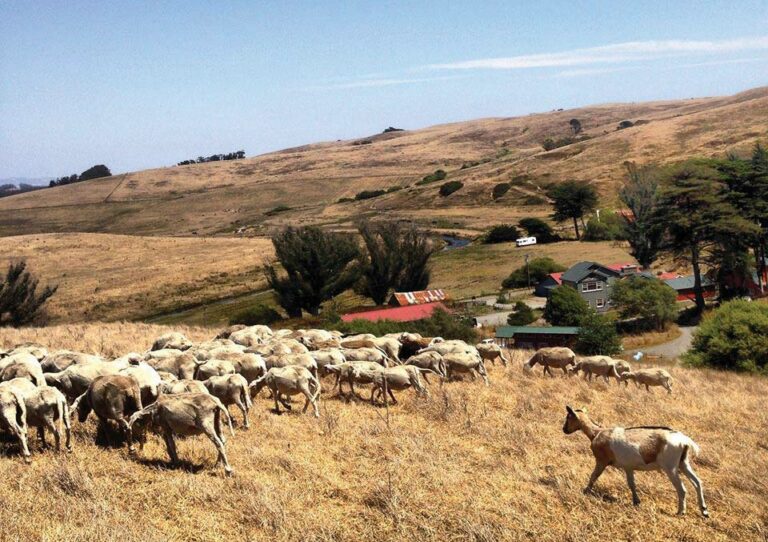
At the recent American Cheese Society annual convention in Richmond, Virginia, Toluma Farms and Tomales Farmstead Creamery took home a prestigious prize. The Marin County creamery nabbed first place in the all-milk, aged-under-60-days “farmstead cheese” category for their Liwa cheese. Perhaps the creamery’s well treated animals have something to do with the award?

The Tomales Farmstead Creamery is a A Greener World (AGW) animal-welfare-approved (AWA) farm. This means the animals range on pasture and meet the highest American and Canadian animal-welfare standards. Unlike other buzzy-but-nebulous food designations, this one actually means something.

“There are an infinite amount of companies and producers claiming sustainable practices without actually walking the walk,” says Emily Moose, the communications director of A Greener World. The Tomales creamery is talking the talk and walking the walk.

“What we’re hoping to elevate when we celebrate achievements like Toluma Farms’ and their Certified AWA colleagues,” Moose says, “is that their practices are actually verified to an incredibly meaningful standard.”

AGW has recognized and accredited the Tomales Farmstead Creamery, run by Tamara Hicks and David Jablons, for the treatment of their dairy goats and sheep for 10 years. This is significant because the couple bought the property in 2003 and started raising sheep and goats in 2007. It didn’t take long for the farm to be recognized for its leadership in animal treatment and product quality. In addition to focusing on the welfare of their animals and production of quality cheese, Toluma Farms is committed to educating the community on where their food comes from.

According to Moose, who is familiar with the farm, “the herd of goats at Toluma Farms is made up of a variety of breeds including Saanens, Alpines, La Manchas, Oberhaslis, Tobbenbergs and Nubians, and Tamara has said that they can identify every one of their 200 goats by name.”

It seems as if humane animal treatment and environmental sustainability go hand in hand with each other and with the quality of the product.

How the sheep and goats that give the milk for the cheese are raised matters immensely for both the quality of the cheese and the ecological footprint. Noting that emissions aren’t the only impact on the environment that our food has, Moose says, “Well-managed pastures are known to store carbon in the soil, while producing high-quality, nutritious food from sun, grass and water.”

The relatively high price of Tomales Farmstead cheese ($10.99 for ten ounces of Liwa) is inevitable in our current system. It is, according to Moose, set up to externalize costs and internalize profits to the greatest extent. “While our food appears inexpensive, we as a society pay dearly for things like pollution, antibiotic resistance, collapsing ecosystems and diet-related diseases.” Cheeses from the Farmstead show the true cost of raising and caring for animals, stewarding the land and creating the product, she says.

It’s not surprising a farm so committed to its animals would produce award-winning cheese. Moose continues, “It absolutely makes sense that farms raising animals well produce delicious cheese.”

Advice Goddess

Q: My father just got diagnosed with cancer. Most people have been extremely supportive, but two girlfriends I texted about this haven’t responded at all. Is it really that hard to say “I’m so sorry”? Should I use this opportunity to do a little friend housecleaning and demote certain “friends” to acquaintance status, knowing now that I can’t count on them?—Too Harsh?

A: At least when you yell into the Grand Canyon, you get back more than the blinking cursor of nothingness.

Ideally, your friends’ responsiveness should not compare unfavorably to a giant hole—especially not when you’re all “Yoohoo…I’m kinda devastated about my dad!” But before you decide to “demote” friends, there are a couple of things to consider: “evolutionary mismatch” and our reliance on technology to get messages across flawlessly.

Evolutionary mismatch, a theory originated by evolutionary biologist Ernst Mayr, refers to how we modern humans are driven by an antique psychological operating system largely calibrated for the world of our human ancestors 2.5 million to 10,000 years ago. This means, for example, that important triggers for others to take action that were there in the ancestral environment aren’t always present in our modern one.

Take expressions of sadness: Bodily expressions of sadness like tears or having all the spring in your step of a curbside couch are basically street corner sign spinners advertising our psychological state. When people see those behaviors, feelings of empathy automatically arise, motivating them to reach out with a hug or, at the very least, a mumbled kind word.

Expressions of sadness via smartphone text—in words on a tiny screen—lack the visual elements, the bodily signals, that evolved to trigger empathy. Also, consider that many people think not knowing what to say is reason to say nothing. What they don’t realize is that saying nothing in a crisis is usually a bigger blunder—more hurtful—than saying the wrong thing would ever be.

It’s also possible they missed your text.

Q: One of my best male friends is in a super-toxic relationship. I’ve told him to end it many times, and he does, but then he gets roped back in. At this point, I don’t want to listen anymore, and I’m tired of saying the same thing. How do I convey that without blowing the friendship?—Earache

A: If you wanted to repeat yourself constantly, you’d get a side hustle as a parrot.

Let’s be honest. When a friend puts their relationship issues on endless repeat, it’s tempting to put the phone down while they’re talking and go prune the ivy. It’s tempting for anyone, but probably more so for you because you’re a woman. Women, in general, have a tendency to be indirect—to hint at what they want rather than come right out and state it.

Women’s hintishness is often viewed as a flaw, but as I wrote recently, the late psychologist Anne Campbell, who researched female psychology and behavior, viewed it as an evolutionary feature. Campbell believed this indirectness evolved as a way for women—the baby carriers and primary child carers of the species—to avoid physical confrontation that could leave them hurt or dead. (If you don’t quite say something, somebody won’t quite have the ammunition to clobber you for it.)

But a tendency is not a mandate. You can understand why you, as a woman, might feel uncomfortable being direct—stating exactly what works for you—but you can decide to be direct despite that. To help keep the guy from seeing you as mean, unkind, or a crappy friend for saying “no más” on hearing the same old, same old, explain, “I care about you, and it’s really painful to hear about you continuing to let yourself be abused.”

Follow this up with something like: “My advice has not changed, and I hope you’ll eventually take it. Until then, I’m sorry. I just can’t hear about this situation anymore.” Difficult as this might be, it’s less invasive than the next-best option: having a string installed in the back of your head that, when pulled, causes you to say “So sorry to hear that” over and over and over again.

Mob Rules

0

The footage coming out of Charlottesville, Virginia in August of 2017 was horrifying: first, on Friday night, a torchlight rally of pallid-faced white nationalist marchers on the University of Virginia grounds, chanting “You will not replace us” and “Blood and soil!” Then, the infamous melee in the streets of Charlottesville, a surreal mix of militia and KKK types parading in broad daylight—white supremacist groups cranked up on years of midnight chat-room binges, now out in numbers looking to hurt people.

The mob in Charlottesville made clear they felt encouraged and even egged on by the demagogue in the White House, with David Duke, a national KKK leader, confirming that very point in Charlottesville that day.

The question was, how would President Trump respond? I’ll make an admission that might make me sound like a naif: Watching the horrors unfold from California, I actually thought Trump might condemn the white supremacists who had come from 35 states—some of them from Northern California—to gather in Charlottesville and revel in hate and violence. I know I wasn’t alone in thinking that the reality-TV president might actually decide to act presidential.

It’s more than an idle point, says former Virginia Gov. Terry McAuliffe’s. He’s been touring California this month in support of his new book, Beyond Charlottesville: Taking a Stand Against White Nationalism, McAuliffe, who was governor at the time, talked with Trump after the melee and hung up the phone convinced Trump was going to do the right thing.

“I had no illusions that a guy whose favorite thing to do was watch himself on TV was suddenly going to turn into Bobby Kennedy,” McAuliffe writes. “Eloquence was no more his thing than consistency. But in the middle of a crisis like this, I honestly did expect him to rise to the occasion. That’s what presidents do.”

The issues remain painfully relevant, given the recent racist shooting in El Paso, Texas, and Trump’s usual tone-deaf response.

While in Northern California for a few book events, McAuliffe talked openly about how the terrible events of that weekend two years ago in Charlottesville “scarred me.”

“I think what happened with El Paso, and what you just saw in Dayton, what you saw here in Gilroy, the public is really shifting now,” McAuliffe said at the Commonwealth Club in San Francisco on Aug. 8. “They’re demanding action. We have these incidents and . .. they’re forgotten after a couple days. But I think that now so much hatred has gone on, that’s why I’m thinking the Republican Party is going to pay a huge price in 2020.”

After the incidents in Charlottesville, Trump showed up before the cameras and condemned “in the strongest possible terms this egregious display of hatred, bigotry, and violence”—and then, in a Dadaist twist, adding, “on many sides, on many sides.” Trump had just hit the gas and barreled past the last exit ramp left in his presidency; instead of veering toward decency and democracy, he went with his base impulses, choosing blatant racism. The president reiterated that same sentiment following the recent mass shootings in El Paso and Dayton.

“I was shocked,” McAuliffe writes. “I felt our nation had just been suckerpunched.”

In an interview with the Pacific Sun, McAuliffe said in writing his book he learned about the importance of listening if we’re going to make any real headway.

“I wrote this book because I wanted people to have a full understanding of what happened in Charlottesville,” McAuliffe says. “It was such a shocking moment in U.S. history that a thousand people could walk down a city street spewing the most hate-filled, vile, disgusting language at fellow Americans.

“Upon reflection, as I wrote the book, as bad as Charlottesville was, there was an upside to it, which was that we exposed this sickening underbelly in American culture and realized that we have to do much more to deal with racism and its effects,” he said.

Charlottesville was not a wakeup call for African Americans, McAuliffe adds, as they did not need a wakeup call—they knew all about these racist white supremacist organizations. But for a lot of the rest of us, the horror of Charlottesville endures in a way that needs to be explored. What more can we do? How do we truly keep alive the memory of Charlottesville?

Beyond Charlottesville details how the governor and his advisors considered declaring a state of emergency and finally did so in time to clear the park where the “Unite the Right Rally” was centered just before noon, the scheduled start time for the gathering of white supremacists.

“My goal is that the book will help open peoples’ eyes,” he says. “For far too long, we’ve tried to sweep racism under the rug. It’s important that this be brought out into the light of day for a full discussion. Until we all realize that, we’re going to be in the same place.”

Locking Horns

West Marin wilderness advocates were quick to the punch last week following the release of a draft management plan for Point Reyes National Seashore. The plan seeks to settle a years-long battle between the legacy cattle ranchers and advocates for the three Tule Elk herds that also live on the land. The draft proposal from the National Parks Service presents the least draconian—or most despicable, depending on one’s perspective on wilderness in PRNS—solution to a problem that has locals, well, locking horns over the role of the elk and the cattle in the park.

Other possible outcomes considered and rejected by the NPS included removing all the elk, or removing all the cattle. The draft plan calls for the killing of four Elk from one of the herds, which numbers 124 members currently and is the herd that has the most reported interactions with the cows and their pasture. The bulk of the Tule Elk, around 700 of them, live in relative obscurity at the upper reaches of PRNS, at Pierce Point.

The wilderness-only bloc has consistently highlighted the cattle’s deleterious impact on the local environment: All that poop, sliding into Drake’s Bay. An uncompromising campaign by those same advocates helped end the presence of Drake’s Bay Oyster Company in the park a few years ago.

For cattle-ranch supporters, that bitter fight in West Marin signaled that they were next, but the then head of the Department of the Interior, Ken Salazar, vowed to protect the handful of cattle ranches and provide them with long-term leases to protect their viability.

The NPS draft plan, says Jeff Miller with the Center For Biological Diversity, would “enshrine cattle grazing as the primary use of a huge swath of the National Seashore, at the expense of native wildlife and natural habitats. The plan would destroy wildlife habitat, harm endangered species, degrade water quality, and lead to killing of some of the park’s most iconic wildlife, including tule elk.”

Miller, the senior conservation advocate with the CBD, asks: “What is the Park Service thinking? “Allowing expansion of agricultural activities would inevitably lead to further conflicts with other native wildlife. After the elk shooting starts, get ready for ranchers to call for killing the park’s bobcats, foxes, coyotes and birds. The Park Service proposes to start killing native tule elk and running elk off of 18,000 acres of the park to allow private ranchers’ cattle sole access to these public lands,” Miller argued in a blistering statement released last week.

The plan is now open for public comment as the NPS works to hammer out a final resolution to this vexing and emotional debate.

One oyster-loving local who doesn’t eat beef and can’t stand the sight of cows, nevertheless told the Pacific Sun that those 20-year leases are themselves a capitulation to the wilderness bloc. This local, who asked to remain nameless, but who laments the loss of Drake’s Bay Oyster Company on an almost daily basis, doesn’t think the leases are enough to keep the ranchers in business. “Perpetuity!” he cried.

A town hall meeting hosted by U.S. Rep. Jared Huffman was held on the eve of the PRNS study released last week. Judging by the applause lines that greeted their respective points-of-view, the wilderness-only argument is not winning the day this time. One wilderness-only advocate thanked Huffman for his work in protecting the Arctic from rapacious commercial exploration, but implored him to get on board with the evict-the-cattle folks.

Huffman noted that the cattle were there before the creation of the PRNS—and that, indeed, part of the driver for the massive set-aside of 26,000 acres of federal lands was to protect ranchers from the destruction of the wilderness by real estate interests.

Locals lollygagging at a West Marin coffee kiosk also had some thoughts to share. Josh Churchman, an affable author-fisherman whose book, The Whale that Lit the World, was featured earlier this year in the Pacific Sun, offered a somewhat cheeky, but worthy jump-off for further discussion. “If you’re so interested in protecting the wilderness, restoring it to its pristine nature, why don’t we reintroduce the grizzly bear while we’re at it.” —Tom Gogola

I Left my Heart in Uranium Springs

1

When the sky burned and the cities of the old world imploded, spilling their starving millions out into the wasteland, the bikers seized the moment. In the midst of the Great Die Out, they formed roving cannibal bands and grew strong on human flesh. One by one the gangs merged, consolidating their power, until they alone prevailed. Now the dread motorcycle gang Machine Army rules the wasteland. And I, it.

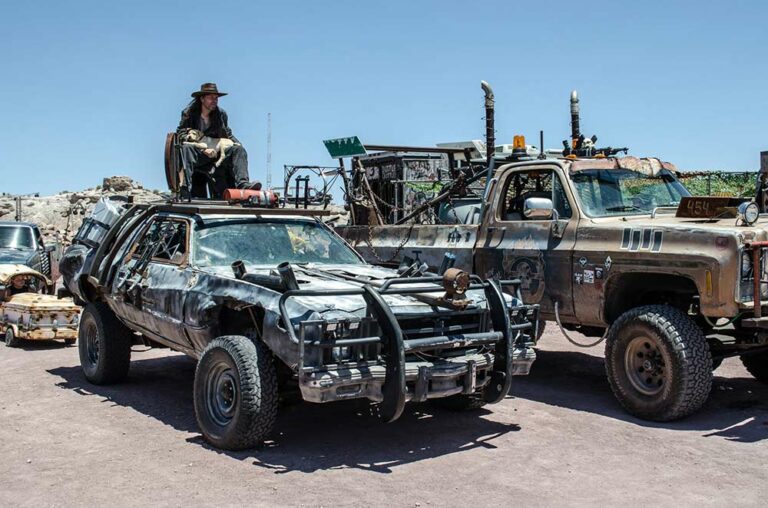
At least that’s what I tell myself as I steer my stripped-down, 70 cc dirt bike through the orange sand of the Painted Desert. The sun blasts down, turning my leather battle jacket into a sweat-drenched inferno and my pupils into pinpoints. Thank God I’m wearing goggles, even if they’re caked with dirt and tropical on the inside. Wooden shacks pass by, doors creaking in the wind. Then the raw shriek of a muffler-free big block V8 splits the air, and an armored ‘77 Monte Carlo bounces into view, riding high on oversized, All Terrain tires and spitting black exhaust. A lone figure, swathed in rags and a leather cowboy hat, sits atop it. It’s the Rev’rend Lawless, on his infamous Rev Rod. Oh God, I think, skidding to a halt and raising my hand in cautious greeting: It has begun.

It isn’t every day I get to be General Car Killer, Maximum Leader of the cannibal biker gang known as Machine Army. Which is why once a year I drive the 15 hours from Santa Rosa, California to Uranium Springs, Arizona. Each May several hundred post-apocalyptic enthusiasts from across the United States gather there to indulge their end-of-the-world fantasies at a week-long festival known as Detonation. In an age where Burning Man represents the penultimate corporate desert party, Detonation provides revelers with a grittier, more personal experience.

We spend the week in post-apocalyptic attire, driving around dented off-road vehicles, conversing with tribemates and friends new and old, admiring the creativity of each others’ costumery, vehicles and campsites and—perhaps—occasionally breaking into insane soliloquies about the merits of eating cooked human flesh. It’s a small-enough event that a person can meet most everyone there in the course of a week.

This is why Uranium Springs may be my favorite town in the entire world.

I use the word “town” lightly, because Uranium Springs doesn’t officially exist. It’s 100 percent off-grid, located on 40 acres of private land deep in the Painted Desert in the northeast corner of Arizona, off Interstate 40 out past Meteor Crater. It feels more like a movie set than an actual town—a smattering of pallet shacks, gutted travel trailers, tents, wooden towers and bombed-out vehicles that arose out of the dust in the past eight years, hand-built by festival founders and attendees.

The origins of the post apocalyptic genre stretch back to the Mad Max movies of the late ’70s–early ’80s. In 2010, a Mad Max-themed event called Wasteland Weekend began in the Mojave desert outside California City, Calif. September, 2019 will mark Wasteland Weekend’s 10th year. In 2015, Fury Road, the fourth movie in the Mad Max series, reignited the franchise and introduced a new generation to the genre. Now, small PA events are popping up around the United States and the world. Detonation is my favorite.

The irony is that, in this age of real-life, slow-motion apocalypse—the plasticization of the oceans, increasingly destructive wildfires and the disintegration of political truth—pretend apocalypse in the form of old-fashioned marauders-in-the-desert escapist fantasy spells good times for so many. It’s the 21st century-version of the Wild West, where motorcycles replace horses and gasoline replaces gold.

The Machine Army camp is a 50×50 plot of weedy sand. Plopped in the middle of it is a tire fort constructed of 105 discarded tires I purchased on-site for one dollar each from Richard Kozac—neighbor to, caretaker of, and quite possibly the very soul of, Uranium Springs. He hauled them in from the nearby town of Holbrook, 20 miles away, in order to make an extra buck, or rather a buck and change, which I gladly paid him.

Every year I spend an hour toiling in the hot desert sun upon my crack-of-noon Monday arrival, rearranging those tires into a new configuration for the coming week. This year the wind is blowing hard, so I take apart last year’s three-sided cabin and build a single, curved windbreak that works out very nicely for the length of my stay. Then I throw on my battle jacket and a pair of repurposed, plastic umpire leg guards, kick-start my little dirt bike—the Death Dart—and go find friends to hug.

Hugs are fierce in the wasteland. Friendships are heartfelt. Many of us see each other only once a year—at this event. It’s a place where we let our hair down and roll in the dirt while drinking whiskey with each other, so to speak. Beetle and Captain Walker from the Bay Area made it out, as well as Chopps from Los Angeles and Yard Hobo from Indiana. Plus the Tucson crowd is here—the event founders. Their tribe is Turbulence and they live in a cluster of clapboard “hovels” at the western edge of town. They have a special place in my heart because when I first drove to this event six years ago, they welcomed me, the crazy Californian, with open arms.

Rev’rend Lawless is the de facto leader of Turbulence and the Detonation event as a whole. In addition to reigning over Uranium Springs from the roof of the Rev Rod, he presides over his very own church, the Church of Fuel. This year he brought his new puppy, Grub, a handsome, bright-eyed little fellow whose innocent antics charm all who meet him. Together, they are the pride of Uranium Springs.

Dammit, I love these people! In no time at all I’m sweaty, dirty and drinking beer. From there on, the week blurs.

Detonation attracts eclectic types from all walks of life. Think: artists, cosplayers, preppers, Ren Faire-participants and machineheads. Put them all together and creative shenanigans abound.

The Texas arm of Machine Army filters in over the next few days, along with other intrepid festival-goers from across the United States. Torque Nut, a new recruit, shows up Tuesday afternoon, followed by old-timers Freight Train and Krash ‘n’ Burn and their first-timer friends Ruby Rock-it and Wonder Bread on Thursday. They bring with them three additional motorcycles. T(h)readz and Bugtooth, the OG co-founders of Machine Army, can’t make it—they recently relocated from SoCal to Maryland and the drive is too far.

“We’re aiming for next year,” says T(h)readz, via a Machine Army group chat. In the meantime, I plant two rubber shrunken heads on posts in the center of camp in their stead and pour beer in front of them each day in their honor.

Fun things, called events, happen. Some of them, such as the Whiskey Tasting and the Explosive Bocce Ball tournament—in which designated team members move bocce balls around the court with, well, actual explosives—are hosted by tribes. Others, such as the Apocalympics and my favorite, the Death Rally Apocalypse Racing (DRAR) event, a balls-out mini dune buggy track race with flames, water balloon grenades and frequent rollovers, are festival events. Screeching live bands and pulsing electronic dance tunes rock the desert til the wee hours each night.

Burning Man, this isn’t. Beyond the obvious similarities between the two events—the desert locale, the devoted fanbases, the rampant creativity and the partying—differences run deep.

Detonation is an immersion, meaning everyone and everything must reflect apocalypse at all times, excepting people in their own camps (but not the camps themselves) and the isolated parking area. Glitter is positively frowned upon. In terms of aesthetic, think Grit vs Glam. Detonation is the punk/heavy metal version of a party, with a distinct Halloween vibe, while Burning Man is known for its high-end beauty. And while Burning Man, now decades old, has a rep for corporate glamping, eight-hour traffic jams and ticket lotteries, these things don’t exist at Detonation, which is still fundamentally a grassroots endeavor.

This is why it rocks.

In between the mayhem I take long rides up and down the nearby wash, exploring miles of remote desert country far from the tourist maps. Every evening before sundown I sneak down to my secret spot in the wash and, ever the introvert, luxuriate in the shadowy silence as the colors turn magnificently to dusk.

Back in town, vendors hawk everything from hides and pelts to beef jerky to burgers to replica weapons. Marauder vehicles roar around, belching flames, smoke and epic amounts of noise from their souped-up engines. Costumery ranges from Fury Road-inspired battle suits to mud-covered bare bodkins to straight-up S&M plastic and rubber.

My own battle jacket—encrusted with 20 pounds of metal weapons, armor and ornamentation—is so heavy I can only stand to wear it for short periods of time. Its excessive weight compresses my spine, making my arms go numb. But you can’t put a price on happiness, my ex-boss once told me. So, numb arms be damned. And, it’s not only a piece of art—the wasteland ladies love it. When I wear my battle jacket, I get the nods.

But the best thing about Uranium Springs is the breezy, lounge chair-bedecked Wreck Room. It’s the de facto hangout spot, the coolest place in the wasteland. Hosted by the ever-beautiful Auntie Virus and the enterprising McAwful, it’s an oasis where thirsty and overheated wastelanders grab cold beers, kick off their boots and relax in the shade, gratis. Yes, the two angelic proprietors host the lounge for free, out of the kindness of their huge hearts. And this year it features a new treat—music.

“Live music at the Wreck Room, who knew?” says McAwful. Unscheduled musicians Pipes and Silence—a solo singer and a soulful, guitar-playing vocalist—both prove to be consummate musicians and their performances are such roaring successes that they, and other solo musicians, are scheduled for later time slots throughout the week.

To me, the Wreck Room is the epicenter of Uranium Springs—the heart of the wasteland. Every wastelander passes through it at some point. It’s a hub of constant activity. Nobody knows it, but late one night I symbolically buried my heart under its floor, so when I die my happy ghost will return to claim it … and continue partying with my friends.

Camaraderie seems to be the fundamental appeal of Detonation.

“Det is about hanging out with friends,” says Turbulence member Corporal Punishment. And most would concur.

“I keep coming back because there’s time to sit around and actually socialize,” says Chopps, from Los Angeles. Other desert events are great, “but there’s so much to see that it’s hard to find a moment to just stop and sit down for an hour to really see how someone’s doing.”

It’s a universal love—and I do mean love—of the Mad Max franchise and everything post apocalyptic that binds us all together. An end-of-the-world ambience permeates everything at Detonation. Borrowing from all historic eras and all cultures, the post-apocalyptic genre makes for extreme artistic freedom.

Humor abounds, too. My own, kid-sized Honda CRF 70 wheeling around my 6-foot-3-inch, 200- pound frame is, in itself, a nod to absurdity. So is the motorized coffin I see putting around town all week. As is the Cundalini Handoff event at the Apocalympics, in which runners in a relay race pass rubber hands representing the paw the villainous Cundalini lost in Mad Max.

Detonation is not for the snowflake crowd. At 6,000 feet, the sun is scorching. Temperatures regularly rise into the 90s, sometimes exceeding 100 degrees. It also gets cold at night. The area is plagued by wind, dust devils and sand mites. Attendees need to pack in all their own water, food and beer, and must wear themed costumery whenever they leave their camps. While two-minute showers are sometimes available on site for a cash fee, no conveniences should be expected.

Detonation doesn’t have a strong sex-and-drugs culture. It is, however, a drinker’s paradise. Beer and wine are consumed, but the whiskey bottle is the most prominent alcoholic conveyance. That said, teetotalers successfully attend.

The event lasts seven days and tickets are sold online in tiered batches. My ticket cost me all of $65. Throw in the cost of my 4×4 rental truck, gas, food, beer and a hotel room, and I spent quite a few bucks-and-change, but like my ex-boss once said, you can’t put a price on happiness.

Our week of fun is intense, but so is the sun, the heat and the dust. By Sunday morning, we’re all cooked. Machine Army breaks down its army surplus camo netting and we take one last group photo, trade hugs and head home. I’ve much to contemplate as I bounce down the long dirt road towards Interstate 40 and my 15 hour-drive back to Santa Rosa.

So, I go for the cannibal thing. I didn’t know I was one til the first time I arrived at Uranium Springs and put on my battle jacket. I looked around, realized I was in a real wasteland, surrounded by actual marauders without any decent, civilized restraint, and instantly devolved into a cannibal warlord. It was the lowest I could go, and I found my footing there. I’ve never left that place of strength since.

But cannibalism goes both ways.

Every year I tell my friends in Uranium Springs, “If I die here, don’t send my corpse back to the real world. Make a jacket and some tacos out of it. Enjoy me, for God’s sake!”

And I mean the hell out of it.

Because being eaten by the ones we love is one way we can remain with them, even unto the end of the world. Plus, if my heart is already buried in Uranium Springs, the rest of me may as well stay there, too.

Detonation is held in Uranium Springs, Ariz. the last week of May every year. Prices vary.

By Mark Fernquest

Hamming It Up

0

Silliness takes the stage at Dominican University’s Forest Meadows Amphitheatre as the Marin Shakespeare Company presents Monty Python’s Spamalot. It’s the company’s first full musical production in 30 years.

“Lovingly ripped off” from the Python’s 1975 cult classic Monty Python and the Holy Grail, it’s the tale of King Arthur and his Knights of the Round Table on their quest to find the revered relic. Original Python member Eric Idle took the core of the screenplay and added songs (with John Du Prez), as well as other Python bits to come up with a full-fledged Broadway musical. Needless to say, it doesn’t hurt to be familiar with the comedy troupe’s repertoire.

King Arthur (Jarion Monroe) and his faithful servant Patsy (Bryan Munar) are scouring the English countryside for men to join the Court at Camelot. After gathering the likes of Robin (Phillip Percy Williams), Lancelot (Ariel Zuckerman), Galahad (Michael McDonald) and Bedivere (Nathan Townsend Levy), they’re off on their quest. Their journey takes them to a castle manned—oddly—by French soldiers and through a very expensive forest. Along the way they encounter the Lady of the Lake (Susan Zelinsky), the Knights Who Say Ni, an argumentative Black Knight, a damsel in distress (Joseph Patrick O’Malley) and a killer rabbit, before their quest is (somewhat) completed.

Python humor runs the gamut from sociopolitical satire to outrageous slapstick. Some of it holds up after 40-plus years, some of it doesn’t. Drag has always been a component of British humor, but the evolution of that performance style makes it as archaic—and funny—as pie throwing.

Director Robert Currier, who along with music director Paul Smith and choreographer Rick Wallace are long-time fans of the comedy troupe, has gathered a game cast to execute the tomfoolery. Many of them essay several roles, with Monroe’s Arthur at the center as more-or-less the show’s straight man forced to deal with the silliness surrounding him. They’re all good, with O’Malley doing yeoman’s work in three very different roles—as the Historian, Not Dead Fred and Prince Herbert. Zelinksy is delightful as the Lady in the Lake and performs one of the show’s best musical numbers with “The Diva’s Lament.”

The timing and choreography could be crisper in several scenes, and sound issues plagued the performance I attended, but if you’re on a quest for laughs, seek out Spamalot.

‘Monty Python’s Spamalot’ runs through Aug. 25 at the Forest Meadows Amphitheatre, Dominican University, 890 Belle Ave., San Rafael. Thursday – Saturday, 8 pm; Sunday, 4 pm. $10 – $38. 415.499.4488.

#Seatoo

A Little Mermaid production undertaken in Bolinas next weekend puts a climate change spin on the Hans Christian Andersen—and Walt Disneyfied—classic fable tale. Molly Maguire and her co-screenwriters weren’t interested in a Mermaid who had to sacrifice her freedom, or her flippers, in order to leave her undersea world and commune with humans. Rather, Maguire, Maya Giannini and Bridget Bartholeme have re-cast the classic as a feminist-informed tale that’s concerned less with marrying off the mermaid to some silly prince, but in saving the planet from garbage. The result is a sustainable upcycling of the classic fairy tale.

“Women chasing after princes?” says Maguire. “Enough of that. We didn’t want Ariel to be so giving—to give everything away for a man. At least give it away for something that’s going to save the world!”

In this rendering, the male lead character of Eric isn’t a prince, but an ocean scientist who is busily trying to remove trash from the ocean, on a paddleboard. Ariel, the Mermaid, is doing the same—collecting ocean trash from the sea-floor and making art out of it. These undersea folks have determined that those land-bound creatures are a total menace.

Eric proves his decency by saving a turtle, Triton starts to appreciate his daughter’s art and what it means to her and Ariel wants some feet. He eventually sends his daughter off, with new human legs, to the human world. In a sweetly comic touch, he sends his child off with a gift, a pair of flippers. Eric is meanwhile telling his scientist friends, who are women, that he’s fallen in love with a mermaid. In the end, they paddleboard off in to the sunset together, destination unknown. Awwww! —Tom Gogola

The Little Mermaid, Bolinas Community Center, 14 Wharf Rd., Bolinas. Aug. 17 at 7pm; Aug 18 at 3pm. For more info: Bolinasbayperformingarts@gmail.

Harder Cider

Hard apple cider is a refreshing, low-alcohol alternative to wine and a gluten-free substitute for craft beer. It also helps save heritage apple trees in Sonoma County. But, you knew it’d lead to harder stuff, didn’t you?

When Tilted Shed Ciderworks cofounders Ellen Cavalli and Scott Heath moved their operation into a little Windsor warehouse space in 2014, they found helpful neighbors in Sonoma Brothers Distilling. Inspired by Calvados, the French apple brandy that’s also a strictly controlled appellation (like Champagne), the shedsters brought their cider next door to be distilled and barreled down. When it’s aged to their liking, they’ll be able to sell bottles of it from their tasting room (only)—like most very small-batch brandies.

Meanwhile, Chris and Brandon Matthies have already released their Sonoma Brothers apple brandy ($50), which is pressed at Tilted Shed, fermented and distilled by the brothers and aged in lightly toasted American oak barrels for two years. Made from Sonoma County Gravenstein apples, it’s a little reminiscent of flakey apple pie crust. The faintly appley, softly floral spirit has extracted sweet vanilla—from the oak, plus some spice, and the body is like a heathery Highland whisky. Fine and delicate, this is only available at the tasting room.

Up in Healdsburg, Jason Jorgensen is happy to distill just about anything you throw at him, and a year or so ago fate threw him a bunch of apple brandy he’d already distilled for the suddenly shuttered Sonoma Cider venture. Aged in 30-gallon, charred American whiskey-style barrels, Alley 6 apple brandy ($45) has even more buttery, apple pie spice notes, an amber-gold hue, and is a touch friskier and hotter on the finish than the Brothers’ brandy.

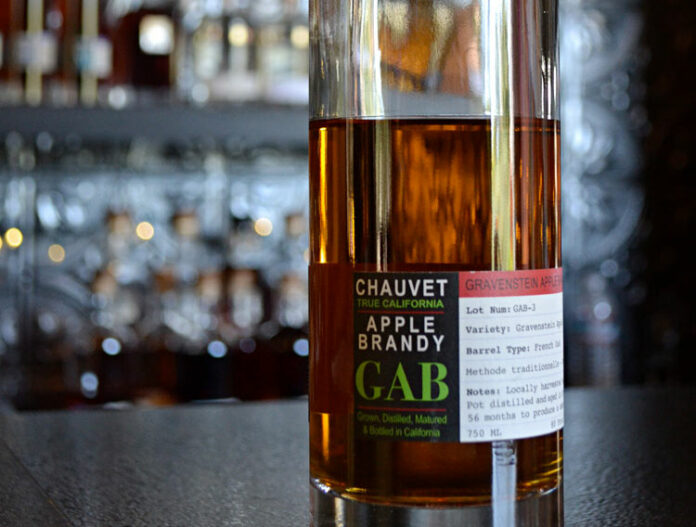
Down in Sonoma Valley, wineries reach out to the Sonoma Coast to source Chardonnay grapes, and the same goes for apples. Prohibition Spirits makes two apple brandies from West County apples, bottled under their Chauvet label.

“I thought it was interesting that everyone was into the Gravenstein apple,” says cofounder Fred Groth. “But nobody was doing anything with it, spirit-wise.”

At Prohibition Spirits, Fred and Amy Groth distilled two brandies with local apples: a rough-chopped, fermented and distilled brandy from Sonoma County Arkansas Black apples ($45) that’s light and sweet-bodied, and what they call a more “Calvados-style” Gravenstein apple brandy ($52) that’s aged in Pinot Noir barrels, and is earthier and drier—more like a dry style of rye.

Make a cocktail if you wish, but these spirits, the distilled essence of Sonoma County apple heritage, are fascinating sipping on their own. With a cider back, naturally.

Advice Goddess

Q: I met a guy, and he was very enthusiastic, calling and texting multiple times every day, almost obsessively. Soon after, I was having a really bad week: too much work, health issues with my parent…just really vulnerable. He said stuff like “I’d never leave you,” “I’ll never run away.” Well, a couple of days later, he just vanished. I blocked him after two days of no contact, and I feel kind of bad. All my girlfriends think it was too harsh, but my guy friends think it was the right thing to do and said they block people all the time. Why the difference in opinion?—Ghosted

A: Being in a relationship can have some costs, but ideally, they don’t include hiring a private detective with a team of tracking dogs.

It actually isn’t surprising that your male and female friends have differing reactions to your blocking the dude. Psychologist Simon Baron-Cohen’s research suggests that women are born empathizers in a way men are not—meaning that from early childhood on, women are driven to notice and identify others’ emotional states. They tend to be deeply affected by others’ feelings and are emotionally triggered into a sort of fellow feeling (empathy). Men, on the other hand, tend to be “systemizers,” driven from early childhood on to identify the “underlying rules” of the inanimate world, like those governing the operation of machines, abstractions (such as numbers), and objects (like a soaring baseball).

Of course, men aren’t without empathy. But research consistently finds women higher in empathy than men. Law professor and evolutionary scientist Kingsley Browne observes in Co-Ed Combat: The New Evidence That Women Shouldn’t Fight the Nation’s Wars that women’s “greater empathy may be responsible for the heightened guilt and anxiety that women feel about acting aggressively.” Browne cites brain imaging research by neuroscientist Tania Singer that suggests men’s empathy for a wrongdoer “may be more easily ‘switched off,’” and observes that “men’s diminished empathy for those who ‘deserve’ punishment probably increases their willingness to kill the enemy” in war.

The thing is biology is not destiny. Recognizing that you, as a woman, might have a propensity to be “nice” to people who don’t deserve it can prompt you to recheck your decisions to go easy on somebody. Don’t expect it to feel comfortable at first when you stand up for yourself; you’re bucking countless centuries of evolved human female psychology. In time, however, acting empowered should start to feel right—meaning you’ll be all “Of course!” about blocking a guy who doesn’t get that just disappearing is acceptable only for a tiny subgroup of beings: those whose workstation is a magician’s top hat.

Q: I’ve slept with a lot of really hot guys, but weirdly, the guys who end up being my long-term boyfriends are not the super hot ones. My current boyfriend is attractive but not even close in hotness to some of the guys I’ve had one-nighters with in the past. I’ve noticed this pattern in female friends’ guys, too. Why is this a thing?—Interested

A: There’s a certain kind of man a woman looks to date exclusively…for three to five hours.

I often cite research from evolutionary psychology that finds that women across cultures prioritize finding a man who’s a “provider.” A man’s appearance isn’t unimportant, but context—whether a woman’s going for a long-term or short-term thing with a man—is a factor in how much it matters. Not surprisingly, if a guy is a potential husband, a woman’s more likely to make do with, say, a dad bod and a weak chin than if she sees him as a potential hookup—a disposable himbo, a single-use Adonis.

However, when a woman needs to make trade-offs between hunkaliciousness and character to land a long-term partner, it surely pays to relax a little on physical criteria: go for a really good man who’s good enough in the looks department. “Good enough”? He doesn’t have to be smokin’ hot, but he can’t be so uggo that you need to reassure him, “Not to worry! My sex drive will come back…um, when you’re on the mantelpiece in an urn.”

Flashback

50 Years Ago I was over at Don Stanley's house in Lagunitas the other night and he showed me a sad little souvenir. It was a photo of a stunning blonde he had pinned up on the wall at his last job. Now the job is dead and so is the blonde. She was Sharon Tate, murdered with four others at...

Treasure Trove

A piratical new travelling show from an iconic political theater company sails into the North Bay this season for a pair of provocative performances in public parks, spotlighting the “free” in freebooter while putting the “buck” back in buccaneer. “It’s definitely a pirate show, with sword fights and sea shanties and everything,” explains Daniel Savio, the lyricist for “Treasure Island,”...

Horoscope

ARIES (March 21-April 19): It’s not cost-efficient to recycle plastic. Sorting and processing the used materials to make them available for fresh stuff is at least as expensive as creating new plastic items from scratch. On the other hand, sending used plastic to a recycling center makes it far less likely that it will end up in the oceans...

Creamery of the Crop

At the recent American Cheese Society annual convention in Richmond, Virginia, Toluma Farms and Tomales Farmstead Creamery took home a prestigious prize. The Marin County creamery nabbed first place in the all-milk, aged-under-60-days “farmstead cheese” category for their Liwa cheese. Perhaps the creamery’s well treated animals have something to do with the award? The Tomales Farmstead Creamery is a A...

Advice Goddess

Q: My father just got diagnosed with cancer. Most people have been extremely supportive, but two girlfriends I texted about this haven’t responded at all. Is it really that hard to say “I’m so sorry”? Should I use this opportunity to do a little friend housecleaning and demote certain “friends” to acquaintance status, knowing now that I can’t count...

Mob Rules

The footage coming out of Charlottesville, Virginia in August of 2017 was horrifying: first, on Friday night, a torchlight rally of pallid-faced white nationalist marchers on the University of Virginia grounds, chanting “You will not replace us” and “Blood and soil!” Then, the infamous melee in the streets of Charlottesville, a surreal mix of militia and KKK types parading...

I Left my Heart in Uranium Springs

When the sky burned and the cities of the old world imploded, spilling their starving millions out into the wasteland, the bikers seized the moment. In the midst of the Great Die Out, they formed roving cannibal bands and grew strong on human flesh. One by one the gangs merged, consolidating their power, until they alone prevailed. Now the...

Hamming It Up

Silliness takes the stage at Dominican University's Forest Meadows Amphitheatre as the Marin Shakespeare Company presents Monty Python's Spamalot. It's the company's first full musical production in 30 years. “Lovingly ripped off” from the Python's 1975 cult classic Monty Python and the Holy Grail, it's the tale of King Arthur and his Knights of the Round Table on their quest...

Harder Cider

Hard apple cider is a refreshing, low-alcohol alternative to wine and a gluten-free substitute for craft beer. It also helps save heritage apple trees in Sonoma County. But, you knew it’d lead to harder stuff, didn’t you? When Tilted Shed Ciderworks cofounders Ellen Cavalli and Scott Heath moved their operation into a little Windsor warehouse space in 2014, they found...

Advice Goddess

Q: I met a guy, and he was very enthusiastic, calling and texting multiple times every day, almost obsessively. Soon after, I was having a really bad week: too much work, health issues with my parent…just really vulnerable. He said stuff like “I’d never leave you,” “I’ll never run away.” Well, a couple of days later, he just vanished....
3,002FansLike
3,850FollowersFollow