Your Letters, March 25

May the Forest Be With You 

The U.S. just lived through its warmest winter on record, a stark reminder that the climate catastrophe is accelerating. International Day of Forests was March 21, and a good reminder that forests are one of our strongest natural defenses—and that we have the power to protect them.

Deforestation plays a major role in the warming climate. When forests are destroyed, the carbon stored in trees is released into the atmosphere, worsening global heating. Yet forests continue to be cleared at alarming rates, largely to make room for animal agriculture, including grazing land and crops grown to feed animals raised for food.

This land use is wildly inefficient. Vast areas of forest are sacrificed even though raising animals for food provides only a fraction of the calories people need. Choosing vegan foods would allow us to feed more humans while using far less land—and give forests the chance to recover.

Forests are also home to animals—birds who nest in canopies, mammals who rely on forest corridors and insects who pollinate the plants that sustain entire ecosystems. When forests fall, these animals lose their homes, families and lives. And, of course, vegan foods also spare animals from being raised and killed for food.

Protecting forests means protecting animals, the climate and ourselves. Let’s recognize that the power to help has been with us all along—and choose vegan living.

Rebecca Libauskas
The PETA Foundation

Dodging Bullets

In order to avoid consequences of his relationships with Jeffrey Epstein and his network of associates, the president is producing a new reality show, War of the Week. Stay tuned.

Craig J. Corsini
San Rafael

Tourist Town: What We Lose When They Find Us

At a certain point, a town stops being a place and becomes a recommendation of some algorithm or other.

One can feel the shift before you can prove it. The coffee shop that once tolerated your loitering now has a line out the door populated by people who describe your hometown as “quaint,” which is rarely meant as a compliment so much as a prelude to conquest. The local dive bar becomes, gulp, a “destination.”

Tourism, to be fair, is not a villain per se. But it is a patron. In Sonoma County, more than 10.3 million visitors arrived in 2024, generating roughly $2.4 billion in spending and more than $218 million in tax revenue, according to Sonoma County Tourism. That money funds parks, roads, arts programs—the civic niceties we prefer to think of as natural rather than subsidized.

Marin, for its part, plays a quieter game. Tourism ticks upward—hotel demand rose about 7% in 2025, according to the ominously titled “Marin Convention And Visitors Bureau Visitor ROI And Metrics To Track,” courtesy of Economic Forensics and Analytics Inc.

I suppose this is the exchange: Tourists get the experience; we get the infrastructure. Kind of.

But what slips away is harder to quantify. A town begins to perform itself. Even the hardware store becomes “charming.” Places that once existed without explanation now come with a backstory, a brand narrative, a suggested hashtag.

Meanwhile, the housing tightens. Prices lift with the morning fog. Service jobs proliferate, but the people who work them increasingly live elsewhere, commuting into a version of another town, thus messing with its economy.

Sure, tourism doesn’t erase a place, but it puts everyone on “good behavior”—boooring. We don’t need to be Instagram-ready—we need to be friends, neighbors and local merchants reminding each other that we are what makes our community what it is, not AI-written marketing copy and the money that apparently follows with a parade of looky-loos. 

Because we love where we live. We’re just bad with boundaries.

Cassady Caution lives and opines in the SonoMarin city of Petaluma.

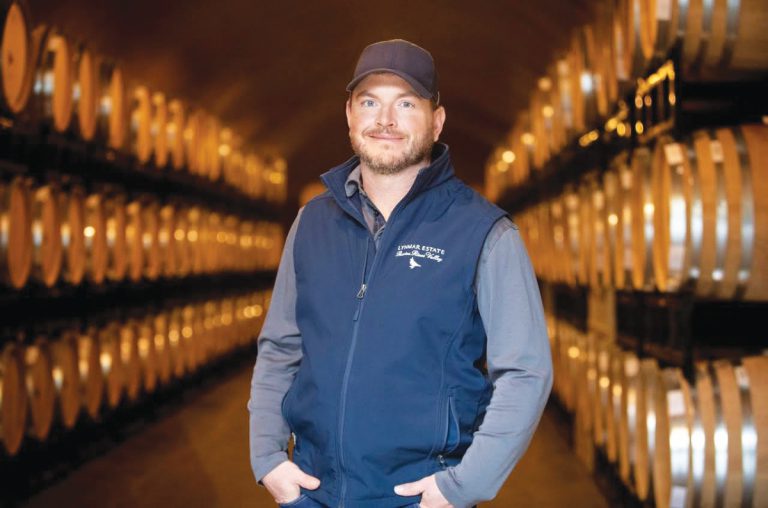
Apples to Wine: Pete Soergel Finds His Way

Raised on a 400-acre farm, Pete Soergel grew up immersed in agriculture alongside his father and grandfather, learning that farming demands equal parts intuition, hard work and humility. 

He went on to get a degree in horticulture at Virginia Tech before heading west. “I found wine by finding myself,” he says—a philosophy that continues to shape his work today.

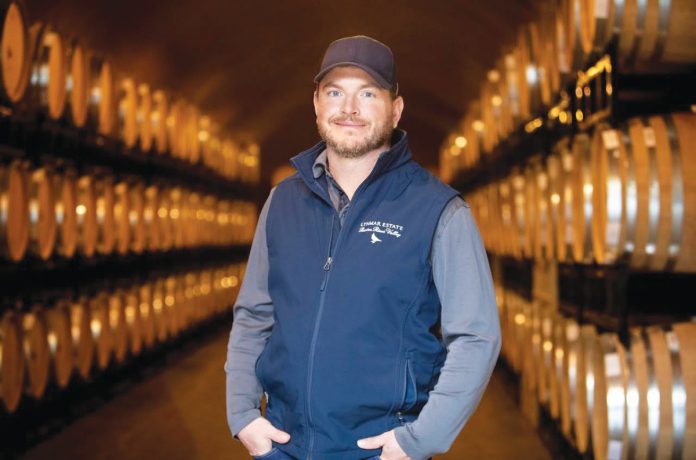
Soergel launched his career at Landmark Vineyards, then joined Kosta Browne, rising from intern to cellarmaster under founders Michael Browne and winemaker Shane Finley. He later returned to Landmark before Finley invited him to Lynmar Estate in 2012. Promoted steadily to winemaker in 2017 and ultimately general manager, he now oversees all aspects of the estate in close partnership with proprietors Lynn and Anisya Fritz.

At the heart of his work are Lynmar’s four estate vineyards, where he and his team conduct up to 90 small-lot fermentations per vintage. “Lynmar is the model of a true estate, which is rare,” Soergel reflects. “We grow the grapes, make the wines, and we pair them with seasonal foods we grow in our own gardens. Everything is connected by the same visions and values … the sum is even greater than the individual parts.”

Amber Turpin: How did you get into this work?

Pete Soergel: I grew up in Pittsburgh, Pennsylvania, on an apple farm, so agriculture was always part of my life. After graduating from college, I wanted to head west to California to explore grape growing and viticulture. That interest led me to an internship in winemaking, and more than 20 years later I’m still happily making wine and doing what I love.

Did you ever have an ‘aha’ moment with a certain beverage? If so, tell us about it.

My ‘aha’ moment came during my first trip to California wine country in 2005, when I was 23. I was visiting the area with my aunt, and we opened a 2001 St. Francis Pagani Ranch Zinfandel. I remember being blown away by the wine, the power, finesse and vibrant fruit flavors all working together. It was the first time I truly understood how expressive and complex wine could be, and from that moment on I knew I wanted wine to be part of my life.

What is your favorite thing to drink at home?

I tend to gravitate toward white wines at home. That said, sometimes there’s nothing better than a simple glass of whole milk.

Where do you like to go out for a drink?

Underwood and Russian River Brewing

If you were stuck on a desert island, what would you want to be drinking (besides fresh water)?

Good wine.

Lynmar Estate Winery, 3909 Frei Rd., Sebastopol, 707.829.3374, lynmarestate.com.

Free Will Astrology, March 25-31

0

ARIES (March 21-April 19): Aries poet Maya Angelou proclaimed, “There is no greater agony than bearing an untold story inside you.” In that spirit, Aries, I urge you to tell everyone everything—all your secret thoughts, hidden feelings and private opinions. Post your diary online. Confess your fantasies to strangers. Share your unfiltered inner monologue with authority figures. APRIL FOOL. I lied. Angelou urged us to bravely communicate our authentic truths, but not to overshare or be careless about observing good boundaries. Here’s the deep wisdom: Express thoughts and feelings that make you feel real and whole, but be discerning about when, where and to whom. 

TAURUS (April 20-May 20): Taurus writer Charlotte Brontë said, “I would always rather be happy than dignified.” Given your current astrological potentials, I think you should tattoo her motto across your forehead so everyone knows you’re committed to pleasure over propriety. Burn your dressy clothes. Quit doing boring duties. Dance naked in the woods. APRIL FOOL. I don’t really think you should tattoo your forehead or dance naked in public. But Brontë’s sentiment is sound: In the coming weeks, if forced to choose between joy and respectability, pick joy every time. Just do it with a modicum of common sense.

GEMINI (May 21-June 20): Gemini actress Marilyn Monroe said, “A wise girl knows her limits. A smart girl knows that she has none.” I propose we expand that counsel to include all genders. And I especially recommend this approach to you right now. It’s time to shed, ignore and surpass ALL your so-called limits. Be as wild and free and uninhibited as you dare. APRIL FOOL. I worry that it’s irresponsible to give you such utter carte blanche. Would you consider honoring one or two limits that prevent you from indulging in crazy and extreme behavior? Otherwise, be wild and free and uninhibited.

CANCER (June 21-July 22): Psychologist Carl Jung wrote extensively about the importance of embracing our shadows: the dark, problematic aspects of ourselves we would rather not acknowledge. In the coming weeks, I recommend that you stop hiding that weird stuff. Throw a coming-out-of-the-closet party for all the questionable parts of you. Let your inner monsters run wild. APRIL FOOL. Please don’t do that. What Jung actually advocated was recognizing and integrating your shadow, not being ruled by it. So yes, explore your moody, unruly impulses, but with consciousness, kindness and containment, not reckless expression.

LEO (July 23-Aug. 22): Leo author James Baldwin observed, “Not everything that is faced can be changed, but nothing can be changed until it is faced.” With that in mind, I advise you to spend the next two weeks obsessively staring at every dilemma in your life. Don’t look away. Don’t take breaks. Just face every dilemma constantly until you’re overwhelmed. APRIL FOOL. Baldwin’s insight is brilliant, but it doesn’t require masochistic endurance. Here’s the truth: Yes, you should courageously acknowledge what needs attention, but do so with care and discernment. And then actually work on changing it. Awareness is the beginning, not the entire process.

VIRGO (Aug. 23-Sept. 22): Virgo author Agatha Christie wrote 66 detective novels in which she meticulously planned every plot twist. I think you should apply her approach to your daily life: Script every conversation. Anticipate every contingency. Control every variable. Leave nothing to chance. APRIL FOOL. Christie’s obsessive planning worked for fiction, but life requires improvisation. For you, the coming weeks favor spontaneity and flexibility. So make rough plans, sure, but stay loose enough to experiment with whatever emerges. Over-control would diminish the magic.

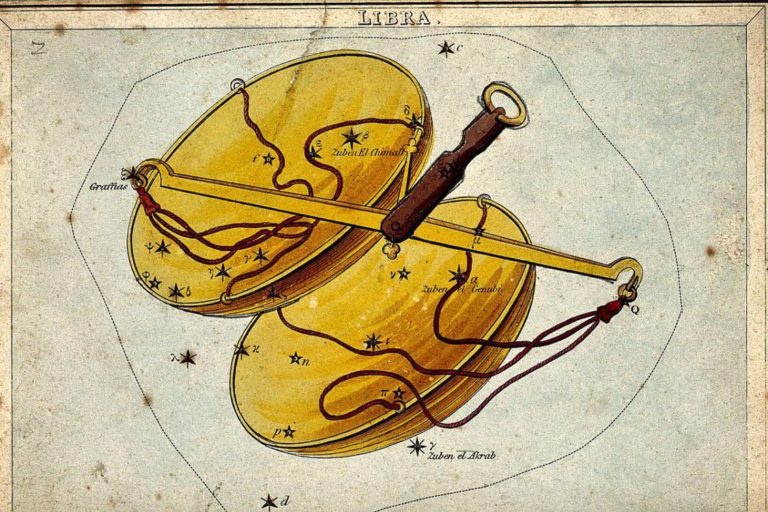
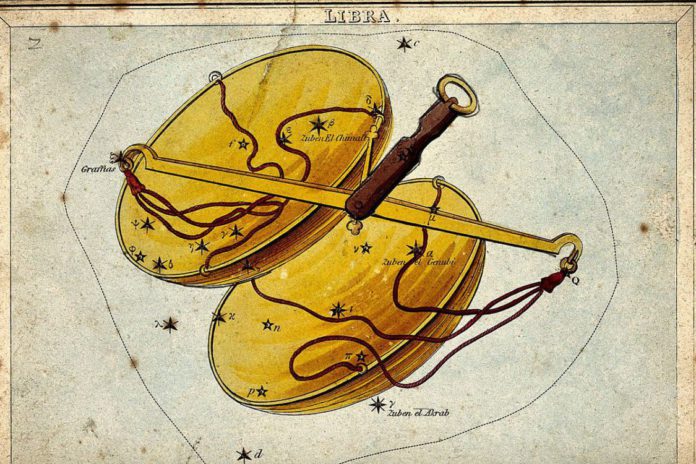
LIBRA (Sept. 23-Oct. 22): My favorite Libran writer didn’t capitalize her name: bell hooks. I recommend you stage a similar rebellion against all rules and structures. Ignore social conventions. Flout traffic laws. Pay your taxes with paintings and poems you’ve created. APRIL FOOL. I was exaggerating. I do love hooks’ charming revolt, but it would be counterproductive for you to randomly break all the rules of daily life. Instead, be judicious and selective as you question conventions thoughtfully and only violate those that genuinely deserve to be spurned. Be a strategic rebel, not a chaotic one.

SCORPIO (Oct. 23-Nov. 21): Scorpio poet Sylvia Plath wrote this passage in her journal: “I desire the things which will destroy me in the end.” I think you should consider embracing her approach—for the sheer, exotic thrill of it. Pursue interesting chaos. If it might unravel you, welcome it passionately. The more unruly, the better. APRIL FOOL. I lied. Plath was describing her struggle with depression, not offering us advice. Here’s what I think you should actually do: Examine which of your yearnings serve your evolution and which ones undermine it. Fully embrace the fact that intensity is one of your greatest gifts, but channel that intensity into experiences that build you up, not tear you down. Choose ardent aliveness over fervent destruction.

SAGITTARIUS (Nov. 22-Dec. 21): Sagittarian philosopher Baruch Spinoza spent years alone in his room developing his radical ideas about God and nature. I recommend total isolation for you, too. In accordance with astrological omens, avoid human contact. Put your relationships on hold while you contemplate the infinite. APRIL FOOL. I totally lied. Spinoza’s solitude served his unique genius, but a similar approach won’t work for you—especially now. Here’s what I really think you require in the coming weeks: periods of meditative alone time balanced by intervals of rich connection with interesting humans. You need to commune with both your deep inner sources and nurturing alliances.

CAPRICORN (Dec. 22-Jan. 19): Capricorn astrologer Linda Goodman wrote that your sign’s “ambition is boundless” and that most Capricorns dream of ruling the world. In accordance with astrological omens, I urge you to indulge this attribute. Launch a campaign for global domination. Start with your neighborhood and work your way up to more and more conquests. APRIL FOOL. The truth is, world domination is exhausting and impractical. What Goodman was referring to is your gift for structure and leadership. Use your organizational genius to improve your corner of the world, not tyrannize it. Think stewardship, not empire.

AQUARIUS (Jan. 20-Feb. 18): Aquarian inventor Thomas Edison said, “I have not failed. I’ve just found 10,000 ways that won’t work.” In the spirit, I recommend that you falter spectacularly in the coming weeks. The more blunders and bungles, the better. Engage in a holy quest to seek as many fizzles and misfires as possible. Make Edison look like an amateur. APRIL FOOL. I lied. Edison wasn’t deliberately courting snafus, of course. His approach was similar to that of many creative artists: driven by exploratory persistence that capitalizes on mistakes and hassles. Here’s your real guidance, Aquarius: Experiment boldly, yes, and don’t fear stumbles and bumbles. But learn from each one and adjust your approach. The goal is eventual success that’s informed by humility and resiliency.

PISCES (Feb. 19-March 20): Piscean physicist Albert Einstein said, “Logic will get you from A to B. Imagination will take you everywhere.” In the spirit of his genius, I recommend that you abandon logic completely. Never think rationally again. Make all decisions based on fantasy and feelings. APRIL FOOL. Einstein was advocating for the creative power of imagination, not the abandonment of reason. What you truly need is a marriage of visionary thinking and practical logic. Ask your imagination to show you possibilities, then call on lucid logic to help you manifest them.

Homework: What’s a good prank you could play on yourself to be liberated from a stale fear? Newsletter.FreeWillAstrology.com

Irish Music, Ceramics & Light and Cedars’ Neighborly Art Show

0

Sebastopol

Sebtown Goes Irish 

Irish traditional music gets a high-octane revival when Lúnasa lands at the Sebastopol Community Cultural Center. Formed in 1997 from members of some of Ireland’s most influential groups, the band has spent decades pushing the boundaries of trad with intricate arrangements, global touring and a sound that feels both rooted and restlessly alive. The group has played more than 2,000 performances across 36 countries and collaborations, spanning Natalie Merchant to Bruce Springsteen. Touring behind their latest release, Live in Kyoto—a live album composed entirely of new material—the current lineup brings virtuosity and momentum in equal measure, from driving pipes and fiddle to fluid guitar and flute, marking Lúnasa as a defining force in contemporary Irish music. 7:30pm, Friday, March 27, Sebastopol Community Cultural Center, 390 Morris St.

Santa Rosa

Smart Arts

Sonoma County’s arts education community gathers to honor Tobias Sparks, founder of Play Marimba!, as the 2026 arts educator of the year. Recognized by the Luther Burbank Center for the Arts and Creative Sonoma, Sparks has built a program that goes beyond music, creating hands-on, technology-free experiences where students are meant to gain confidence, community and a sense of rhythm that extends well past the classroom. A master percussionist and educator, Sparks has spent decades studying and performing globally, bringing those influences back to Sonoma County through Play Marimba!, where he builds instruments, trains teachers and leads youth ensembles. The award ceremony takes place during the Arts Education Alliance Mix-and-Mingle, a casual gathering celebrating the educators shaping the region’s creative future. 4:30–6:30pm, Thursday, March 26, Mitote Food Park, Santa Rosa.

San Rafael 

Way of Clay

Clay catches the light—and lets it go—at Illuminations: How the Light Gets In, a ceramic-focused exhibition at Falkirk Cultural Center. The show explores light not just as illumination, but as a presence that moves through form, surface and space. Artists lean into cracks, voids and translucencies, treating them not as imperfections but as portals—places where something deeper can pass through. Working in three dimensions, each piece becomes a quiet study in contrast: interior and exterior, shadow and glow, structure and release. Some works approach light as memory or emotion, others as balance or transformation, but together they form a contemplative, tactile meditation on how we hold and reflect what comes in. Juried by John Toki. Exhibit runs now through April 25, Falkirk Cultural Center, 1408 Mission Ave., San Rafael. Hours 1–4:30pm Tuesday–Friday, 10am–2pm Saturday.

Point Reyes Station

Neighborly Art

Cedars—one of California’s original programs supporting people with developmental disabilities—asks its artists to turn their gaze close to home in You’re My Neighbor, a warm, community-minded exhibition at Toby’s Feed Barn. From grazing cows and coastal birds to the familiar faces just down the road, the show captures the textures of everyday life in West Marin—those small, shared moments that quietly define a place. The exhibition reflects a deeply rooted creative community where art and lived experience meet. Through colorful, imaginative works, You’re My Neighbor celebrates the beauty of proximity: living alongside one another, alongside nature and within the rhythms of a working landscape. Exhibit runs now through April 12, Toby’s Feed Barn, 11250 Hwy. 1, Point Reyes Station. Hours vary; free.

Marin Sheriff Continues Voluntary Cooperation with ICE

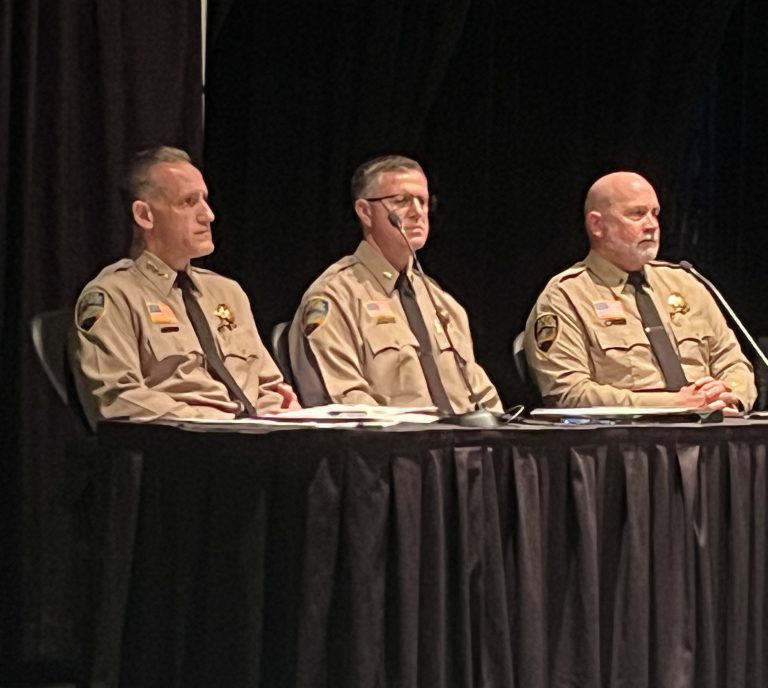
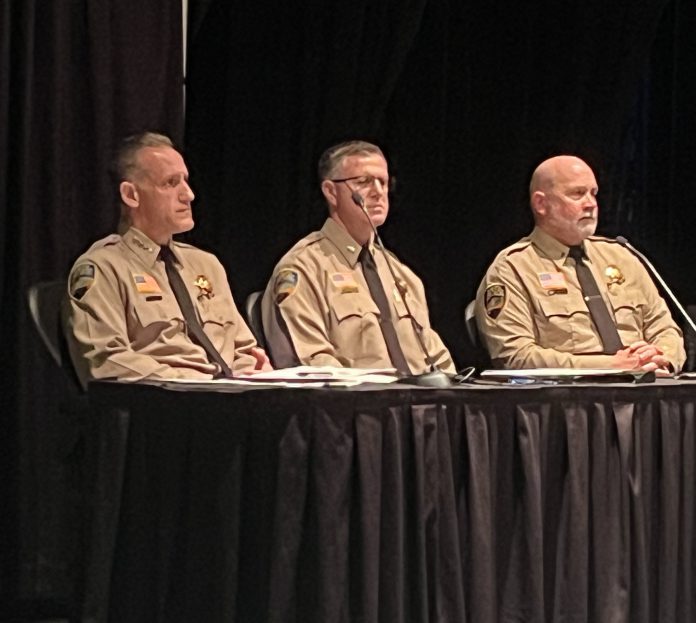
Marin County Sheriff Jamie Scardina announced at a meeting last week that he began limiting his discretionary collaboration with ICE in August but continues to provide information about incarcerated people to the federal agency.

Until last year, the sheriff’s office responded to ICE requests about people booked into the county jail on charges for serious or violent crimes—prior to conviction. Now, the jail responds to ICE only when an individual has a prior conviction for such an offense or has been ordered by a judge to stand trial on serious charges.

A crowd of approximately 200 attendees at the TRUTH Act Forum seemed unimpressed by the sheriff’s policy change. Most of the dozens who spoke during public comment demanded that Scardina stop all ICE assistance immediately, including posting the release dates of all incarcerated people on a public website.

California’s Transparent Review of Unjust Transfers and Holds (TRUTH) Act requires that a community forum take place annually if local law enforcement provided ICE with access to individuals during the last year.

According to Scardina, ICE becomes aware of whom is in the county jail because state law requires the sheriff’s office to send identifying information for every incarcerated individual to the Department of Justice, which shares the data with other federal agencies.

In 2025, ICE issued 147 detainer requests to the Marin County Jail. The detainer request, Form I-247, asks the jail for notification before releasing a person who ICE wants to place in custody.

The jail responded to 23 ICE requests last year, up from 14 in 2024. Scardina attributed the 64% increase to the higher number of jail bookings year over year.

ICE also seeks the release dates of the people they want to detain. That data appears on the Marin County Jail’s public website. Scardina maintains that providing this information benefits victims, who want to “keep track of their offenders.”

Nevertheless, it also hands ICE the release date of every person in the jail. Community members point to a state-supported program, Victim Information and Notification Everyday (VINE), that provides release dates in a searchable database. The sheriff said that he doesn’t mind the redundancy between VINE and the jail’s booking log website.

But Scardina also wants Marin residents to know what he doesn’t do.

“A lot of people, because of misinformation, think that we do conduct raids, or we do conduct sweeps, or we do ask somebody’s immigration status,” Scardina said in an interview with the Pacific Sun. “It’s not legal for us to do those things.”

Senate Bill 54 prevents local resources from being used to assist federal immigration enforcement. Additionally, it states that local law enforcement can only cooperate with immigration authorities when a person has been arrested for or convicted of serious crimes listed in the bill.

It is the nature of the crimes enumerated in SB 54 that troubles Scardina and drives his collaboration with ICE. The sheriff referred to offenses including theft, burglary, evading arrest, cruelty to a child, false imprisonment, domestic violence, firearm offenses, robbery, kidnapping and sex crimes.

“That’s why I choose to contact ICE,” Scardina said. “I’m in the business of public safety, right? It’s my responsibility to keep the residents and community of Marin County safe. And if there is a serious and violent offender who meets the criteria under SB 54 under those predicate crimes, that’s what allows me to notify ICE.”

“Choose” is the key word. And community members like Curt Ries, co-chair of the Marin County Democratic Socialists of America, believe that Scardina’s cooperation with ICE aids the Trump administration in violating democratic doctrines. At the same time, Ries acknowledges that those accused of crimes should be held to answer.

“We’re not asking for these people to be exonerated,” Ries told the Pacific Sun. “We’re not asking for them to evade justice. We’re asking for them to go through the normal criminal justice process that all of us deserve under the law—equal due process. And that basic principle is being fundamentally threatened by sending these people over to ICE, where they can be detained and deported.”

At the forum, some members of the Board of Supervisors also expressed concerns about the sheriff’s policies, such as providing release dates on a public website. Supervisor Mary Sackett suggested that a searchable database could replace posting the booking log on the jail website. This system would still allow victims to access release dates.

Supervisor Dennis Rodoni said that he probably represents the most immigrants in the community. And he wants to get the number of times the sheriff’s office collaborates with ICE down to zero.

However, Scardina’s policies have improved, Rodoni said in a written response to questions from the Pacific Sun.

“The Sheriff has implemented the Board’s recommendation from last year to report data only on individuals with convictions or held over for trial by a judge for a predicate crime, rather than those with charges alone,” Rodoni said. “That reflects progress.”

For many Marin residents, these changes are not enough. More than 6,100 people have signed a petition calling for Scardina to cease all aid to ICE.

Despite the large turnout at the TRUTH Act Forum and thousands of petition signatures, some people agree with Scardina’s policies. Three spoke up during the forum’s public comment period, and the sheriff has heard from others.

“I don’t think everybody thinks the way a lot of the activists do,” Scardina said. “And I know that because I get emails and telephone calls from people who tell me to continue to put information on the website and tell me to continue to notify ICE about serious and violent offenders.”

At the end of the day, Scardina, an elected official, makes the policy for his office. The Board of Supervisors has no authority over his decisions. Yet some community members have noted that the supervisors do have control over the sheriff’s budget and could use the purse strings to influence Scardina’s choice to collaborate with ICE.

Rodoni rejects the idea.

“This is not a budget issue,” he said. “It is about maintaining an ongoing and constructive dialogue between the Board of Supervisors and the Sheriff to ensure that Board direction and community expectations are being met. These conversations are essential to public trust and to ensuring residents have meaningful engagement with their elected officials.”


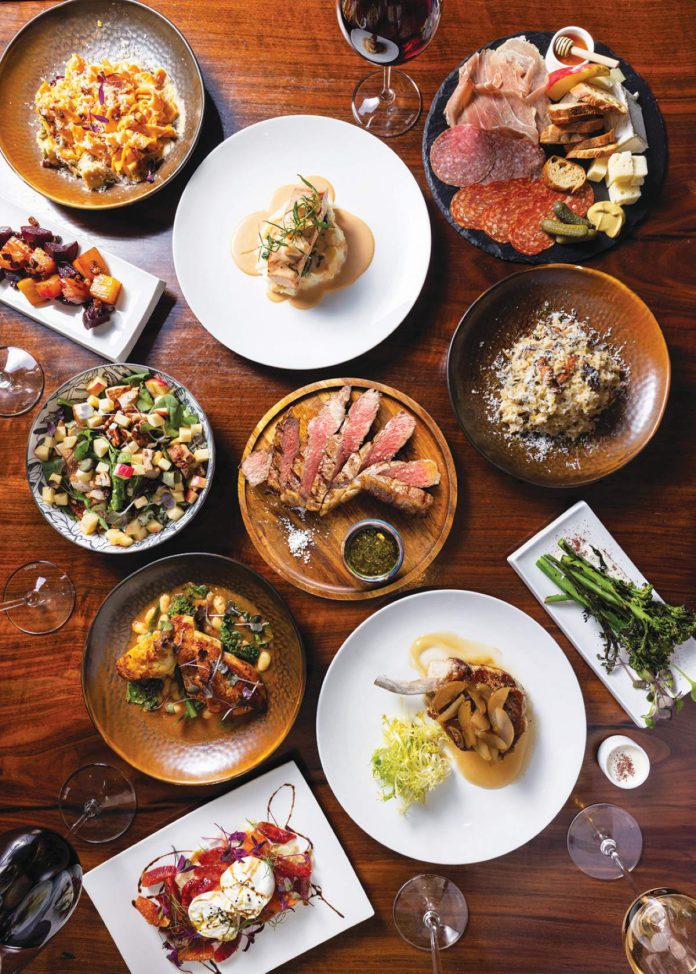
Dock & Dine: Sausalito Restaurant Week Showcases City’s Finest

There are towns where one goes to dine, and then there are towns where said dining is a scenic activity. Sausalito is firmly in the latter category.

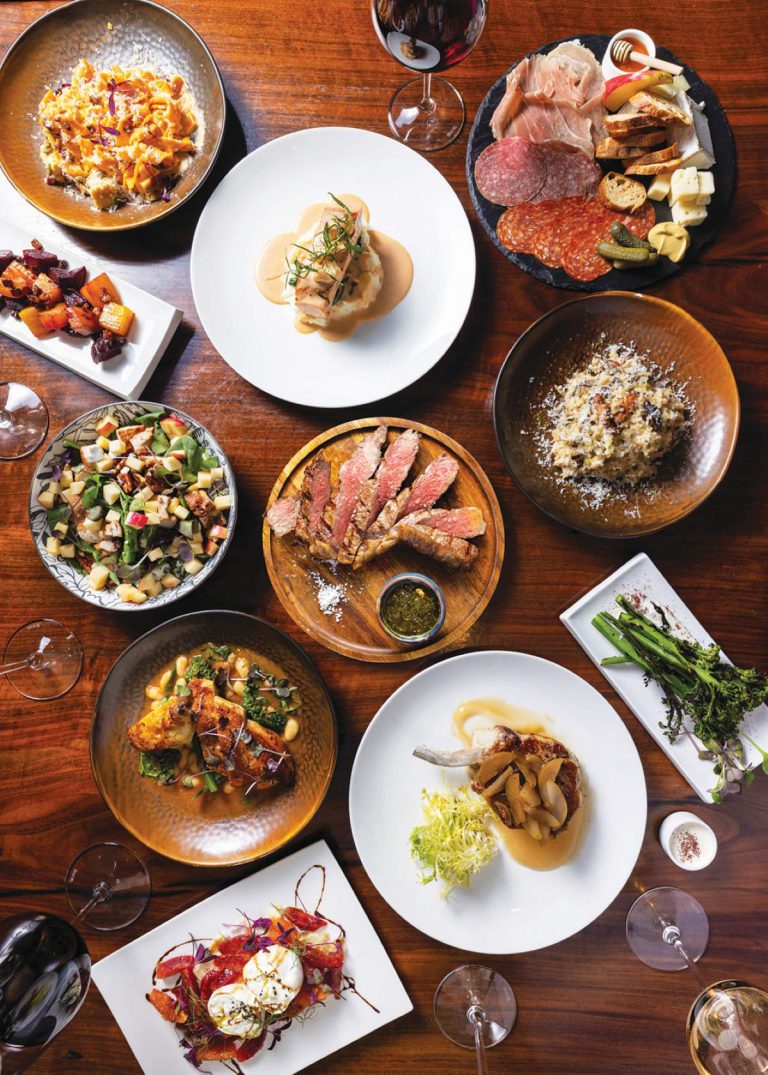
Perched along the northern lip of the Golden Gate, the city has long been one of the Bay Area’s most seductive dining destinations—a place where the view competes with the menu (usually a tie). But once a year, the culinary spotlight swings decisively back to the plates themselves. That moment arrives March 16–22 with the return of Sausalito Restaurant Week.

Think of it less as a promotion and more as a guided tour through one of Marin’s most concentrated dining districts. For seven days, restaurants across town roll out special prix-fixe menus designed to showcase their best work—and to lure diners into ordering that extra glass of wine while the sun sets over the bay.

The format is refreshingly straightforward. Diners can enjoy three-course dinner menus priced from $50 to $75, along with two-course lunch menus ranging from $25 to $45. Select spots are even offering a $10 specialty cocktail, which—let’s be honest—is the sort of civic generosity we should all support.

This year’s lineup reads like a greatest-hits compilation of Sausalito dining: Angelino, Copita, Cultivar, Le Garage, Poggio, Scoma’s, Sula, Sushi Ran and The Spinnaker. 

Where to begin? Start with Angelino, where classic Italian cooking gets the waterfront treatment. For Restaurant Week, diners might begin with grilled Monterey calamari brightened with blood oranges, pickled onions, Castelvetrano olives and arugula salsa verde and continue with a spinach-potato gnocchi alla Genovese with braised short ribs in a white wine, onion and herb sauce finished with Parmigiano and close with a plate of house-made Italian cookies.

A few doors down the culinary spectrum sits Copita, Joanne Weir’s exuberant temple of Mexican cuisine, with a Restaurant Week menu that includes citrusy salads, tortilla soup or tacos and entree choices including enchiladas de pollo bathed in rich mole manchamanteles, filled with roasted chicken, apple and queso Oaxaca, and finished with almonds and crema Mexicana.

Likewise, Poggio continues to anchor the town’s Italian scene with its polished trattoria fare, while Sushi Ran remains one of the Bay Area’s most respected Japanese restaurants—an establishment whose reputation has long extended far beyond Marin County.

Meanwhile, waterfront classics like Scoma’s and The Spinnaker remind diners why Sausalito became synonymous with seafood in the first place. Few dining experiences rival cracking into fresh fish or shellfish while gazing across the water toward San Francisco’s skyline.

The week also offers a chance to explore newer additions to the local food ecosystem, including Cultivar and Sula, which bring contemporary California sensibilities to the Bridgeway corridor.

In many ways, Restaurant Week reflects Sausalito’s quiet culinary renaissance. The city has steadily built up its reputation as a serious dining destination—and the setting doesn’t hurt.

Most of these places are within walking distance of one another, turning dinner into a kind of edible promenade along the waterfront.

It’s not difficult to imagine the ideal itinerary: a long lunch, a sunset stroll past the harbor, perhaps that aforementioned specialty cocktail, followed by dinner somewhere with a view of the bridge lights flickering on across the bay.

Come hungry. And maybe plan to loosen the belt a notch or two. In Sausalito, during Restaurant Week, that’s practically part of the dress code.

Sausalito Restaurant Week runs March 16–22, presented by Marin Magazine, The Marin Dish and LocalGetaways. For menus, reservations and the full restaurant lineup, visit SausalitoRestaurantWeek.com.

Speak Easy: Roberta Donnay & The Prohibition Mob at The Lark

Marin Jazz continues its newer collaboration with Larkspur’s Lark Theater this Saturday, March 21, as jazz musician Roberta Donnay & The Prohibition Mob take the stage at 7:30pm. 

While there are many forms and interpretations of jazz, Donnay, a self-proclaimed “jazz head,” has found her voice in the earliest versions of jazz music.

Speaking from her home in Mill Valley, Donnay says, “I grew up listening to Billie Holiday and George Gershwin and all kinds of stuff. And then I heard Bessie Smith because I wanted to hear who Billie was listening to.” She adds, “I just got into that whole era, and it was so magical. I don’t know how to describe it, but it was just completely different because it’s before the American Songbook.” She was hooked. 

Donnay grew up in the Washington, DC area and moved to San Francisco to pursue a career in music. But that path was a bit different from the paths many professional musicians are able to follow today. She explains that music classes just “weren’t something we could do” as a child, and everything she learned was self-taught, including guitar. The singer-songwriter route was the way she thought she was headed; alas, her attraction to the earliest jazz kept pulling her towards that sound.

“I was singing jazz since I was a little kid. And that was my first real love, jazz, and blues was like, that was my home,” Donnay says. From there, “I studied kind of more modern jazz and Brazilian jazz before that, and I’d studied a little bit of bebop.” All of this adds to her excitement for the March 21 show. This is because Marin Jazz shows act as fundraisers where 100% of the proceeds go to their “Future Stars” after school programs throughout Marin County.

It’s clear Donnay is moved by the intent of Marin Jazz, as she pauses with intention when starting to talk about their events benefitting local youth. “Having art. Oh my God … and that’s why I’m really excited about the show, because they’re doing a benefit to raise money for arts and music in the schools. I’m totally down with that,” she notes.

Donnay’s group, The Prohibition Mob, was formed in 2011 and signed with Motema Music, releasing “A Little Sugar” in 2012 and “Bathtub Gin” in 2015. They were then signed to Blujazz for the 2018 album, My Heart Belongs to Satchmo. The band has performed at a wide range of venues and festivals, including Birdland NYC, the Exit Zero Jazz Fest, San Jose Jazz, Jacksonville Jazz and the Berkshires Jazz Fest, in addition to appearing as guest artists at the Monterey Jazz Festival and Montreux Jazz Festival, among others.

As to what people can expect at the show, Donnay once again becomes clearly excited by what she brings to the stage. “It’s kind of like a theater performance,” she enthuses. “Years ago, I created a character from that era, like the 1920s, ’30s, like a gun moll kind of character from New York.”

When asked how or, better, why the need for this character, Donnay says it kind of came together in pieces, over time. She explains, “All the women that I had studied, they all had similar beginnings. Like, they were dancing on the street, and then they started singing, and then it was [strange] how a lot of stories were similar, and it was similar in a way to mine.” 

For the March 21 gig at The Lark, the Prohibition Mob will be a 7-piece, including Donnay, with Mike Rinta on trombone, Michael Whiteley on piano, Mark Williams on bass, Mark Lee on drums, Danny Caron on guitar and Dave Johnson on trumpet.

For more information, check out marinjazz.com and robertadonnay.com.

Recipes & Stories, Full Belly Farm’s New Cookbook

Dru Rivers of Full Belly Farm is one of the farmers’ names that first appeared on Northern California restaurant menus in the 1990s. 

It wasn’t common practice back then to credit the farmers who provided the beautiful fruits and vegetables that were expertly showcased in delicious dishes from lauded chefs. Thankfully, much has changed since then. 

“My real culinary mentor was always going to be the farm,” says Amon Muller, second generation farmer and son of Dru Rivers and Paul Muller. Along with his wife, Jenna, Amon Muller has created a delightful cookbook, called Full Belly: Recipes and Stories from a Family Farm, featuring 100 recipes and stories from his family’s 400-acre farm in the Capay Valley.      

As promised, this no fuss compendium of more than 300 pages offers readers more than recipes. Chapters are designated by the four seasons, but each season is helpfully broken out into early, mid, late and preserving. Lengthy headnotes for each recipe tell a deeper story about the ingredients or the genesis for the recipes, and many offer a swaps/spins option for substituting ingredients.

While it’s a hard-working cookbook (much like the farm itself, which has utilized sustainable farming practices since 1985), it also includes plenty of whimsy and storytelling. Along with a two-page explanation including the necessary qualifications for “How to be a Farm Dog,” there are also detailed descriptions of specific varieties of potatoes and tomatoes grown on their farm and their distinctive characteristics. Even surprising recipes for a fermented hot sauce and a pomegranate syrup exemplify how Full Belly utilizes everything that it grows.  

Regardless of one’s culinary or farm knowledge, this book is a perfect companion for all food lovers. With its beautifully balanced snapshot of farm life, it offers invaluable information that is designed to enhance and deepen the appreciation for farms and all they offer. At the very least, it will help us all to enjoy fruits and vegetables at their very best, seasonal peak.

And one can meet the authors nearby soon. Amon and Jenna Muller will be signing their book at the upcoming Thursday, March 26, Chef’s Farmers Market in San Rafael, where Full Belly is a regular exhibitor and chef favorite.

The following is excerpted with permission from Full Belly: Recipes and Stories from a Family Farm by Amon and Jenna Muller, published by ‎Hardie Grant Publishing, March 2025, RRP $40 hardcover.

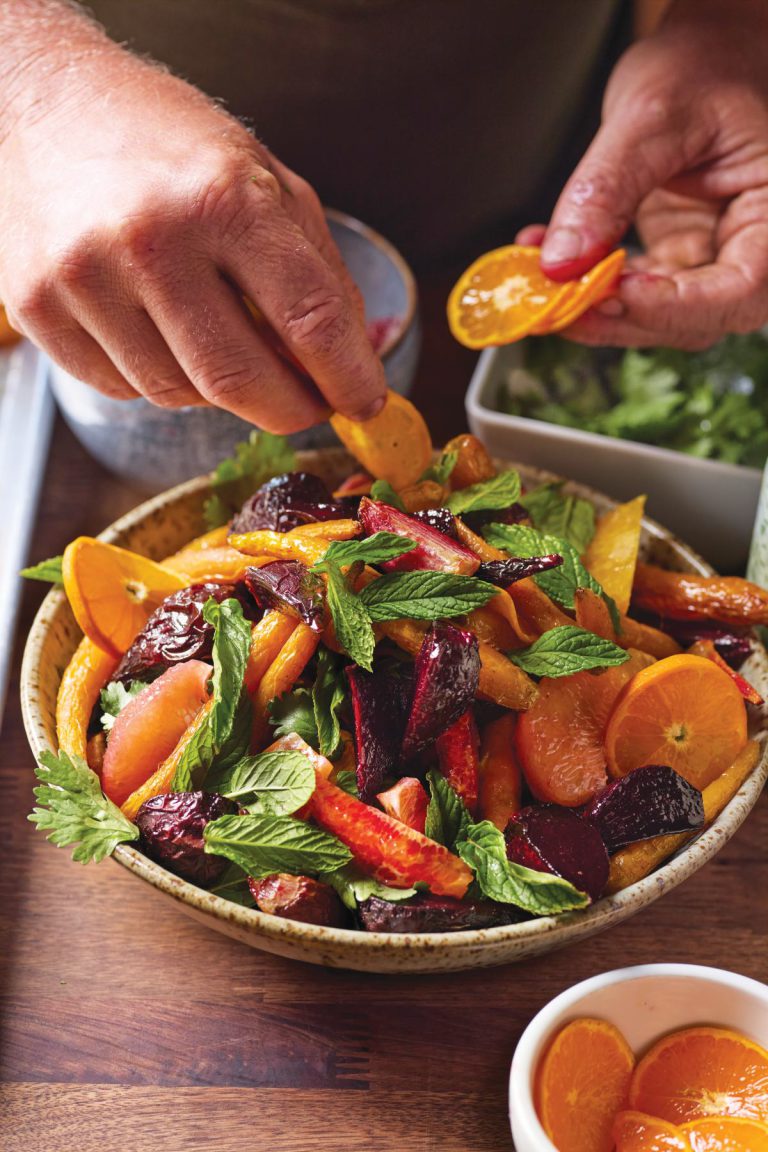
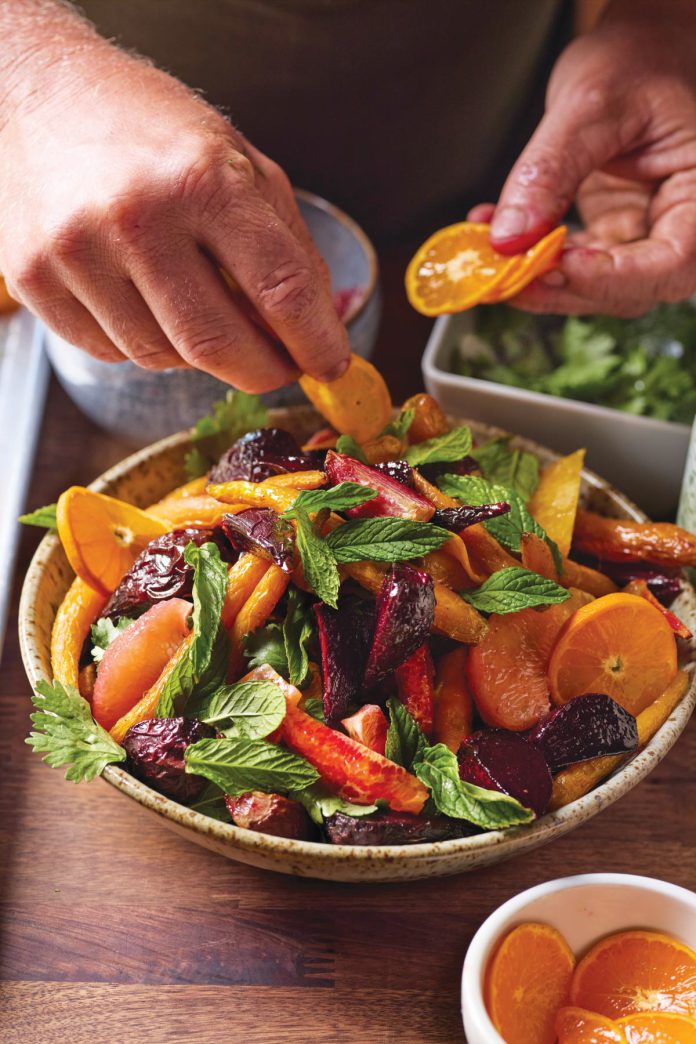
Roasted Beet, Carrot, And Citrus Salad With Mint And Yogurt 

Serves 4 to 6 

This colorful salad packs a real vitamin C punch and is just what we want to eat when winter gives way to spring. A combination of different beet varieties makes a beautiful salad. I love to leave the skin on the beets. It gives them an earthy flavor when roasted, so take your time scrubbing them clean and trimming any bits that look tough. 

If you can find beets with the tops on, they are often fresher than storage beets, and the skins are much more tender. The herbs are what make it really shine, so don’t skimp there. While destemming herbs can be tedious, think of it as meditative and know that it will make a big difference in the end result.

Swaps/Spins: You can omit the yogurt to make it dairy free, opting for some good-quality olive or avocado oil. And for the herbs, we like mint and parsley best, but tarragon is also nice on this salad, or a mix of the three. Amon

Ingredients: 

Beets and Carrots

2 tablespoons kosher salt

¼ teaspoon ground cumin

¼ teaspoon freshly ground black pepper

¼ teaspoon chili flakes

4 tablespoons extra-virgin olive oil

10 medium red, gold or Chioggia beets, washed, trimmed and cut into wedges

10 to 15 small new carrots, washed and trimmed (7 to 8 if large, peeled and cut into spears)

Citrus

1 navel orange

1 blood orange

1 grapefruit or pomelo

2 small mandarins

Herbs

1 bunch mint, washed

1 bunch Italian parsley, washed

Dressing

1 cup (240 grams) yogurt

Grated zest of 1 lemon

Juice of ½ lemon

1 tablespoon extra-virgin olive oil

Assembly

Extra-virgin olive oil

Preparation:

Roast the beets and carrots: Preheat the oven to 400°F (200°C).

In a small bowl, combine the salt, cumin, pepper and chili flakes. Toss the beets with 3 tablespoons (45 ml) of the olive oil and half of the salt mixture and arrange on a sheet pan in a single layer. If using different color beets, try to keep the varieties separate, as the colors will run and bleed into each other as they cook.

Roast until fork-tender, 15 to 20 minutes. Remove and let cool slightly. Toss the carrots with the remaining 1 tablespoon olive oil and all but 1 teaspoon of the remaining salt mixture. Arrange on a sheet pan in a single layer and roast until fork-tender, 10 to 15 minutes. Remove and let cool slightly.

Meanwhile, prepare the citrus: Supreme the orange, blood orange and pomelo into a bowl, squeezing the juice from the membranes into the bowl. For the mandarins, if you are using a variety with a very thin skin, slice paper thin from stem end to blossom end lengthwise with a very sharp knife and place into the bowl with the other citrus, without removing the peel. If the peel is thick, peel before slicing.

Prep the herbs: Pull the leaves off the mint and parsley stems. Finely chop 1 tablespoon or so of each for the dressing. The remainder can be left whole for the salad.

Make the dressing: In a small bowl, combine the yogurt, lemon zest, lemon juice, olive oil, and chopped mint and parsley and stir to combine.

To assemble: Arrange some of the warm beets and carrots on a platter; layer with some of the citrus and herbs. Continue to build the salad until all items have been used. Sprinkle with the reserved salt mixture and drizzle with the dressing.

‘Glory of Art’: Metabolizing Chaos

During the tributes to Hollywood’s recently departed at the Academy Awards ceremony, a handsome portrait and quote from Robert Redford loomed over the stage as Barbra Streisand toasted him with a few bars of “The Way We Were.” It read: “The glory of art is that it can not only survive change, it can lead it.”

It was the sort of line that might otherwise glide past in the soft-focus nostalgia of an awards ceremony, but given our particular historical moment it landed with unusual gravity. War flickers across our screens with terrible familiarity. Politics hums with the endless, exhausting static of white noise. The cultural temperature seems permanently set to “boil.”

And yet there was Redford’s quiet assertion, hanging above the stage like a small lantern in the night.

This isn’t a sentimental claim. In the long scope of wars, plagues, political upheavals and economic collapse, artists have been counted on to step forward—not necessarily with answers, but with the images, songs, stories and ideas that help the rest of us remember who we are. Art is how civilizations metabolize chaos.

When “things fall apart” (oh, Yeats), someone somewhere picks up a guitar, writes a poem or paints an image that captures a feeling that might otherwise remain inexpressible—yet somehow gives form to the idea we need precisely when we need it. Art doesn’t help us escape so much as orient us to the changed landscape of our times (both figuratively and, sadly, literally).

The arts have the peculiar ability to make courage contagious. One voice becomes two, then 10, then thousands. A film reframes a moment. A song becomes a rallying cry. A novel quietly rearranges the furniture inside someone’s mind, and they’re better for it.

None of this requires grand gestures. The myth of art is that it must be monumental to matter. Not true. Its power often resides in smaller acts: the local theater putting on a play, the street musician filling a corner with melody, the freshman auteur making a film on their phone.

Artists do not stop the storms of history. But we build the lanterns we carry through them. This is why Redford’s line reads less like a platitude than a reminder.

When the world grows uncertain, artists don’t disappear.

We get to work.

Daedalus Howell is the editor of this paper, host of ‘The Drive’ on 95.5 FM and writer-director of ‘Werewolf Serenade.’ More at dhowell.com.

Your Letters, March 25

May the Forest Be With You  The U.S. just lived through its warmest winter on record, a stark reminder that the climate catastrophe is accelerating. International Day of Forests was March 21, and a good reminder that forests are one of our strongest natural defenses—and that we have the power to protect them. Deforestation plays a major role in the warming...

Tourist Town: What We Lose When They Find Us

At a certain point, a town stops being a place and becomes a recommendation of some algorithm or other.
At a certain point, a town stops being a place and becomes a recommendation of some algorithm or other. One can feel the shift before you can prove it. The coffee shop that once tolerated your loitering now has a line out the door populated by people who describe your hometown as “quaint,” which is rarely meant as a compliment...

Apples to Wine: Pete Soergel Finds His Way

Promoted to Lynmar Estate's winemaker in 2017 and ultimately general manager, Pete Soergel now oversees all aspects of the winery.
Raised on a 400-acre farm, Pete Soergel grew up immersed in agriculture alongside his father and grandfather, learning that farming demands equal parts intuition, hard work and humility.  He went on to get a degree in horticulture at Virginia Tech before heading west. “I found wine by finding myself,” he says—a philosophy that continues to shape his work today. Soergel launched...

Free Will Astrology, March 25-31

Free Will Astrology
ARIES (March 21-April 19): Aries poet Maya Angelou proclaimed, “There is no greater agony than bearing an untold story inside you.” In that spirit, Aries, I urge you to tell everyone everything—all your secret thoughts, hidden feelings and private opinions. Post your diary online. Confess your fantasies to strangers. Share your unfiltered inner monologue with authority figures. APRIL FOOL....

Irish Music, Ceramics & Light and Cedars’ Neighborly Art Show

Lúnasa's current material brings virtuosity and momentum in equal measure, from driving pipes and fiddle to fluid guitar and flute.
Sebastopol Sebtown Goes Irish  Irish traditional music gets a high-octane revival when Lúnasa lands at the Sebastopol Community Cultural Center. Formed in 1997 from members of some of Ireland’s most influential groups, the band has spent decades pushing the boundaries of trad with intricate arrangements, global touring and a sound that feels both rooted and restlessly alive. The group has played...

Marin Sheriff Continues Voluntary Cooperation with ICE

Marin County Sheriff Jamie Scardina announced at a meeting last week that he began limiting his discretionary collaboration with ICE in August but continues to provide information about incarcerated people to the federal agency.
Marin County Sheriff Jamie Scardina announced at a meeting last week that he began limiting his discretionary collaboration with ICE in August but continues to provide information about incarcerated people to the federal agency. Until last year, the sheriff’s office responded to ICE requests about people booked into the county jail on charges for serious or violent crimes—prior to conviction....

Dock & Dine: Sausalito Restaurant Week Showcases City’s Finest

There are towns where one goes to dine, and then there are towns where said dining is a scenic activity. Sausalito is firmly in the latter category. Perched along the northern lip of the Golden Gate, the city has long been one of the Bay Area’s most seductive dining destinations—a place where the view competes with the menu (usually a...

Speak Easy: Roberta Donnay & The Prohibition Mob at The Lark

While there are many forms and interpretations of jazz, Roberta Donnay, a self-proclaimed “jazz head,” has found her voice in the earliest versions of jazz music.
Marin Jazz continues its newer collaboration with Larkspur’s Lark Theater this Saturday, March 21, as jazz musician Roberta Donnay & The Prohibition Mob take the stage at 7:30pm.  While there are many forms and interpretations of jazz, Donnay, a self-proclaimed “jazz head,” has found her voice in the earliest versions of jazz music. Speaking from her home in Mill Valley, Donnay...

Recipes & Stories, Full Belly Farm’s New Cookbook

Along with his wife, Jenna, Amon Muller has created a delightful cookbook, called Full Belly: Recipes and Stories from a Family Farm, featuring 100 recipes and stories from his family’s 400-acre farm in the Capay Valley.
Dru Rivers of Full Belly Farm is one of the farmers’ names that first appeared on Northern California restaurant menus in the 1990s.  It wasn’t common practice back then to credit the farmers who provided the beautiful fruits and vegetables that were expertly showcased in delicious dishes from lauded chefs. Thankfully, much has changed since then.  “My real culinary mentor was...

‘Glory of Art’: Metabolizing Chaos

“The glory of art is that it can not only survive change, it can lead it.” --Robert Redford
During the tributes to Hollywood’s recently departed at the Academy Awards ceremony, a handsome portrait and quote from Robert Redford loomed over the stage as Barbra Streisand toasted him with a few bars of “The Way We Were.” It read: “The glory of art is that it can not only survive change, it can lead it.” It was the sort...
3,002FansLike
3,850FollowersFollow